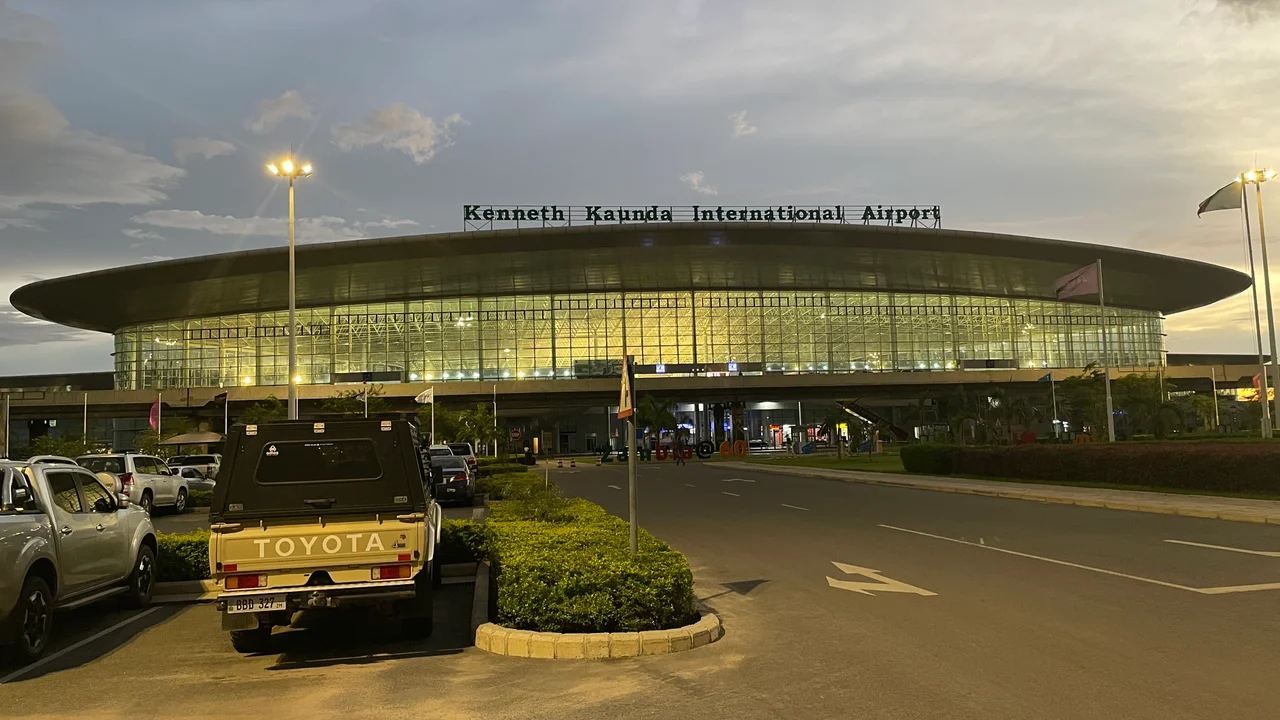

Kenneth Kaunda International Airport
The airport that now carries Kenneth Kaunda's name opened in 1967 under another one. It was plain Lusaka International Airport then, a single terminal on the Great East Road, twenty-seven kilometers northeast of a capital city that had been independent for barely three years. The renaming came in 2011, while Kaunda was still alive and would remain so until 2021, long enough to watch the airport honoring him get torn up and rebuilt almost entirely. Today Terminal Two handles every international flight, six gates polished and glowing, a 360-million-dollar monument funded by Chinese credit and built by Chinese contractors, opened in August 2021 after the pandemic nearly erased the reason for building it in the first place.
A New Name for a New Century
President Michael Sata renamed three Zambian airports in September 2011 as a political gesture that also happened to be a form of reconciliation. Kaunda had led the country from independence in 1964 until 1991, and the airport on the Great East Road had grown up under his gaze. Sata's decision attached the founder's name to the piece of infrastructure that foreign visitors would encounter first. It was a choice about national memory, and it mattered in ways that are easy to underrate. Kaunda died in 2021, aged 97, just weeks after the new Terminal Two opened. The old Lusaka Airport signage came down. The name Kenneth Kaunda stayed where international arrivals could not miss it, stamped across the approach charts of every airline flying into southern Africa.
Building Terminal Two
In 2015 the Zambian government began a three-year expansion financed by the Export-Import Bank of China and contracted to China Jiangxi International. The brief was ambitious: a two-story terminal building with twenty-two check-in counters, twelve border channels, six security checkpoints, a presidential terminal, a new control tower, and an on-site hotel. Construction dragged across a fourth year. By late January 2020 the work was substantially complete, and then COVID-19 arrived. Passenger numbers collapsed. Airlines suspended routes. The new terminal opened anyway on 5 August 2021, gleaming and mostly empty. Recovery was slow. Only in 2023 did Kenneth Kaunda finally exceed its pre-pandemic passenger counts. By then it was moving 75 percent of all air passengers in Zambia, the overwhelming hub of a country that is twice the size of Spain and wraps around neighboring borders in every direction.
The Shadow Record
Every major airport keeps a memory of its accidents, and Kenneth Kaunda keeps more than most. On 26 August 1969, a Zambian Air Force Hawker Siddeley HS-748 lost control on takeoff and crashed; three of the four people aboard died. On 14 May 1977, a Dan-Air Boeing 707 on approach lost its right elevator and horizontal stabilizer to metal fatigue, and all six aboard were killed. The worst day in Zambian aviation history came on 17 February 1990, when a Zambian Air Force de Havilland Buffalo struck a field on approach. All 29 people aboard died. These numbers are small by global standards and enormous by personal ones. Crews and families are named in the reports, even when the Wikipedia articles do not repeat them. Every approach chart is, among other things, a list of the places airmen have been lost.
The Hub Spreads Out
From Terminal Two today you can reach Addis Ababa on Ethiopian, Doha on Qatar, Istanbul on Turkish, Johannesburg on several carriers, Nairobi on Kenya Airways, Dubai on Emirates. Proflight Zambia fans out from here to Mfuwe and Livingstone and the South Luangwa. Zambia Airways, relaunched in 2021 in a joint venture with Ethiopian, flies from Kenneth Kaunda to destinations across the region. Mahogany Air and Royal Zambian Airlines add regional capacity. The original Terminal One, unchanged since 1967, now serves domestic traffic only. It has no jet bridges; passengers walk across the apron in the heat. For anyone arriving from Europe or the Gulf, the first impression of Zambia is the crisp new concrete of Terminal Two. For anyone going on to Mfuwe or Ndola, the last impression is the older terminal's bare apron and the warm wind coming off the miombo.
From the Air
ICAO: FLKK. IATA: LUN. Located at 15.33 degrees S, 28.45 degrees E, elevation roughly 1,150 meters (3,779 ft), approximately 27 km northeast of central Lusaka on the Great East Road. Single runway, capable of wide-body operations. Terminal Two handles all international flights; Terminal One serves domestic only. From cruising altitude, the airport sits on open plateau country west of the Luangwa escarpment; Lusaka itself is the largest visible built-up area in south-central Zambia.
Nearby Stories
- Northern Rhodesia 13 km away
- Rhodesia (region) 15 km away
- Lusaka Province 19 km away
- Mazabuka 25 km away
- Chirundu Bridge 44 km away
- Zambezian flooded grasslands 80 km away
- Kafue Flats 81 km away
- Lukanga Swamp 101 km away