
The Brown River That Built a Capital
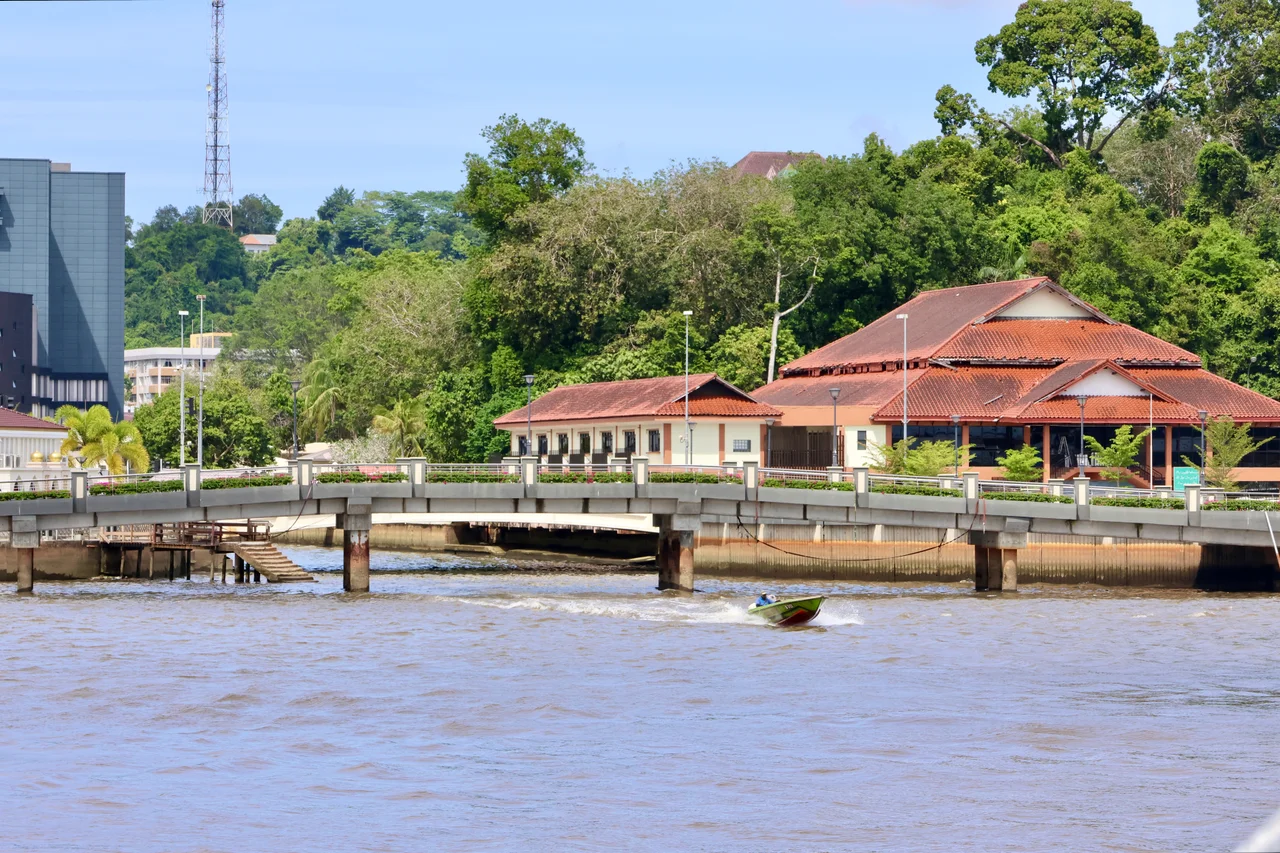
The name may come from the Chinese word kiang, meaning river -- a river called River. It is a fitting redundancy for a waterway that has always been more vital than its size suggests. The Kianggeh is a small tributary of the Brunei River, flowing through the eastern edge of Bandar Seri Begawan's city center, and it has quietly shaped the life of Brunei's capital for generations. On one bank, the Kianggeh Market has operated since the 1960s, believed to be the oldest market in the country. On the other, the brown water slides past a Muslim cemetery, a pier connecting the capital to Kampong Ayer -- the world's largest water village -- and the ruins and renovations of a century of colonial and postcolonial engineering. The Kianggeh is not scenic in any postcard sense. It is something better: necessary.
Where the Name Comes From
According to the book Dokumentasi, the name Kianggeh likely derives from the Chinese term kiang. Chinese merchants traded along Brunei's rivers for centuries, and their linguistic traces survive in place names that most modern residents no longer parse. An alternative theory holds that the name derives from a person, though no documentation supports this. The river sits on the eastern border of Pusat Bandar, the city's commercial heart, a ten-minute walk from the Omar Ali Saifuddien Mosque. That proximity matters. The Kianggeh connects the formal, monumental Brunei of golden domes to the informal, working Brunei of boat traffic and fish stalls -- two versions of the same country separated by a short walk and a world of texture.
Water in a Time of Thirst
In 1968, Brunei faced a water crisis. An emergency plan authorized pumping 500,000 gallons per day from the Kianggeh into the Tasek Lama reservoir, a stopgap measure that proved critical during the coronation celebrations of Sultan Hassanal Bolkiah. The same year, the government commissioned a 90-foot bridge over the Kianggeh in what was then still called Brunei Town, at a cost of $330,000 -- designed by an outside consulting firm because the country lacked enough engineers of its own. By 1976, reinforced concrete slopes and protective slabs were added along the riverbanks for $65,798. A year later, a fire boat was deployed to the Kianggeh, using river water to supplement the city's firefighting supply. These are not glamorous details. They are the bones of a functioning city, and the Kianggeh provided them when nothing else could.
The Market on the Muddy Banks
By the 1980s, the Kianggeh had evolved into something livelier. Small powered boats from Kampong Saba began congregating at the river base, their part-time operators ferrying passengers and goods between the water village and the land. Vendors selling daily necessities clustered at the stops, and barter trading took root -- fishermen from Kampong Ayer swapping their catches for fruit from inland villages. Handicraft shops and clothing stalls pressed against the water's edge, the rushing brown current a few steps from bolts of fabric. The Kianggeh Market, rebuilt in 2016 as a modern complex with 313 stalls spread across eight buildings and 4,450 square meters of floor space, is now the formalized descendant of that informal river economy. It still sells produce, fish, meat, and local foods -- the same goods that have changed hands along this stretch of water for decades.
The Bridge the British Built
The Residency Bridge, constructed around 1900, is one of the oldest surviving pieces of colonial infrastructure in Bandar Seri Begawan. The British Resident in Brunei built it to connect Jalan Residency with Jalan Kianggeh and the villages of Kota Batu, since the officials administering Brunei Town lived across the water in Subok. The bridge is entirely concrete -- functional, unadorned, designed for a purpose it still serves. In 1990, it was refurbished and a new bridge was added alongside it to accommodate two-way traffic. Today the mouth of the Kianggeh passes beneath the Residency Bridge before joining the Brunei River, the older structure standing beside its modern twin like a before-and-after photograph of the same country.
Seen from Above, Seen from the Water
From the air, the Kianggeh is a dark thread stitching together the grid of Bandar Seri Begawan's streets with the organic sprawl of Kampong Ayer's stilt houses. In 1945, Allied bombers photographed the river during air raids on Brunei Town -- the same vantage point available today to anyone flying over the capital. The water is still brown, still tidal, still threading past the same cemetery and the same market district. What has changed is everything around it. The city grew up. The market was modernized. The bridges were doubled. Yet the Kianggeh remains the boundary line between Brunei's two identities -- the planned capital on solid ground and the water village that preceded it by centuries. A river called River, doing exactly what it has always done.
From the Air
Located at 4.887N, 114.945E in central Bandar Seri Begawan. The Kianggeh is a narrow brown tributary visible where it joins the Brunei River near Kampong Ayer. Look for the Residency Bridge and the adjacent Kianggeh Market complex on the eastern edge of Pusat Bandar. Nearest airport is Brunei International Airport (WBSB), approximately 9 km to the northeast. The Omar Ali Saifuddien Mosque is a prominent visual reference roughly 500 meters west. Best viewed at low altitude (1,500-2,500 feet) where the contrast between the gridded city center and the stilt village becomes clear.
Nearby Stories
- From Residency to Memory 28 km away
- Twenty Years on the Seattle Run 30 km away
- The Abode of Peace on Borrowed Coastline 31 km away
- USS Salute: The Minesweeper That Found the Last Mine 33 km away
- The Ants of Borneo 50 km away
- Sabah State Railway 55 km away
- Starcevich Monument 74 km away
- Luconia Shoals 209 km away