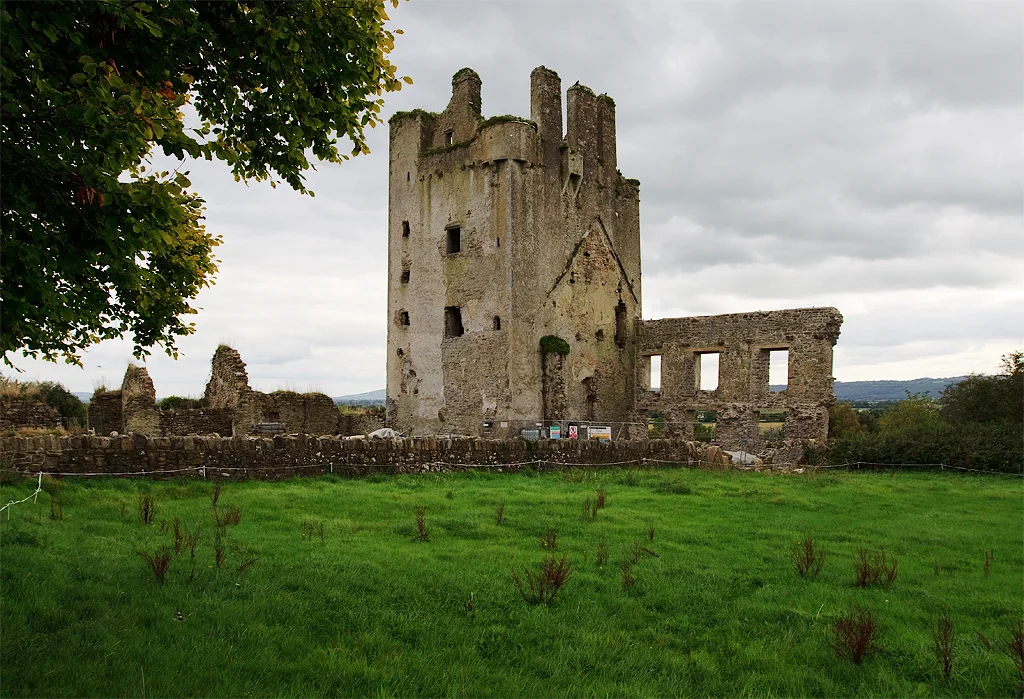

Kilcash Castle
Cad a dhéanfaimid feasta gan adhmad? -- 'Now what will we do for timber?' The opening line of the great Irish lament 'Cill Chais' has been recited by generations of schoolchildren in Ireland, but the question is not abstract. The woods around Kilcash Castle were real. They were sold in 1797 and 1801. The lady the lament mourns -- Margaret Magennis, Viscountess Iveagh -- was buried in the small church beside the castle in 1744. The ruined tower house that gave the song its name still stands above the N24 road just west of Ballydine in County Tipperary, and it is one of the few literary landmarks in Ireland whose stones you can actually touch.
Butlers of Ormond
The main castle is a fortified tower dating from the 16th century, with an adjoining hall added later, after the need for defence gave way to the appetite for large windows. In the 16th century the manor of Kilcash was taken from the Wall family during the Irish Confederate Wars and granted to the Butlers of Ormond, who would hold it for centuries. The Butler family is one of the great Anglo-Norman dynasties of Ireland, and Walter, 11th Earl of Ormond, who lived at Kilcash, inherited the title in 1614. Walter promptly spent the years 1619-1625 in prison in London while James VI and I pressured him to surrender most of his property in a dispute over the Ormond inheritance. He eventually passed the manor on to his grandson, Colonel Richard Butler of Kilcash, who died in 1701. In a final indignity, the Butlers sold the castle to the Irish State in 1997 -- for £500.
Confederate Catholics and Civil War
The 3rd Earl of Castlehaven, a noted Confederate Catholic commander during the 1641-52 wars, was a frequent visitor to Kilcash. His sister Lady Frances had married Richard Butler of Kilcash, another Confederate commander, and Castlehaven wrote his memoirs at the castle -- they were published as The Earl of Castlehaven's Review. In the 19th century the castle fell into ruin after parts of the Kilcash Estate were sold around 1800. Three hundred years later it would be drawn back into another civil war: during the Irish Civil War of the 1920s, Anti-Treaty forces occupied Kilcash in an attempt to slow the Pro-Treaty advance toward Clonmel. Commandant-General John T. Prout brought artillery against them and dislodged them, in the process further wrecking the already crumbling structure. Restoration finally began in 2011, mostly to stop the castle from collapsing entirely.
The Mermaid and the Butler Mausoleum
Beside the castle stand the remains of a medieval church, a simple chancel and nave with a Romanesque doorway in its south wall. The church was partially repaired in the 1980s and is now open to the public. In the graveyard, a Butler mausoleum -- nearly as large as the church itself -- contains the tombs of Thomas Butler of Garryricken; his younger brother Christopher Butler, the Roman Catholic Archbishop of Cashel from 1712 to 1757; Margaret Magennis, Viscountess Iveagh, who died in 1744; Walter Butler, 16th Earl of Ormonde, who died in 1773; and John Butler, 17th Earl of Ormonde, who died in 1795. Some of the 18th-century headstones in the graveyard are carved with elaborate scenes of the crucifixion. It is an unusual concentration of Butler aristocracy in one small Tipperary churchyard.
The Lament
The song 'Cill Chais' -- 'Kilcash' -- mourns the ruin of the castle and the death of Viscountess Iveagh. It was long ascribed to Father John Lane, who died in 1776, but the woods the song laments were not sold until 1797 and 1801, long after Lane's death. The earliest manuscripts of the poem date only from the mid-19th century, so its true author is unknown. The first stanza, in Irish and in Eiléan Ní Chuilleanáin's translation, reads: 'Cad a dhéanfaimid feasta gan adhmad? / Tá deireadh na gcoillte ar lár' -- 'Now what will we do for timber, / With the last of the woods laid low? / There's no talk of Cill Chais or its household / And its bell will be struck no more.' The lament treats the felling of the woods as the death of a culture. In a way, it was.
From the Air
Located at 52.40 degrees N, 7.52 degrees W in County Tipperary, Ireland, just west of Ballydine off the N24 road between Clonmel and Carrick-on-Suir. The castle ruin appears from altitude as a square stone tower standing on rising ground above the Suir Valley, the remains of the medieval church beside it. Nearest airports: Waterford (EIWF) approximately 35 km southeast; Cork (EICK) approximately 85 km southwest. Best viewed below 2,500 ft AGL. The slopes of Slievenamon rise prominently to the north.
Nearby Stories
- Tipperary (town) 5.2 km away
- Stradbally, County Waterford 11 km away
- Hook Lighthouse 12 km away
- Fermoy 15 km away
- Nenagh 16 km away
- Loughmoe Castle 18 km away
- Dunbrody Abbey 21 km away
- Kildare Cathedral 48 km away