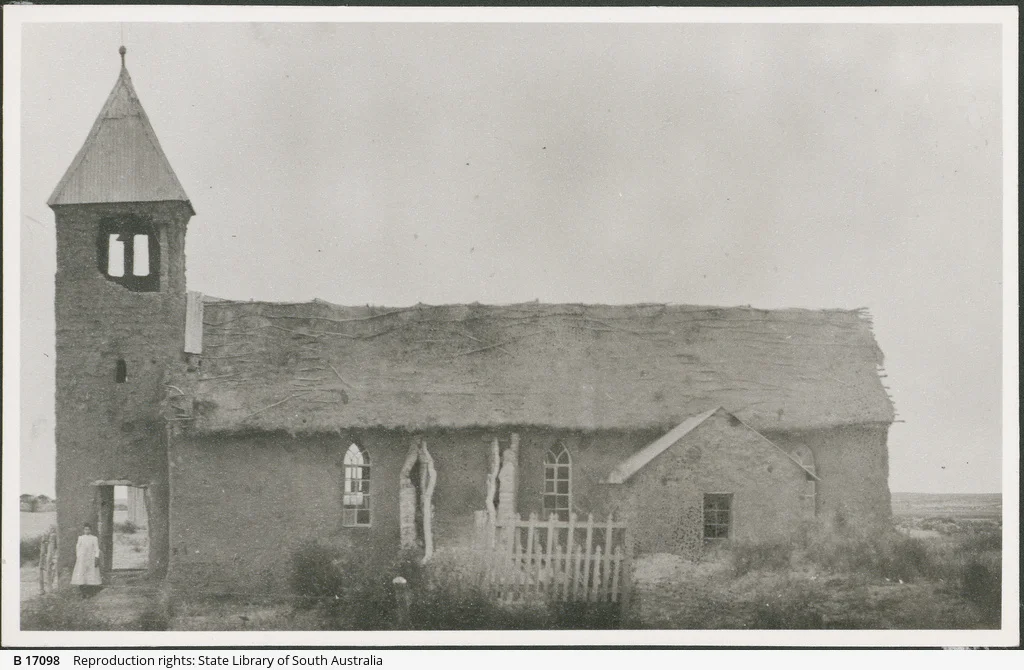

Killalpaninna Mission
In 1897, a book came off a printing press that had never existed before in human history: the entire New Testament, rendered in an Australian Aboriginal language. The language was Diyari, the tongue of the Dieri people of the Cooper Creek country, and the place that produced it was Killalpaninna, a Lutheran mission in one of the most remote corners of South Australia. The German missionaries who ran it called it Bethesda. To understand this windswept ruin near the locality of Etadunna, you have to hold two truths at once. It was a place where the Dieri language was studied and recorded with unusual devotion, and it was also part of the machinery that pulled the Dieri away from the life they had lived on this land for thousands of years.
Dieri Country on the Cooper
The land the mission occupied was never empty. For countless generations the Dieri had lived across this stretch of channel country south of Cooper Creek, reading water and weather in a landscape that swings between flood and bone-dry famine. They were people of long-distance trade and ceremony, connected by foot and song to communities far across the inland. When the Lutheran missionaries arrived in 1866 and built their station beside Lake Killalpaninna, they came onto an inhabited, governed country, not a frontier. Everything the mission later achieved, and everything it cost, unfolded on Dieri ground and in Dieri lives.
The Word in Diyari
What sets Killalpaninna apart from many missions of its era is the sheer seriousness with which its missionaries took the Dieri language. Johann Georg Reuther and Carl Strehlow set out to learn Diyari thoroughly, and between roughly 1895 and 1906 they produced an extraordinary body of work: translations of scripture, teaching materials, and Reuther's vast manuscript on Dieri language, mythology, history, and culture, including a four-volume dictionary running to thousands of pages. The crowning achievement was the Testamenta Marra of 1897, the first translation of the complete New Testament into any Aboriginal Australian language. In the school, opened in 1868, Dieri children were taught to read and write in both Diyari and English, a rare double literacy for the time.
A Legacy the Dieri Carry
It would be dishonest to tell only the gentler half of this story. A Christian mission was, by design, an instrument of change: it gathered people in, discouraged ceremony and custom it did not understand, and by 1879 ran dormitories that separated Aboriginal children, boys and girls, into mission care. Families were drawn off their country and into a settlement governed by foreign rules and a foreign faith. The disruption was real, and its weight fell on the Dieri, not the missionaries. Yet the relationships forged here were not simple either. Ben Murray, born in 1893 and raised in this world, led the mission's camel teams, kept up a correspondence with the missionaries for the rest of his long life, and in 1934 helped translate Reuther's papers at the South Australian Museum. The Diyari language preserved in those pages would one day help the Dieri themselves reclaim and revive it.
The Mission Closes
The end came through a tangle of pressures. In 1914 the South Australian Royal Commission on the Aborigines gathered evidence at the mission and recommended the government take it over. Drought had gripped the country, the church faced mounting financial strain, and the outbreak of the First World War turned suspicion sharply against a German-run institution. The state government closed Killalpaninna in 1915. At that moment seventy Aboriginal children were living there. The property became an ordinary cattle station; the mission school struggled on until 1917, when the government shut down all Lutheran schools. What survives now is a scatter of ruins on the salt-streaked plain, and something harder to see, the recorded words of a language that refused to disappear.
From the Air
Killalpaninna Mission lies at 28.60°S, 138.56°E in the channel country of the Far North, roughly 40 km south of Cooper Creek and within the locality of Etadunna. From the air the site is a faint scatter of ruins on a flat, pale plain; navigate instead by Cooper Creek's broad tree-lined channels to the north and the chain of ephemeral lakes nearby, which hold water and stand out only after flooding. Best viewed from 2,500 to 5,000 feet AGL in clear morning light, when low sun rakes shadow across the ruins and the old lake beds. This is isolated outback airspace with minimal infrastructure: the nearest airstrips of note are at Innamincka (YINN) to the northeast and Marree to the south, and the Birdsville Track passes through the wider region as a navigation aid. Carry full fuel and water reserves, expect strong surface heat haze, and plan for long featureless legs between landmarks.
Nearby Stories
- Anna Creek Station 3.9 km away
- Mungerannie 32 km away
- Kalamurina Sanctuary 46 km away
- Cooper Creek 51 km away
- Strzelecki Creek 82 km away
- Ediacara Hills 108 km away
- Strzelecki Desert 135 km away
- Lake Callabonna 148 km away