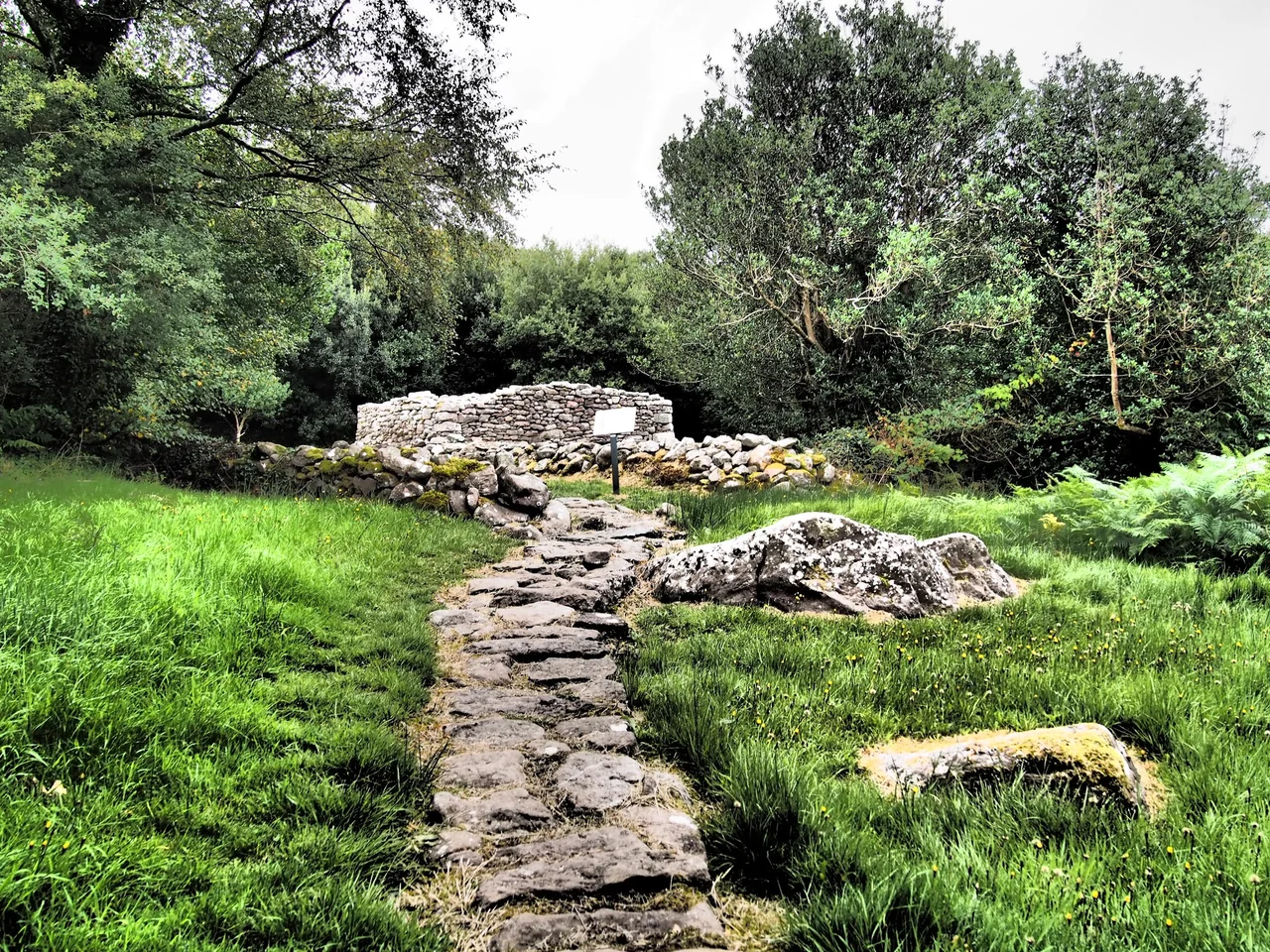

Killelton Church
There is a footpath, then a stile, then a field. Beyond the field, set against a slope of green pasture facing south toward Tralee Bay, stands a small rectangular building of drystone construction - a structure so simple that at first glance it could be a sheep shelter or a ruined cottage. It is, in fact, a thousand-year-old church. Killelton oratory was built by Irish monks sometime in the ninth or tenth century, dedicated to a saint named Eltan whose biography is barely a name, and used long enough to become part of the landscape. It has been a ruin for centuries. In 1984 a careful restoration began. Today it stands as one of the most authentic surviving examples of an Irish early-medieval oratory - small, anonymous, and almost overlooked.
Saint Eltan
Saint Eltan - or Elton, or sometimes Eilton - is one of the many Irish saints whose existence is known only from the place names they left behind. Killelton means the church of Eltan: cill plus Eltan, in the standard Irish topographic formula that pins so many early Christian sites to their founders. Beyond his name and this site, almost nothing is known about him. He may have been a disciple of one of the better-known Munster saints; he may have been a hermit who built his own oratory; he may have founded a small community of monks whose written record vanished with them. The church he built or commissioned is dated by its architecture to the ninth or tenth century, which puts it firmly in the era when small monasteries and hermitages were proliferating across Ireland's western counties.
The Building
Killelton is classified as an oratory - a small early-Christian church, used for private or small-group prayer rather than full congregational worship. The structure is rectangular, with its long axis running roughly east to west. The walls are built of unmortared drystone, an Irish vernacular technique that requires no timber roof beams - the walls themselves taper inward to support a corbelled stone roof, though in Killelton's case most of the upper structure is long gone. A characteristic feature of early oratories is preserved here: a plinth runs along the base of the north and south walls, a slight outward step at ground level whose function may have been structural, ceremonial, or both. The west doorway, the east window - small, narrow openings designed to admit minimal light and minimal weather - remain in place.
The 1984 Restoration
By the twentieth century, Killelton had collapsed in places and been quietly forgotten. In 1984 a restoration project carefully reassembled the standing walls, re-set displaced stones, and stabilised what remained. During the work, archaeologists discovered a holed stone - a flat stone with a hole pierced through it - similar to the holed stones found at Gallarus, the famous oratory near Ballyferriter at the far western tip of the Dingle Peninsula. Holed stones in early Irish Christian sites are thought to have been used for swearing oaths, exchanging tokens, or possibly for a form of healing ritual; their precise function remains contested. The discovery of a holed stone at Killelton ties the site explicitly to the broader pattern of west Kerry monastic architecture - Gallarus, Reask, Kilmalkedar, Riasc - that the Dingle Peninsula is famous for.
Bullaun and Enclosure
The site is more than just the oratory. A rectangular enclosure surrounds it, demarcating the sacred ground. Inside the enclosure stand two more rectangular buildings - probably ancillary cells or workrooms - and a bullaun, a stone with a hollow ground or worn into its upper surface. Bullauns are common at Irish early-Christian sites; their function is debated. Some scholars argue they were practical mortars for grinding grain or herbs. Others believe they had ritual purposes, perhaps catching rainwater for use in folk-healing or oath-taking. Many remained in folk use long after the original Christian community had vanished, sometimes being designated as cursing stones or wishing stones by local tradition. Killelton's bullaun sits where the monks left it, holding rainwater on damp days, slowly weathering.
Finding It
Killelton is 2.5 kilometres east-northeast of the village of Camp, on the southern side of the N86 road that runs the length of the Dingle Peninsula. There are no large signs, no visitor centre, no car park. The Heritage Ireland inventory lists it; the National Monuments Service maintains it; the surrounding fields are working farmland. To visit, you park along the road, find the footpath, cross the stile, and walk a few hundred metres up the slope. There may be sheep. There will be silence. The oratory sits where it has sat for a millennium, watching the same view of Tralee Bay that Eltan's monks watched - a view largely unchanged in the centuries since.
From the Air
Located at 52.23 degrees N, 9.87 degrees W, 2.5 kilometres east-northeast of Camp on the south side of the Dingle Peninsula, just south of the N86 road. Recommended viewing altitude 1,500 to 3,000 feet AGL to see the small rectangular oratory in its enclosure on the south-facing slope above Tralee Bay. The Slieve Mish mountains rise to the north. Nearest airport is Kerry (EIKY), about twenty kilometres east near Farranfore. The site is small and unmarked from the air - look for the rectangular field enclosure off the N86 between Camp and Aughils.
Nearby Stories
- Castleisland 7.4 km away
- Kilrush 9.1 km away
- Ring of Kerry 12 km away
- Kilgarvan 15 km away
- Inishtooskert 18 km away
- SM U-68 27 km away
- Kilkee 29 km away
- RMS Carinthia (1925) 74 km away