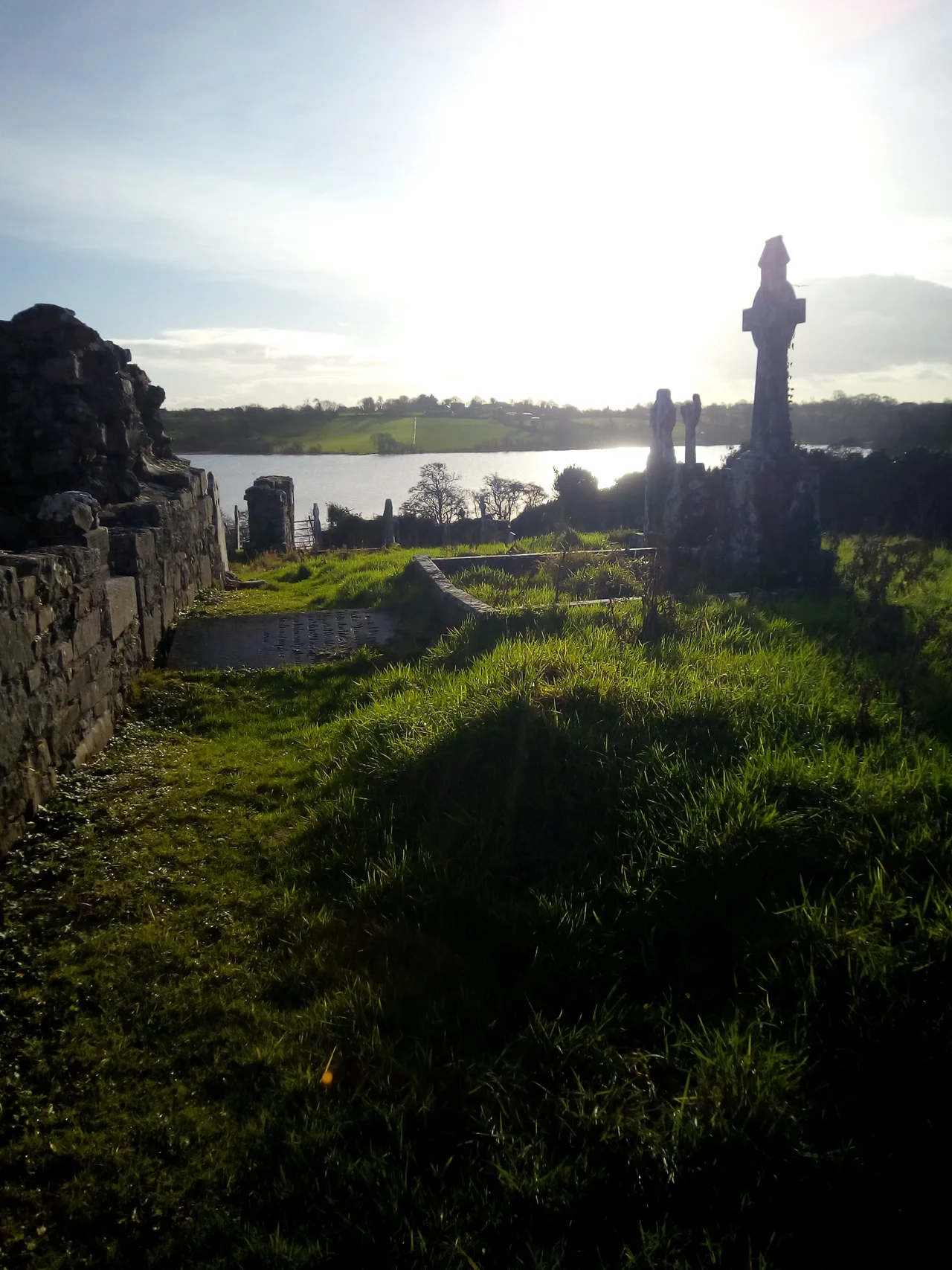

Killone Abbey
Slaney O'Brien, daughter of Carbreagh, King of Thomond, walked away from her royal status some time before 1260. She gave up worldly possessions and entered Killone Abbey, an Augustinian nunnery her family had founded on a lakeside in Clare seventy years earlier. The Irish annals described her, on her death, as "the most pious, most charitable, and most generous woman in all Munster." It is a remarkable obituary for a princess who chose to disappear into a cloistered life. The abbey she joined was one of the few institutions in medieval Gaelic Ireland where a woman could exercise meaningful authority, and several Killone abbesses came from the O'Brien dynasty itself.
The Lakeside Foundation
Donal Mór O'Brien, King of Thomond and Munster, founded Killone Abbey in 1190 - one year after he founded Clare Abbey, the male Augustinian house two kilometres north. Killone was a house of Canonesses Regular following the Rule of Saint Augustine. The Augustinian order had spread into Ireland during the 12th-century reform movement that reshaped Irish monasticism along continental European lines, replacing or absorbing older Celtic foundations. Female monastic institutions were rare in Gaelic Ireland; Killone was one of a small handful and the most prominent in Thomond. The abbey buildings stood near the northern shore of Killone Lake, a body of water now within the Newhall Estate.
The O'Brien Connection
Killone's abbesses were drawn repeatedly from the O'Brien dynasty. Beyond Slaney, the abbey's last abbess was Lady Honora O'Brien, daughter of Murrough O'Brien, the 1st Earl of Thomond. Honora's life sat exactly on the fault line between medieval and early modern Ireland. The suppression of Catholic monastic houses under Henry VIII's Dissolution reached Ireland in 1540, and Killone was suppressed along with the others. Honora subsequently married Sir Roger O'Shaughnessy and became heiress to Newhall and Killone - a transition from religious life to landed gentry that required papal dispensation, and that occurred after the birth of their three eldest children. The order of events would be scandalous by Counter-Reformation standards. It was apparently transacted quietly enough.
By 1617 a Ruin
Within seventy-five years of dissolution, the abbey was a ruin. A 1617 record describes the buildings as already collapsed. The crypt remained intact - it had been an undercroft of the original abbey church and was reused as a burial place by the later O'Brien and gentry families. The surviving walls include substantial portions of the church and a narrow stone stairway, situated between the altar and the east window, that leads up to a ledge atop the south wall. Stand there and you can see the surrounding grounds - Killone Lake to the south, the parklands of Newhall behind, the gravestones clustered at the abbey's foot.
The Holy Well
Adjacent to the abbey is Saint John's Holy Well - Tobar Eoin in Irish - whose use predates Christianity. Pagan well-veneration was widespread across Celtic Ireland, and many such sites were rededicated to Christian saints rather than being suppressed. Local folklore attributes healing properties to the water. Pilgrims gathered here especially on the feast day of Saint John the Baptist (24 June), and the practice continues. Stone inscriptions around the well date back to 1600, and Lord Walter Fitzgerald - the fourth son of the fourth Duke of Leinster - visited in 1899 and documented them in a paper for the Royal Society of Antiquaries of Ireland. The well still draws visitors, both for its spiritual significance and for the simple fact of being a quiet stone-walled spring on private land.
The Mermaid's Curse
Killone Lake carries a folktale that has clung to it for centuries. A member of the O'Brien family living near the lake noticed wine disappearing from his cellar. Determined to find the thief, he stayed awake one night - and saw a mermaid swimming from the lake through an underground passage to steal the wine. Versions of what happened next vary: some say he shot her, others that a servant scalded her with boiling water. Wounded, she fled back to the lake, cursing the O'Briens with the words: "As the mermaid goes on the sea, so shall the race of O'Briens pass away, till they leave Killone in wild weeds." Every seven years, local tradition holds, the lake's waters turn red - the mermaid's blood, foretelling a change in the estate's occupants. By the 20th century the O'Brien family had indeed left Newhall and Killone. The abbey is now owned by the Commane family. Its ruins are protected under the National Monuments Acts, with guardianship vested in the Office of Public Works. Visiting requires the owner's permission.
From the Air
Coordinates 52.81°N, 9.00°W. Killone Abbey sits within the Newhall Estate, 4 km southwest of Ennis in County Clare. Shannon Airport (EINN) is 15 km southeast - the principal regional airfield. From altitude the abbey appears as a small ruined building on the north shore of Killone Lake, surrounded by the wooded parkland of the Newhall demesne. The medieval Pilgrim's Path connects the site north through Ballybeg forest to Clare Abbey near Clarecastle. Best viewed at 1,500-2,500 ft AGL; the lake is the most identifiable landmark, with the abbey ruins on its northern edge.
Nearby Stories
- Kinvara 6.1 km away
- William Smith O'Brien 9.3 km away
- Newport, County Tipperary 13 km away
- Aran Islands 14 km away
- Portumna 15 km away
- Kilkee 19 km away
- Tipperary (town) 21 km away
- Kilflynn 25 km away