.jpg)
Kiltimagh
The Oxford English Dictionary, somewhat to the surprise of the locals, traces the Irish word culchie back to Kiltimagh. The term is mildly derogatory in Irish English - a slang label for country people, particularly those not from Dublin - and the Oxford speculates that it is "an alteration of Kiltimagh, Irish Coillte Mach (older Maghach), the name of a country town in Co. Mayo." The alternative theory is that culchie derives more directly from coillte, the plural of coill, the Irish for woodland or forest. Either way, the etymology runs through this small town of 1,232 people in the barony of Gallen, two hundred and sixty-two metres above sea level on the slopes of Slieve Carn, where the disused railway station has been converted into a sculpture park and the locals now pedal carts down the old line for fun.
The Ormsby Town
The lands around Kiltimagh were granted by patent to the Ormsby family in April and July of 1677. The Ormsbys had originally come from Louth in Lincolnshire and had been living in the area for some time before they formalised their claim, having bought their first holdings from people transplanted under the Cromwellian land settlement. By 1876, Anthony Ormsby of Ballinamore was recorded as owning 4,492 acres around the town. Their family seat, Ballinamore House, was built around 1777 by Thomas Ormsby and modified for him in 1836 by the builder Thomas Murphy. The Ormsbys held it until 1936, when it was sold. Today it operates as a nursing home, the great Anglo-Irish house outlasting the family that built it by reinventing itself as a place of late-life care.
William Henry Byrne's Streetscape
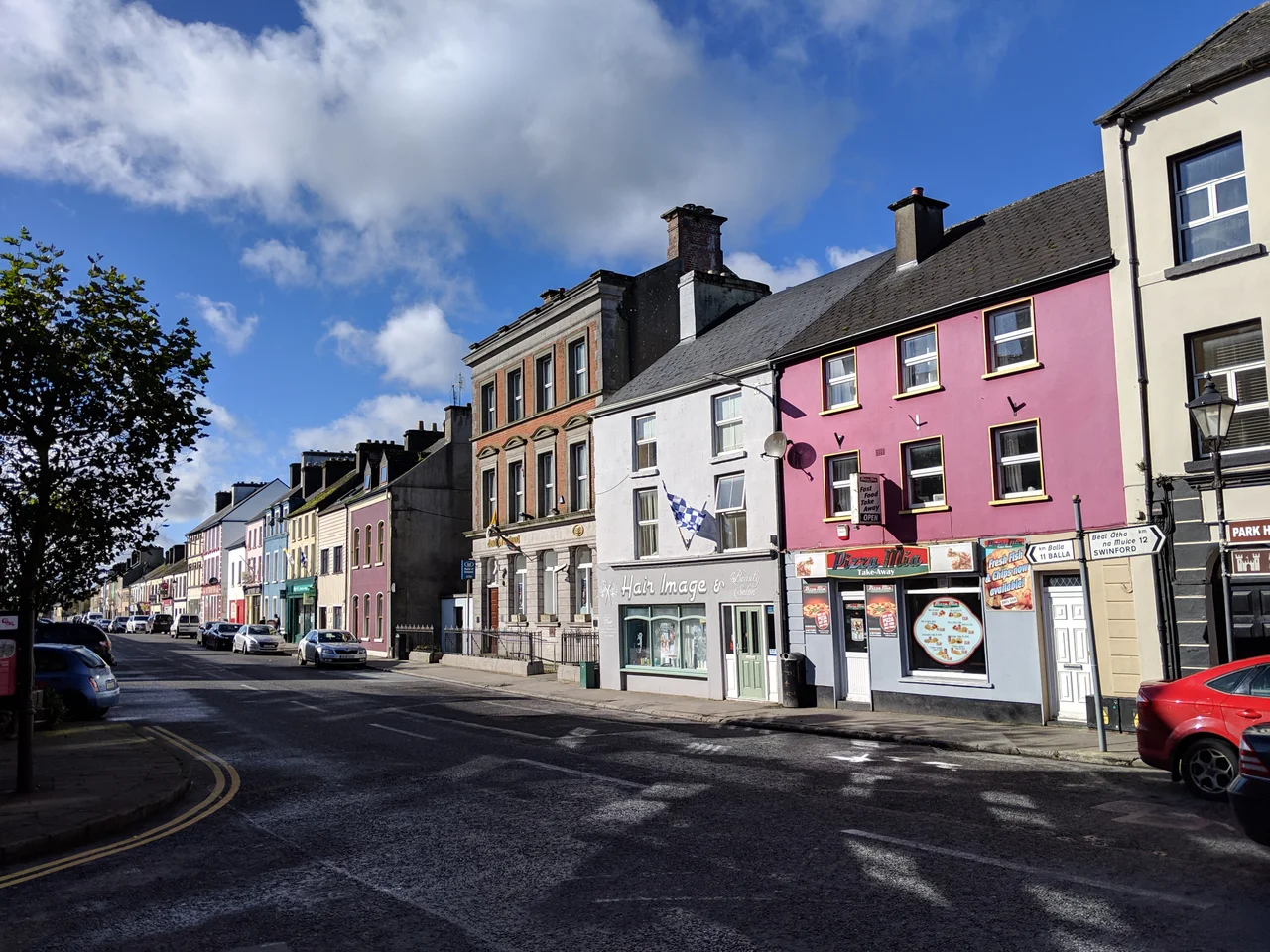
From the late nineteenth century onward, Kiltimagh built itself up as a market town, and an unusual share of the resulting commercial and civic architecture came from a single firm. The Hibernian Bank, built in 1904, Kiltimagh Hospital, built in 1919, and parts of the St Louis Convent and chapel constructed between 1896 and 1915 - all of them were designed by the Dublin architect William Henry Byrne, latterly working with his son Ralph Henry Byrne. The result is a small town with a coherent late-Victorian to Edwardian streetscape, the kind of architectural unity that bigger towns lost to redevelopment and that smaller ones rarely had the money to commission in the first place. Walk the streets of Kiltimagh today and the Byrne signature is hard to miss once you know to look for it.
Slieve Carn and Bill Berry Cliff
Just outside the town rises Slieve Carn - Sliabh Cairn, the mountain of the cairn - at 262 metres. The 1802 Statistical Survey of Mayo recorded coal in the hill, with evidence of iron deposits in places. Neither resource proved commercially worthwhile, and the hill has reverted to bog, heather and pasture. Cutting through the slope is a feature locals call Bill Berry Cliff, a rocky escarpment that farmers in the area have measured at about 100 metres deep. A tributary of the Pollagh River starts at the top, draining out of the bog and tumbling through the cliff in a sequence of three waterfalls. None of this is on most maps. It is the kind of feature that the surrounding farms know well and that strangers stumble into by accident, walking the bohereens above the town.
Velorail on the Old Track
Kiltimagh Railway Station opened on 1 October 1895 and closed for passenger traffic on 17 June 1963 - a fate shared by many of the Irish branch lines killed off in the great Beeching-era closures. Proposals to reopen the line as part of the Western Railway Corridor have circulated for years. In the meantime, the closed station has been put to creative work. It now houses the Kiltimagh Museum, with displays on local history and culture, surrounded by a sculpture park whose works dot the surrounding parkland. In June 2023, the town opened a velorail service: visitors pedal small carts along nine kilometres of the disused track. One Westport councillor pronounced it "an hour and a half of boredom," but the venture has drawn steady visitors. It is the kind of inventive small-town tourism that Irish towns of Kiltimagh's size have to try if they are to keep themselves on the map at all.
Tunneys, Walshes, Raftery
Antoine O Raifteiri - Anthony Raftery - the blind Irish-language poet whose work survives in the great oral tradition of the west of Ireland, was associated with the area. Gene Tunney, the champion Irish-American boxer, had parents who came from Kiltimagh - his father John Tunney and mother Mary Lydon Tunney. Sean Lavan ran the 200 metres for Ireland at the 1924 and 1928 Olympics. Louis Walsh, the pop music manager and longtime judge on The X Factor in the UK, hails from Kiltimagh; his nineties success with Boyzone, Westlife and other acts ran out of an Irish music management practice that began far from the London talent scene. Thomas Flatley emigrated to Boston and became one of the leading Irish-American real estate developers of his generation. The town keeps producing people who make it elsewhere - but the velorail and the sculpture park are reasons to come back.
From the Air
Located at 53.85 degrees north, 9.00 degrees west, in central County Mayo. The closed railway station and surrounding sculpture park are visible from low altitudes. Slieve Carn rises just outside the town to 262 metres. Ireland West Airport (EIKN) is 16 km to the north-east; Knock village lies about 13 km east.
Nearby Stories
- Newport, County Mayo 3.7 km away
- Bellanagare Bog 5.5 km away
- Ballygar 13 km away
- Leenane 13 km away
- Creevelea Abbey 13 km away
- St Mary's Cathedral, Tuam 13 km away
- Bangor Erris 16 km away
- Easky 17 km away