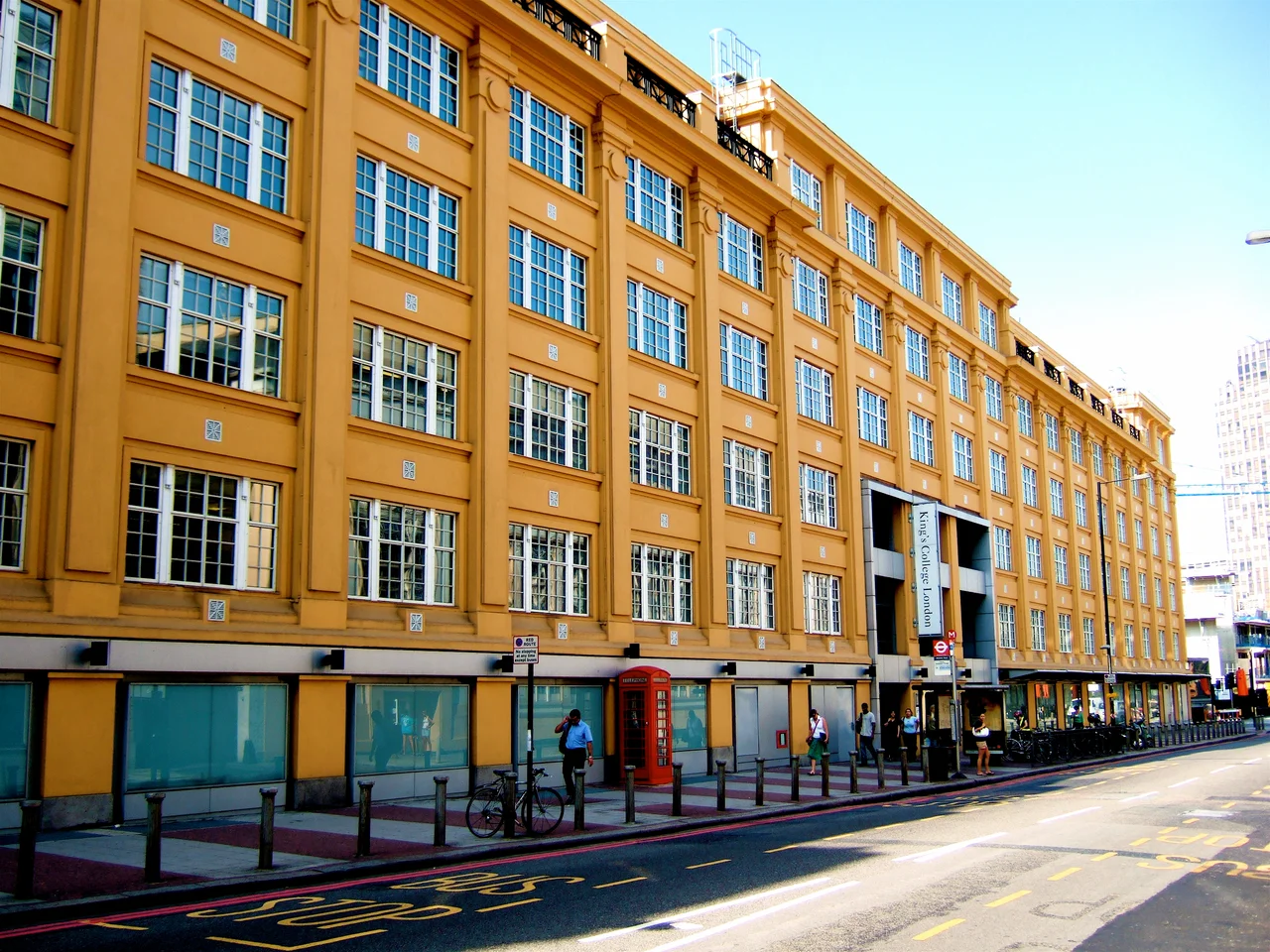

King's College London
On 21 March 1829, the Duke of Wellington - prime minister, victor of Waterloo, and reluctant duellist - met a fellow peer in a field at Battersea with a pair of pistols. The other man was the Earl of Winchilsea, who had accused him in print of plotting to introduce Catholicism into every department of the British state. Winchilsea raised his pistol and held it across his arm without firing. Wellington took aim and shot to one side, missing on purpose. Honour was satisfied. An apology was written. And in the middle of all this, somewhere between the insult and the bullet, was an institution Wellington was trying to build: King's College London. The duel was about who would teach England's young men.
Tory Answer, Whig Question
The Whigs and Utilitarians had founded London University - what is now University College London - on Gower Street in 1826 as a secular institution open to Jews, dissenters, and anyone whose Anglican credentials Oxford and Cambridge would have refused. Within months a coalition of bishops and Tories started calling it 'the godless college in Gower Street.' Their answer arrived in 1829 with a royal charter from George IV and an endowment list of nervous Anglicans. King's College would teach the same modern subjects - science, medicine, modern languages - but with the Archbishop of Canterbury as its visitor and compulsory chapel for the students. Both colleges merged in 1836 to become the founding members of a single federal University of London, which is why two institutions that began as rivals now share the same parchment and the same Senate House library card. The pamphleteers of 1829 would not have approved.
The Strand Building
King's took up residence in what is now its oldest building - a sober yellow-brick wing along the Thames frontage of Somerset House. The architect was Sir Robert Smirke, who had already designed the British Museum and would soon design the General Post Office. He completed the river frontage in April 1835 for £7,100 - a stipulation written into the Crown grant of the land. The Chapel was redesigned in 1864 by Sir George Gilbert Scott in his confident High Victorian Gothic, with a barrel-vaulted ceiling and Italianate marble. The basement of this building, for forty years, also housed King's College School - now a separate institution in Wimbledon, but at the time the same building taught nine-year-olds and twenty-year-olds at different ends of the same staircase. Today the Strand Campus is still anchored on Smirke's building, with departments of philosophy, law, history, and English crammed into rooms that once belonged to wholly different generations of King's.
Lister and the Hospital
In 1840, with the medical school growing, King's opened its own hospital on Portugal Street near Lincoln's Inn Fields. Portugal Street ran through some of the worst slums in central London - rookeries of unpaved alleys and cholera epidemics. The hospital, then, served the patients its students most needed to learn from. In 1877 the college appointed Joseph Lister as professor of clinical surgery. Lister had spent the previous decade in Glasgow and Edinburgh proving that carbolic acid sprayed during operations could turn the lethal post-surgical infection rates of the Victorian hospital into something survivable. He brought antiseptic surgery to London, and through King's College Hospital it spread to the rest of the country. The hospital moved out to Denmark Hill in 1913, where it remains - a teaching hospital still tied to King's, with the medical school named for the Florence Nightingale School of Nursing and Midwifery, which merged into King's in 1998.
Photograph 51
Of the dozens of researchers King's would later claim as Nobel-adjacent, the one whose work most quietly changed the world never received a Nobel. Rosalind Franklin came to King's in 1951 as a research associate in the biophysics unit and turned her X-ray crystallography skills on DNA. In May 1952 she and her student Raymond Gosling produced Photograph 51 - the now-famous image showing the helical structure of DNA in sharp detail. Maurice Wilkins, a colleague at King's, showed the photograph without her knowledge to James Watson and Francis Crick at Cambridge in 1953. They built their model from her data. Wilkins, Watson, and Crick shared the 1962 Nobel Prize. Franklin had died of ovarian cancer in 1958, aged thirty-seven, and the Nobel is not awarded posthumously. King's later named a building for her - the Franklin-Wilkins Building on the Waterloo Campus - and the historical record has slowly corrected itself. The work was hers.
Strand to Aldwych
King's today has roughly 33,000 students across five campuses in central London: the Strand, Waterloo, Guy's near London Bridge, St Thomas' opposite Parliament, and Denmark Hill in Southwark. The medical, dental, and nursing schools at Guy's and St Thomas' joined King's in 1998 in one of the largest university mergers in British history. In 2015 the college took on a 50-year lease for the Aldwych Quarter, which includes Bush House - the building where the BBC World Service broadcast in 28 languages from 1941 to 2012 and which now contains lecture theatres where students study international relations and music. The Queen opened it as a King's building in 2019. The Russell Group university that emerged from a duel in 1829 now occupies more of central London than any other educational institution. The chapel still has compulsory services. Almost no one goes.
From the Air
King's College London's Strand Campus sits at 51.512N, 0.117W, on the north bank of the Thames between Waterloo Bridge and the river side of Somerset House. The campus is best identified by Somerset House itself - a vast 18th-century classical quadrangle directly upstream from Cleopatra's Needle - with King's main buildings running along the eastern wing and Surrey Street. The Maughan Library, an 1860s Gothic block on Chancery Lane, is the other distinctive building. London City Airport (EGLC) lies five nautical miles east, Heathrow (EGLL) twelve nautical miles west, and the Thames helicopter route passes directly south of the campus.
Nearby Stories
- Stevenage 5.7 km away
- Malling Abbey 5.7 km away
- 1952 Farnborough Airshow Crash 7.7 km away
- Ingatestone Hall 8.2 km away
- Hellfire Caves 9.1 km away
- The Carrington Event: The Solar Storm That Could Happen Again 9.8 km away
- Bletchley Park 16 km away
- Castle Hedingham 23 km away