
King's Cross fire
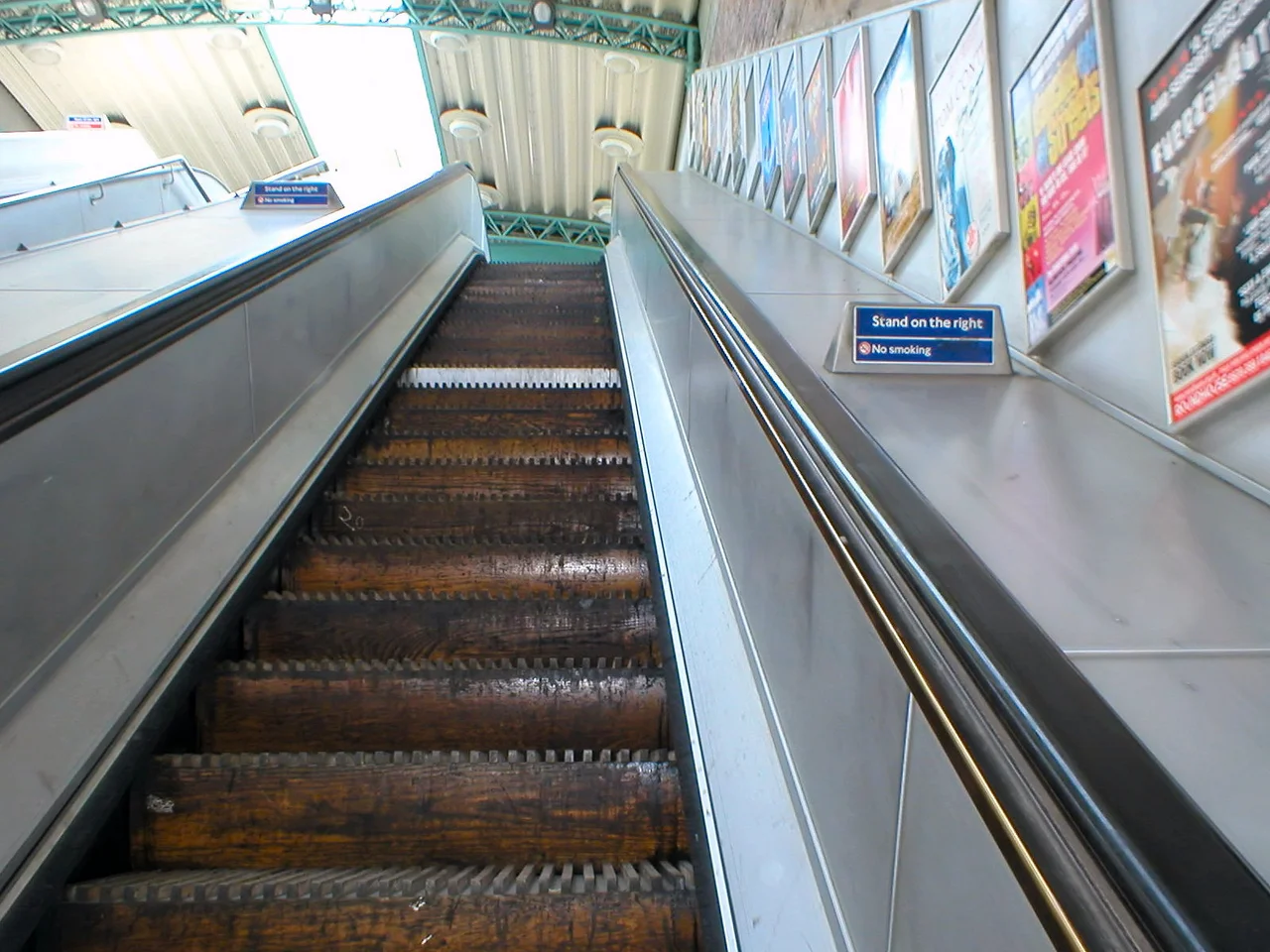
At twenty-five to eight on a Wednesday evening in November, a passenger riding up the Piccadilly line escalator at King's Cross noticed smoke curling from beneath the wooden treads. It was 1987, and there had never been a fatal fire on the London Underground. Staff had been trained to call it a 'smouldering' and try to handle it themselves. By the time the first fire crews arrived, the fire still looked manageable. At quarter to nine - fifteen minutes after the first call - the escalator shaft erupted. A jet of flame the size of a swimming pool roared up out of the tunnel, hit the ticket-hall ceiling, and turned the rush-hour evacuation into a furnace.
The Thirty-One
Thirty-one people died. A hundred more were taken to hospital, nineteen of them seriously burned. Station Officer Colin Townsley, in charge of the first pump fire engine on the scene, ran into the ticket hall before the flashover. His body was found beside that of a badly burned passenger at the foot of the exit stairs to Pancras Road. The investigators believe he had stopped to help her. He was forty-five and was posthumously awarded the George Medal. One of the victims would not be named for sixteen years. The mortuary tagged him 'Body 115' and the press began calling him Michael. In January 2004 a forensic match with dental records and a hip-replacement plate identified him as Alexander Fallon, a seventy-three-year-old widower from Falkirk in Scotland who had been living rough in London after his wife's death. His family in Scotland had no idea where he had gone or that he had been on the Underground that night.
The Match
The inquiry, conducted by Desmond Fennell QC over 91 days at Central Hall in Westminster, concluded that the fire had almost certainly started when someone dropped a lit match while lighting a cigarette on the escalator. Smoking had been banned on Underground trains since 1984 and on platforms and escalators since 1985, but enforcement was casual; passengers still lit up on the way out. Investigators found charred wood in eight separate places on the same section of escalator skirting and matches in the running track - evidence of fires that had started and then burned themselves out before anyone noticed. Underneath, in the machinery space, was a thick build-up of lubricant grease saturated with passenger debris: fluff from clothes, human hair, ticket fragments, rat fur. The grease alone would have been hard to ignite. The grease plus the fluff plus a falling match was a different matter. The investigators dropped lit matches onto a replica and the grease caught and spread. The fire had nine minutes before they put it out.
The Trench Effect
But the inquiry could not explain why a small grease fire became a furnace. Four expert witnesses argued over it. Eventually a computer simulation at the Atomic Energy Research Establishment showed something startling: the flames did not rise up the 30-degree escalator shaft as you would expect. They lay down flat against the floor of the trench, hugging the slope, drawn forward by the airflow until they reached the open ticket hall and exploded vertically. Some of the engineers thought the simulation must be wrong - flames are supposed to go up - so they built a one-third-scale model at the Health and Safety Executive site in Buxton and lit it. The flames lay down. After seven and a half minutes of normal burning the wooden treads flashed over, and a jet of flame discharged from the tunnel into the model ticket hall exactly as the computer had predicted. The phenomenon was new to fire science. They named it the trench effect, and it has been part of the syllabus ever since.
Cyanide and Paint
There was a second, quieter finding that the final report did not emphasise. The pathologist Patrick Toseland reported that the majority of the victims he had examined had lethal levels of cyanide in their blood. The London Underground had painted the ticket-hall ceiling with a polyurethane gloss to make it easier to clean off graffiti. When the gloss burned in the flashover, it released hydrogen cyanide into the smoke. The Times reported in 1989 that at least 23 of the 31 dead, Townsley included, had been killed by cyanide rather than by fire or heat. The anti-graffiti paint was quietly stripped from every Underground ceiling in the following years. London Underground had made one decision to keep its stations looking clean and another to leave wooden escalators in service - and the two decisions, on a single Wednesday in November, multiplied each other into something nobody had imagined.
What Changed
Senior management resigned. Keith Bright, chairman of London Regional Transport, went first. The Fire Precautions (Sub-surface Railway Stations) Regulations 1989 followed. Heat detectors, sprinklers, CCTV, alarms, and personal radios were installed across the network. The wooden escalators came out one by one over the next 27 years. The last one - at Greenford on the Central line - was decommissioned on 11 March 2014. Smoking was banned across the entire Underground five days after the fire and has remained banned. The station itself was rebuilt as part of the High Speed 1 project in the late 2000s, its ticket hall doubled in size and capacity. A memorial plaque inside the station, and another at St Pancras Church unveiled by the Princess of Wales, carry the names of the dead. Each November, on the anniversary, a wreath is laid. The trains keep running, on metal escalators, beneath ceilings that no longer have anything on them that can burn.
From the Air
King's Cross St Pancras lies at 51.531N, 0.124W in north-central London - the largest interchange on the Underground system, connecting six tube lines with the King's Cross and St Pancras mainline termini. From the air the site is unmistakable: the long red-brick frontage of St Pancras with its Victorian Gothic clock tower and the long curved shed of King's Cross, set side by side a half-mile north of the British Library. Heathrow (EGLL) lies 12 nautical miles southwest, London City (EGLC) seven nautical miles east-southeast. The London Helicopter Route H4 passes about a mile to the south along the Thames.
Nearby Stories
- Stevenage 5.7 km away
- Malling Abbey 5.7 km away
- 1952 Farnborough Airshow Crash 7.7 km away
- Ingatestone Hall 8.2 km away
- Hellfire Caves 9.1 km away
- The Carrington Event: The Solar Storm That Could Happen Again 9.8 km away
- Bletchley Park 16 km away
- Castle Hedingham 23 km away