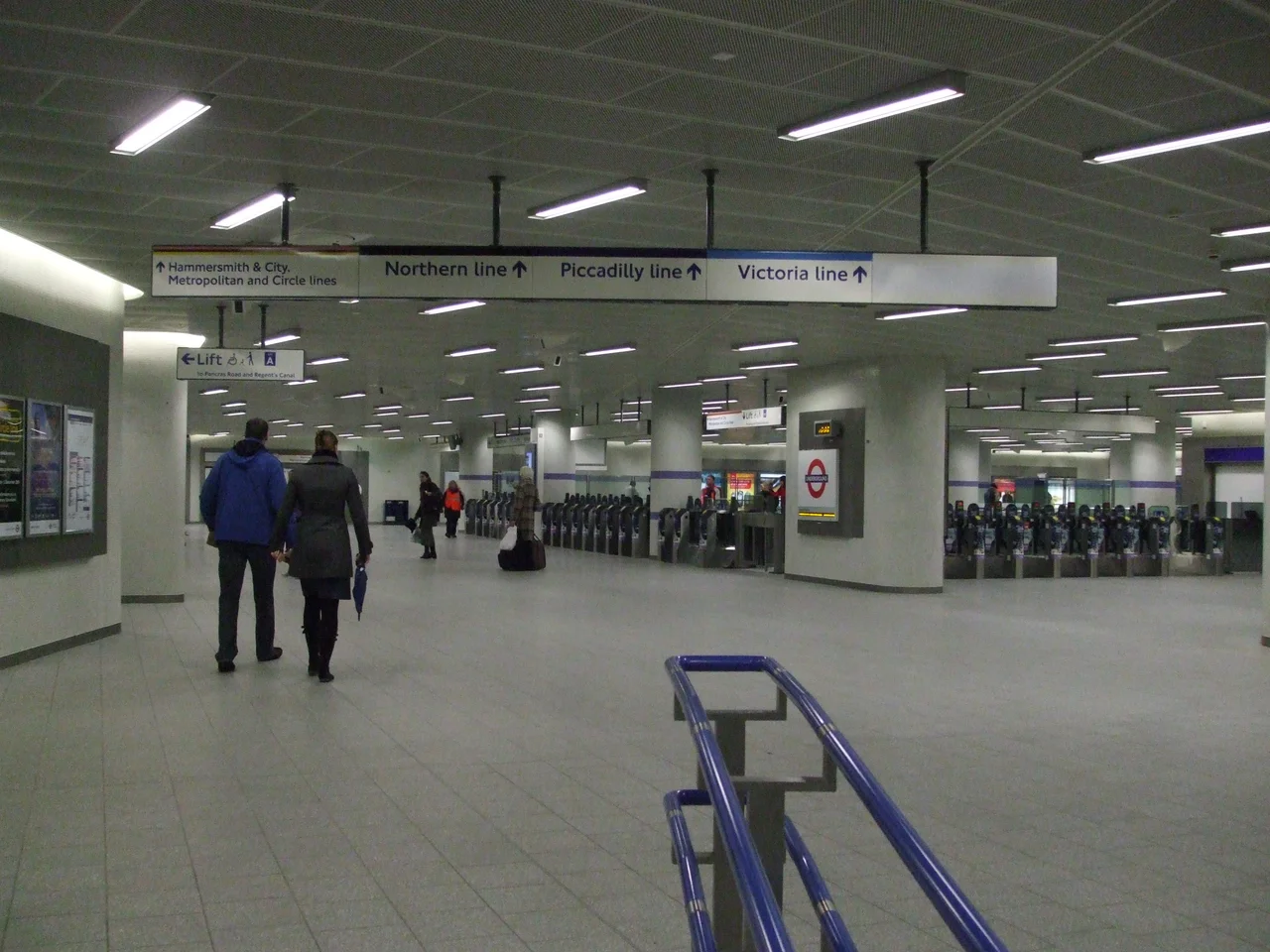

King's Cross St Pancras tube station
King's Cross St Pancras has more entrances than most British cities have railway stations. Eleven of them. Four ticket halls. Eight platforms underground, for six different tube lines, beneath the largest mainline interchange in central London. Walk in from the Euston Road on a Friday evening and the floor is a moving carpet of suitcases - travellers off the East Coast express to Edinburgh, off Thameslink from Brighton, off Eurostar from Brussels, all converging on the escalators down to the Victoria, Piccadilly, Northern, Metropolitan, Circle, and Hammersmith & City lines. On the busiest days, more than 100,000 people pass through here. It is the largest, most overworked underground station in Britain, and for almost all of the last century and a half, it has been adapting to whatever London demanded next.
1863
The original station opened on 10 January 1863 as part of the world's first underground railway - the Metropolitan Railway, running between Paddington and Farringdon under what is now the Marylebone and Euston Road. The point of the Metropolitan was to connect the great northern railway termini - King's Cross, St Pancras, Euston, Paddington - to the City of London without making passengers struggle across the surface streets. King's Cross was one of the original stops. The station opened with sub-surface platforms (not deep tubes; just shallow trenches with brick arches over them) for the Metropolitan trains, which were hauled by steam locomotives fitted with condensing apparatus that was meant to keep the smoke out of the tunnels. It mostly didn't work. Passengers in the 1860s complained of choking on coal smoke. They got out at King's Cross with sooty handkerchiefs and watering eyes and called the line, with some affection, the Drain.
Deep Tubes
The deep-level platforms arrived in the early 1900s with a generation of new tube lines that bored hundreds of feet below the surface using electric trains. The Piccadilly line opened in December 1906, the City and South London Railway (now the Northern line) in May 1907. The two were financed in significant part by the American businessman Charles Tyson Yerkes, a transplant from Chicago who built a company around London Underground expansion. Each new line at King's Cross required new platforms, new lifts, new staircases, and eventually new escalators - all carved into the same crowded patch of ground beneath Euston Road. In 1933 the station was formally consolidated and renamed King's Cross St Pancras. In June 1939 a new circular ticket hall opened, costing £260,000. A subway under Euston Road, linking the underground station directly to St Pancras, opened two years later. The station was becoming what it is today: a multi-level honeycomb of platforms and tunnels stitched together over a hundred and fifty years of compromises.
The Blitz Years
On 9 March 1941 a German bomb struck the Metropolitan line platforms during the Blitz. The train, the station roof, the signal box, and the platforms were damaged. Two railway staff - whose names appear in the LNER war memorials at King's Cross - were killed. New sub-surface platforms 250 metres west had been under construction since the 1930s. They were rushed into service, still unfinished, on 14 March - five days after the bomb - and decorated with cream tiles trimmed with pale green that you can still spot on the Circle and Hammersmith & City line platforms today. London Transport ran the wartime station with patches and improvisations: shelters in the deep platforms by night, commuters by day, with the wounded city above carrying on as best it could. The 1868 platforms became Thameslink, which was eventually replaced with new platforms at St Pancras when Eurostar arrived in 2007. The story of every layer of King's Cross underground is patched onto the wartime survival of the layer beneath it.
1968 and 1987
The Victoria line opened on 1 December 1968 as part of the post-war Underground expansion - a fully automatic deep-level line that gave the station a sixth tube. Because the new platforms could not be placed on the same level as the existing ones, the architects built two more escalators and an extra subway. This created exactly the kind of interleaved escalator-and-tunnel geometry that, on the evening of 18 November 1987, would prove catastrophic. The King's Cross fire began on a wooden Piccadilly line escalator, flashed over via what was then an unknown phenomenon called the trench effect, and killed thirty-one people in the ticket hall above. Among them was Station Officer Colin Townsley, who had stopped to help an injured passenger before the flashover, and Alexander Fallon - a seventy-three-year-old widower from Falkirk whose body lay unidentified for sixteen years. The fire transformed Underground safety: wooden escalators were phased out (the last gone in 2014), heat detectors and sprinklers installed under every staircase, smoking banned across the network, and the very concept of passenger flow re-engineered.
Eurostar and After
When the Channel Tunnel Rail Link decided to terminate at St Pancras rather than Waterloo, the Underground station had to be enlarged again - radically. Work began in August 2000 and took almost a decade. The cost was £810 million. The capacity doubled to more than 100,000 passengers a day. Two new ticket halls were dug: the Western Ticket Hall under the St Pancras forecourt, and the Northern Ticket Hall under the new King's Cross concourse with its famous fanned white-tiled roof. King's Cross Thameslink station closed in December 2007 when through-services moved to the deep new platforms at St Pancras. Art on the Underground commissioned Knut Henrik Henriksen's Full Circle sculptures - the first permanent Underground artwork installed since the 1980s. Today the station is mostly step-free, with ten lifts, and the eight underground platforms run from early morning until past midnight on weekend Night Tube services. On the Piccadilly line platform, between King's Cross and Russell Square, lies the spot where the deadliest of the 7 July 2005 attacks killed twenty-six commuters - a section of deep tunnel marked by no visible memorial but remembered by everyone who passes through it.
From the Air
King's Cross St Pancras station sits at 51.530N, 0.124W in the London Borough of Camden, immediately on either side of Euston Road. From the air the complex is one of the most distinctive transport landmarks in Britain - the long curved arched roof of King's Cross (1852) next to the Victorian Gothic frontage and clock tower of St Pancras (1873), with the British Library's red-brick mass a quarter-mile to the south. Heathrow (EGLL) lies twelve nautical miles southwest; London City (EGLC) seven nautical miles east-southeast. The Thames helicopter route runs roughly a mile to the south, following the river.
Nearby Stories
- Stevenage 5.7 km away
- Malling Abbey 5.7 km away
- 1952 Farnborough Airshow Crash 7.7 km away
- Ingatestone Hall 8.2 km away
- Hellfire Caves 9.1 km away
- The Carrington Event: The Solar Storm That Could Happen Again 9.8 km away
- Bletchley Park 16 km away
- Castle Hedingham 23 km away