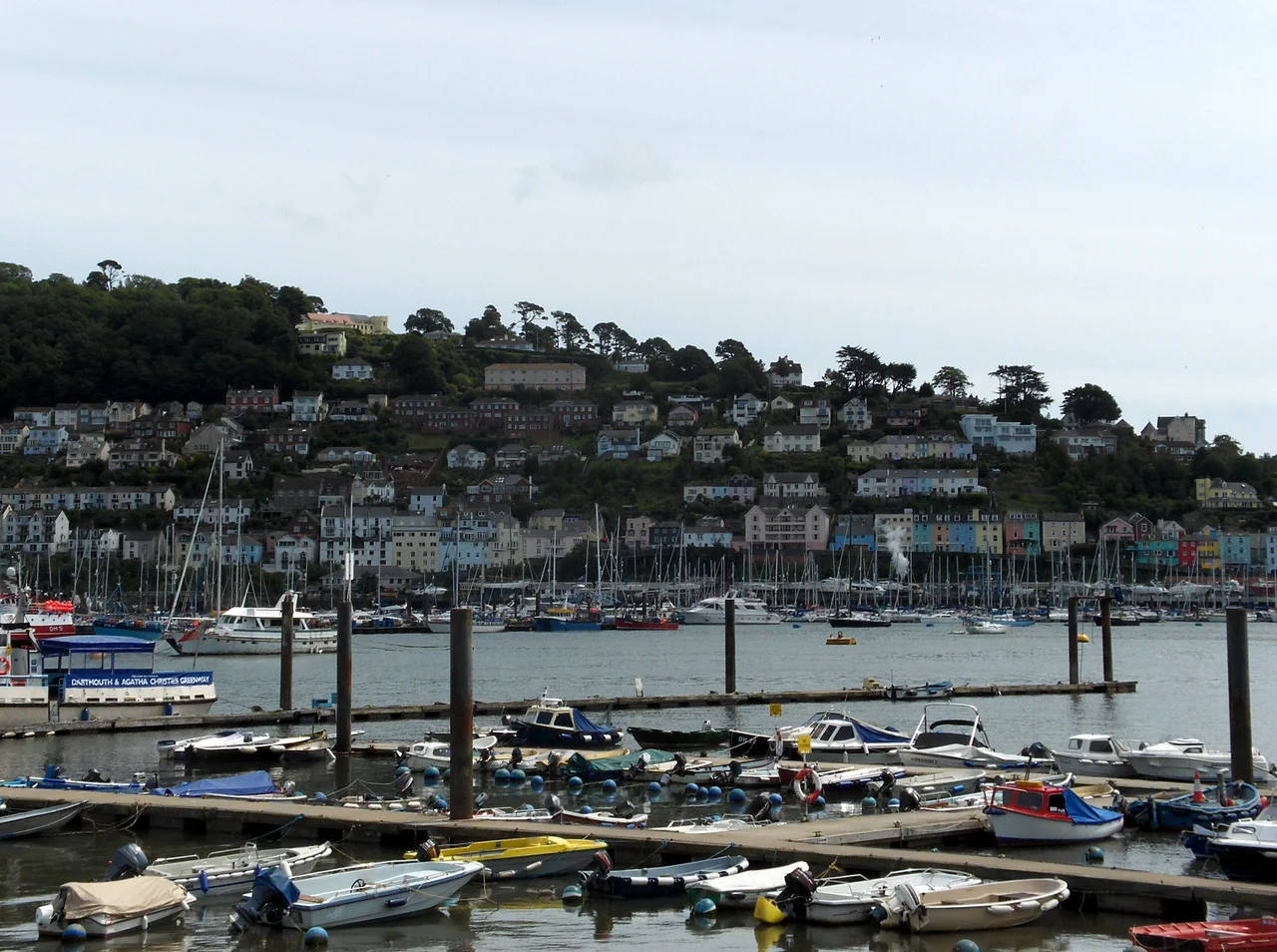

Kingswear
There are three ways to get to Dartmouth: a long road around to Totnes and back, the Higher Ferry, the Lower Ferry, or a passenger ferry barely wider than a rowboat. Two of those ways start at Kingswear, on the east bank of the River Dart. The village climbs steeply up the hillside from the water - terraces of pink and yellow houses stacked above the slipways, the slate roofs slipping down toward the river like a deck of cards. At the bottom, the steam railway from Paignton arrives in a hiss of coal smoke and stops at a wooden platform that has been the end of the line since 1864. For 160 years, Kingswear has been the place where you change from train to boat to get to Dartmouth. It is also, less obviously, the place where men sailed to found a city in Maine.
Pilgrims, Saints, and a Murder in Canterbury
Kingswear does not appear in the Domesday Book of 1086, but Stone Age tools have come out of the soil at nearby Kingston, and the Anglo-Saxons certainly knew the place. The first written record is from around 1170, when a man named William de Vinci gave the local church half the land in the village. That same year, Thomas Becket was murdered at Canterbury Cathedral and Becket's tomb almost immediately became one of the great pilgrim destinations of Christendom. Pilgrims coming by sea from Brittany and further west would land at Kingswear and walk overland to Canterbury. The village church was rebuilt and rededicated to Saint Thomas as a staging point on that pilgrim route. The church still stands today, rebuilt again in 1847, and still bears Becket's name.
The Kittery Crossing
Kingswear's most consequential export was probably not its wool or its fish. By 1365 a ferry was operating from Kittery Point, the westernmost tip of Kingswear, across the river to Dartmouth - the same crossing the Lower Ferry now makes. In 1636, a group of settlers boarded ships at Kingswear and sailed across the Atlantic to the mouth of the Piscataqua River in what would become Maine. They named their new town Kittery, after the point they had left behind. Today Kittery, Maine is the oldest incorporated town in the state, full of shipyards and lobster boats, and almost no one there knows that its name belongs to a tiny rocky tip in south Devon. The local tour guides on the River Dart like to point out that the short cross-river ferry between Kingswear and Dartmouth was used in The Onedin Line as the Atlantic crossing - making it, the joke goes, the shortest Atlantic ever filmed.
Wartime Secrets
The Royal Dart Hotel, a tall Victorian building right at the railway terminus, became HMS Cicala during the Second World War - headquarters of the British 15th Destroyer Flotilla. From the moored launches and motor torpedo boats tied up below the hotel, Allied agents and Free French operatives left for the beaches of Brittany at night, landing supplies for the Resistance and bringing back downed airmen and escaping soldiers. The Free French Navy itself operated from Brookhill, a Regency house on the village outskirts. The men who went out from Kingswear on those black-water crossings were doing the most dangerous work of the war - very small boats, no lights, German E-boats hunting the same waters - and most people in the village never knew. Above the hotel, the steam railway carried regular passengers and a great deal of military traffic, and the slate roofs of Kingswear caught the moonlight just as they had for centuries.
A Village That Stayed Itself
The 2011 census recorded 1,217 people in Kingswear, modestly down from 1,332 a decade before. By Devon village standards it is small. By the standards of what such places usually become - second-home enclaves with no shops and no children - Kingswear has held its shape surprisingly well. The Royal Dart Yacht Club still races every summer. Kingswear Castle still squats on its rocks at the river mouth, now a Landmark Trust holiday let. Three ferries still connect to Dartmouth across the water. The Dartmouth Steam Railway still hisses into the station on summer afternoons. The South West Coast Path - the 630-mile cliff trail that runs from Minehead to Poole - lands here from Dartmouth on the passenger ferry and immediately starts climbing eastward toward Brixham, hikers in waterproof jackets fanning out into the lanes. Kingswear absorbs them. By morning the village belongs to itself again.
From the Air
Coordinates 50.35 N, 3.57 W. Kingswear sits on the east bank of the River Dart at the river's mouth, directly opposite Dartmouth. Best viewed at 1,500-3,000 ft AGL - the village stacks steeply up the hillside above the water, with the railway terminus on the riverbank and Kingswear Castle visible at the river's mouth. Exeter (EGTE) is 25 nm to the north-northeast. The Dartmouth Steam Railway's track curves north along the coast to Paignton.
Nearby Stories
- St Germans Priory 7.6 km away
- Launceston, Cornwall 9.6 km away
- Castle Drogo 12 km away
- HMS Formidable (1898) 17 km away
- Siege of Lyme Regis 19 km away
- Battle of Plymouth (1652) 40 km away
- German Submarine U-672 48 km away
- Goonhilly Satellite Earth Station 69 km away