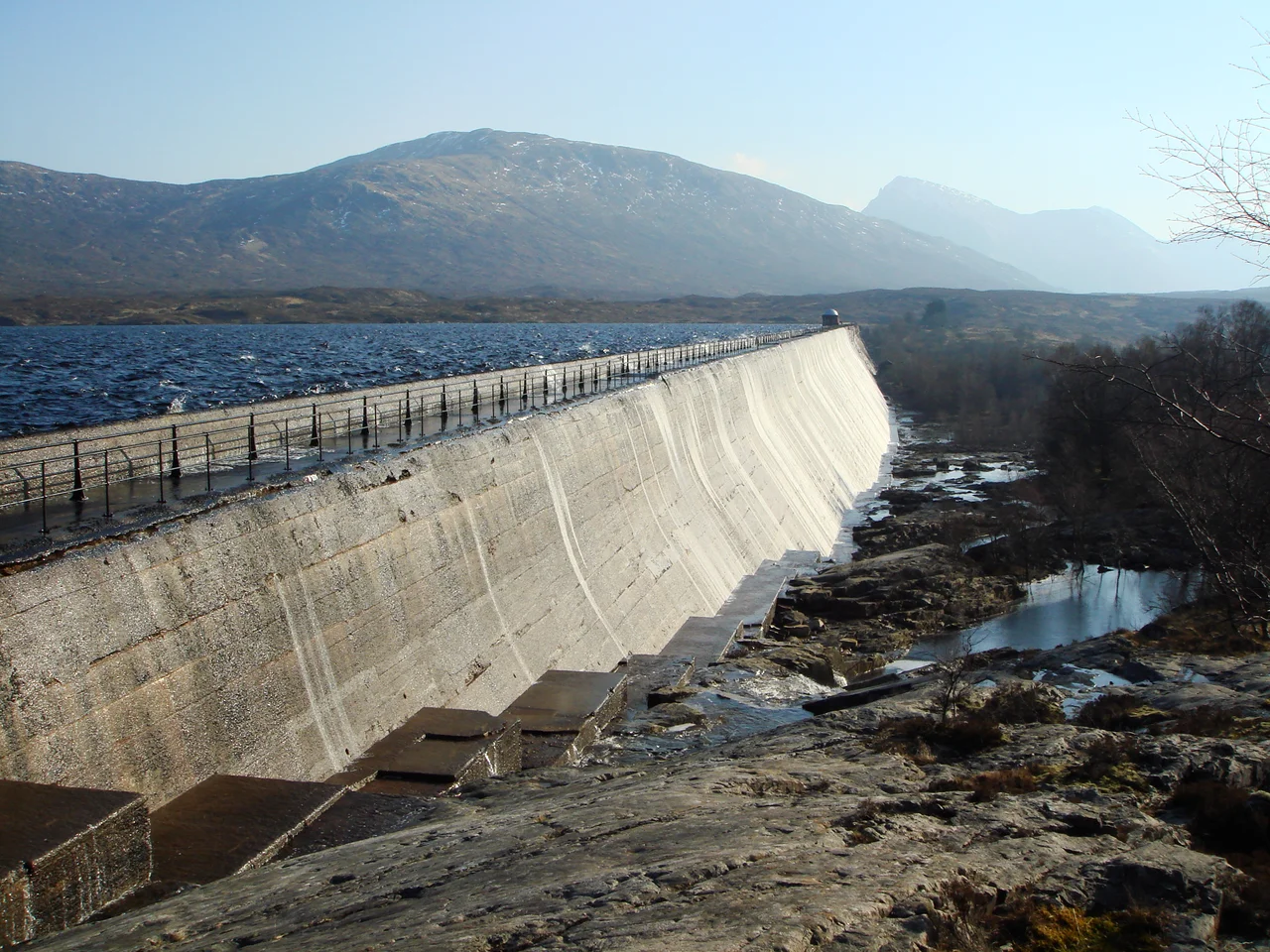

Kinlochleven Hydroelectric Scheme
Three thousand men, mostly Irish navvies, lived on the moor above Kinlochleven for four years and built a dam half a mile wide across the Blackwater. Many died in construction accidents and were buried beside the dam under concrete headstones. The scheme they finished in 1909 was the second hydroelectric installation in Scotland after the 1896 Falls of Foyers. It powered a brand-new aluminium smelter that was, on its own, larger than every other aluminium smelter in Britain combined. The smelter closed in 2000. The hydro scheme is still running.
A Dam in Difficult Country
Thomas Meik and Sons designed the scheme. Sir A R Binnie consulted. Sir John Jackson Ltd was the main contractor, with A H Roberts as resident engineer. The Loch Leven Water Power Acts of 1901 and 1904 gave them legal authority. What they had to build was a mass-concrete gravity dam over half a mile wide, 800 metres, across the main tributary of the River Leven, in an almost inaccessible upland with a catchment of sixty square miles. Water from the new Blackwater Reservoir would run downhill 935 feet through a covered concrete conduit three and a half miles long, then drop through six steel penstocks to a power house at sea level beside the smelter. Eleven Pelton wheel turbines, each coupled to two thousand-kilowatt DC generators made by Dick, Kerr & Co., would do the work. The total installed capacity was 25,725 kilowatts. Construction took roughly four years, from 1905 to 1909, and cost about £600,000, equivalent to around £60 million today.
The Navvies
Three thousand men, most of them Irish navvies, did the actual building. They lived in temporary camps on a high moor that for most of the year is brutally cold and wet. The work was dangerous. The cableway that brought materials up from a wharf on Loch Leven was strung on trestles ten to a hundred and thirty feet high, with spans of up to a thousand feet, powered by a temporary hydroelectric plant of its own. A railway with rope inclines of 200 and 600 feet ran alongside it. The conditions on the moor were squalid. Men died in accidents and were buried beside the dam, their graves marked with poured concrete headstones. The Donegal writer Patrick MacGill, who had worked at Kinlochleven as a navvy, later wrote it all into a novel called Children of the Dead End. One scene he describes, where a worker drives his pick into a buried explosive charge and dies when the metal is driven into his neck, is based on an actual incident recorded as having happened to an Inverness man in April 1908.
Prisoners of War Built the Extension
During the First World War, aluminium demand spiked. Balfour Beatty was brought in to extend the scheme by tapping Loch Eilde Mor, increasing the catchment to sixty-six square miles. The new dam and aqueduct were built by 1,200 German prisoners of war and 500 British troops of low medical category, those classified as unfit for combat. The aluminium they helped produce went into the airframes of the war their captors were still trying to win. After the armistice the prisoners were sent home. The dam they had built remained, and remains today, feeding water into the system that runs the power house in the village below.
What Powers It Now
The original eleven Pelton turbines ran for most of the twentieth century. Between 1996 and 2001 Gilkes, the Kendal engineering firm, replaced them in stages with three 10-megawatt horizontal-axis Francis turbines while the facility was still operating. The first new turbine, K1, was installed in 1996 and controlled by a programmable logic controller to maintain grid frequency. K2 and K3 followed in 1999 and 2000. A Gilkes digital speed governor controls the whole system and can run the scheme in island mode if the grid drops out. Flow to each turbine comes from two of the six original penstocks, joined at the bottom by a new Y-piece. The aluminium smelter closed in June 2000. The power house, Grade A listed since 2004, kept running and now exports power via the National Grid to the Lochaber smelter at Fort William over an upgraded 132-kilovolt line. In April 2002 the declared net capacity was downrated to 19.5 megawatts to qualify for Renewables Obligation support, which only applied to schemes under 20 megawatts. The actual output is often higher. In a week in April 2020 the scheme generated an average of 23.27 megawatts, about 3.9 gigawatt-hours total.
From the Air
The Kinlochleven hydroelectric scheme stretches across the Blackwater moor at about 56.713 N, 4.958 W in Lochaber, with Blackwater Reservoir to the east of Kinlochleven village. Recommended viewing altitude 3,000-5,000 ft AGL to see both the reservoir and the power house. Visual references: Blackwater Reservoir as a long curved ribbon at elevation in the moor north of Loch Leven, the village of Kinlochleven at the head of Loch Leven, and the Mamores ridge to the north. Nearest ICAO airport is Oban (EGEO) about 30 nm southwest; Inverness (EGPE) is the regional alternate well to the northeast. Expect rapid weather changes, severe turbulence over the Mamores, and persistent cloud on the moor.
Nearby Stories
- Falls of Cruachan derailment 3.6 km away
- River Morar 12 km away
- Morvern 12 km away
- Great Glen Way 13 km away
- Easdale 15 km away
- Ben Alder 15 km away
- Glendoe Hydro Scheme 16 km away
- Lochearnhead 18 km away