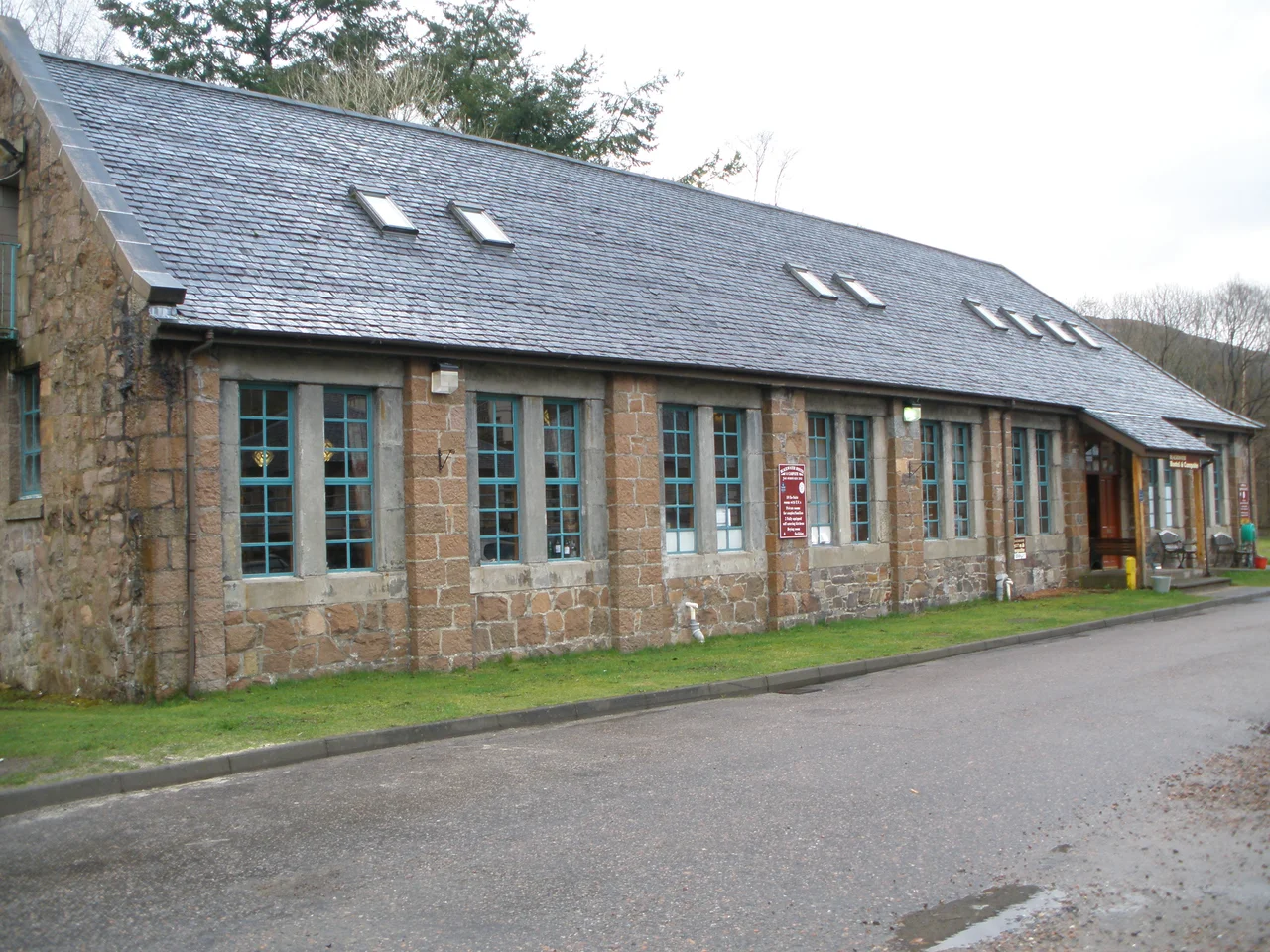

Kinlochleven
Around 1908 a small Highland village at the head of Loch Leven became the first place on Earth where every single house had electric light. It happened by accident. The British Aluminium Company needed massive amounts of electricity to run a brand new smelter, and they had just built a hydroelectric scheme on the moors above to deliver it. The houses they had thrown up for their workers were on the same circuit. So the marketing slogan The Electric Village fit Kinlochleven before anyone realised it was a first. The smelter ran until 2000. The village kept the lights on and now sells the mountains around it to climbers instead.
Two Villages Welded by a Smelter
Before 1905 there were two small communities here: Kinlochmore on the north side of the River Leven, in Inverness-shire, and Kinlochbeg on the south, in Argyll. The British Aluminium Company picked the head of the loch for its smelter because the surrounding mountains made an ideal hydroelectric site and the loch itself gave them a sea port. The dam they built was over 914 metres long, then the longest in the Highlands, holding back the Blackwater Reservoir at over 305 metres elevation. The engineers were brothers, Patrick and Charles Meik. The chief assistant resident engineer was a young William Halcrow, who later founded the engineering firm still carrying his name. Work began in 1905 and was complete by 1907. The smelter and the two villages had merged into Kinlochleven. Every house was connected to the new power.
The Aluminium Story
When the Kinlochleven smelter opened in 1909, its designed output exceeded the total annual production of every other aluminium smelter in Britain combined. At peak employment over seven hundred people worked the reduction line. The smelter was small by modern standards, but its grade of aluminium was very high, and it ran for nine decades. In 1982 the British Aluminium Company merged with Canada's Alcan to form British Alcan. In 2007, Rio Tinto bought British Alcan and rebranded it Rio Tinto Alcan. By then the writing was on the wall. The smelter's small scale could not compete with the new American plants. Closure had been announced in 1994 by the then-owners, and the lines finally went cold in June 2000. The power house kept running. A visitor centre called The Aluminium Story now tells the village how it became what it is.
Ice Factor and the West Highland Way
After the smelter closed, Kinlochleven had to reinvent itself. The West Highland Way runs straight through the village, attracting more than 85,000 walkers a year, and mountaineering as a whole contributes about £163.7 million annually to the Highland economy. In 2003 the Ice Factor opened, a major mountain activity centre incorporating the world's largest indoor ice climbing wall, a tall articulated rock wall, and one of the best competition bouldering walls in the UK. Queen Elizabeth and Prince Philip formally opened it in June 2005. The centre also acted as a staging post for walkers on the West Highland Way, with a bar, sauna, steam room, cafe and shop. Ten Munros rise into the Mamores directly above the village, with Binnein Mor the highest, and the wild mountain land around Kinlochleven exceeds the total area of all the mountain national parks in England and Wales combined. The Ice Factor closed in March 2023 after an unpaid rent dispute, then was reported as set to reopen later that year.
Children of the Dead End
Patrick MacGill worked on the Blackwater dam as a navvy and lived in the camps on the moor above. He later wrote a novel about it called Children of the Dead End. One scene draws on a real incident from April 1908, when a worker drove his pick into a rock and inadvertently struck a buried explosive charge that drove the pick into his neck and killed him. MacGill turned the men he had laboured beside into characters and the moor into a setting and the construction work itself into the novel's central drama. Kinlochleven is unusual among industrial communities for having had its working-class history recorded in literary fiction by someone who had actually pushed a wheelbarrow on the site. The brewery that opened in 2002 in the former coke bunker, now producing River Leven Ales, is in the building where the smelter once cooked its carbon anodes. Even the beer is a continuation of the industrial history.
From the Air
Kinlochleven sits at 56.713 N, 4.965 W at the eastern head of Loch Leven in Lochaber. Recommended viewing altitude 2,000-4,000 ft AGL. Visual references: Loch Leven as a fjord-like ribbon running west to the bridge at Ballachulish, the Mamores ridge holding ten Munros directly north of the village, and Glen Coe opening to the south. Nearest ICAO airport is Oban (EGEO) about 25 nm southwest; Inverness (EGPE) is the regional alternate well to the northeast. Expect rapid weather changes off the loch, severe turbulence over the Mamores, and orographic cloud on Bidean nam Bian to the south.
Nearby Stories
- Falls of Cruachan derailment 3.6 km away
- River Morar 12 km away
- Morvern 12 km away
- Great Glen Way 13 km away
- Easdale 15 km away
- Ben Alder 15 km away
- Glendoe Hydro Scheme 16 km away
- Lochearnhead 18 km away