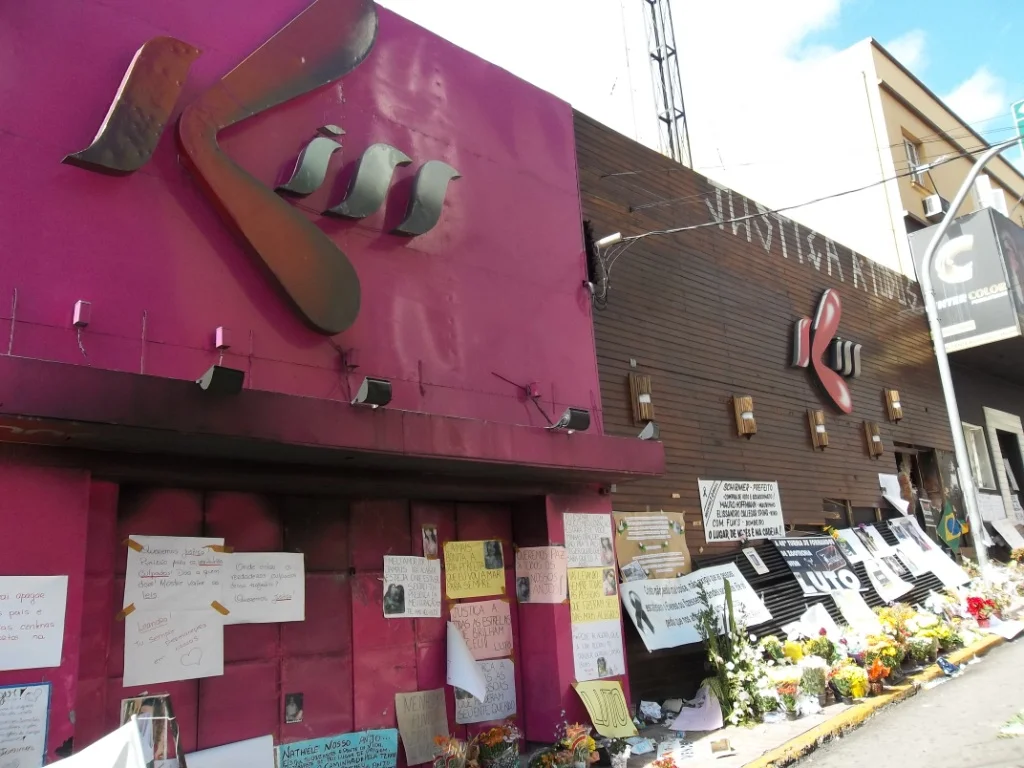

Kiss Nightclub Fire
They were mostly students, eighteen to thirty years old, out for an ordinary Saturday night that spilled past midnight into the early hours of 27 January 2013. The party at the Kiss nightclub in Santa Maria had been organized by university classmates, a freshers' celebration with live music and a crowded floor. Sometime between two and half past two in the morning, a band lit a small pyrotechnic on stage. Within minutes, 242 people would be dead and more than six hundred injured. They left behind parents who would spend years searching for answers, friends who survived and could not forget, and an entire city plunged into mourning. This is not a story of statistics. It is a story of young lives, and of the failures that ended them.
An Ordinary Saturday Night
The event was called Agromerados, put together by students from six faculties and technical courses at the Federal University of Santa Maria. Two bands were on the bill, and the club was packed, by later estimates holding between 1,200 and 1,300 people in a space built to hold no more than 700. These were students celebrating the start of a new term, the most ordinary thing in the world. Many had grown up together in this university town in Rio Grande do Sul. When the band Gurizada Fandangueira lit a flare-like pyrotechnic during their set, no one in that crowd had any reason to think the night would not end like any other, with friends spilling out into the cool air to walk home.
How a Spark Became a Catastrophe
The pyrotechnic caught the flammable acoustic foam lining the ceiling, and the fire spread with terrible speed. As the foam burned, it released toxic smoke laden with cyanide, and roughly 90 percent of those who died were killed not by flames but by what they breathed. The club had a single way in and out, the front door. There were no clear exit signs, and in the smoke and panic many people, unable to find the way they had come in, ran toward the bathrooms believing them to be exits. More than 180 people were found there. The fire commander, Colonel Guido Pedroso de Melo, told reporters the front door had been locked and that, by the information then available, security staff had at first blocked people from leaving. In the crush at that single door, scores more were hurt.
A Disaster That Did Not Have to Happen
Investigators found a chain of preventable failures behind the death toll. The club had been packed far beyond capacity. It lacked sufficient emergency exits, and the only way out was the front door. The pyrotechnics used that night were not authorized, the acoustic foam was dangerously flammable, and there was no alarm or sprinkler system. Reports indicated some fire extinguishers may have been non-functional. The fire department had nonetheless issued a permit to operate, one that wrongly stated the club had two emergency exits, prompting an investigation of the officials responsible for oversight, including city hall and the fire service itself. Every one of these gaps was a decision, or a failure to decide, and together they turned a small fire into one of the deadliest nightclub disasters the world has known, second in Brazil only to the 1961 Niteroi circus fire.
Mourning, Justice, and Memory
Brazil grieved as one. President Dilma Rousseff left a summit in Chile to be with the families and declared three days of national mourning; Santa Maria declared thirty. Across the world, players at a friendly match at Wembley wore black armbands for the dead, and Argentina sent skin grafts from its burn bank to help treat the injured. The pursuit of accountability proved long and painful. Club co-owners Elissandro Callegaro Spohr and Mauro Londero Hoffmann, along with band members Marcelo de Jesus dos Santos and Luciano Bonilha, were charged, and in December 2021, nearly nine years on, they were convicted and sentenced to between eighteen and twenty-two years; the verdict was overturned in 2022 over how the jury had been selected, reopening wounds for families still seeking justice. Then, in April 2025, Brazil's Federal Supreme Court unanimously reinstated the convictions, confirming sentences of 22 years and 6 months for Spohr, 19 years and 6 months for Hoffmann, and 18 years each for the two band members. After more than twelve years, the families had their verdict. The building stood boarded and silent, its walls covered with painted tributes, until it was demolished in 2024 to make way for a permanent memorial garden, a living place to remember the 242.
From the Air
The site of the former Kiss nightclub lies in Santa Maria, central Rio Grande do Sul, Brazil, at roughly 29.68 degrees south, 53.81 degrees west, within the city's urban grid. Santa Maria is a university town set in rolling subtropical country; from the air it reads as a compact city surrounded by farmland and low ridges. The nearest airport is Santa Maria Airport (ICAO: SBSM). Rivera's binational airport (ICAO: SURV) lies to the southwest near the Uruguayan border, and Montevideo's Carrasco International (ICAO: SUMU) farther south. The exact location is best regarded as a place of remembrance rather than a landmark; a memorial garden is planned where the building once stood.
Nearby Stories
- Battle of Ituzaingó 55 km away
- Ruins of São Miguel das Missões 90 km away
- Santa Cruz do Sul 98 km away
- Santo Ângelo 121 km away
- São Lourenço Mártir Archaeological Site 130 km away
- Passo Fundo 158 km away
- Bagé 162 km away
- 2009 Brasil de Pelotas Bus Disaster 182 km away