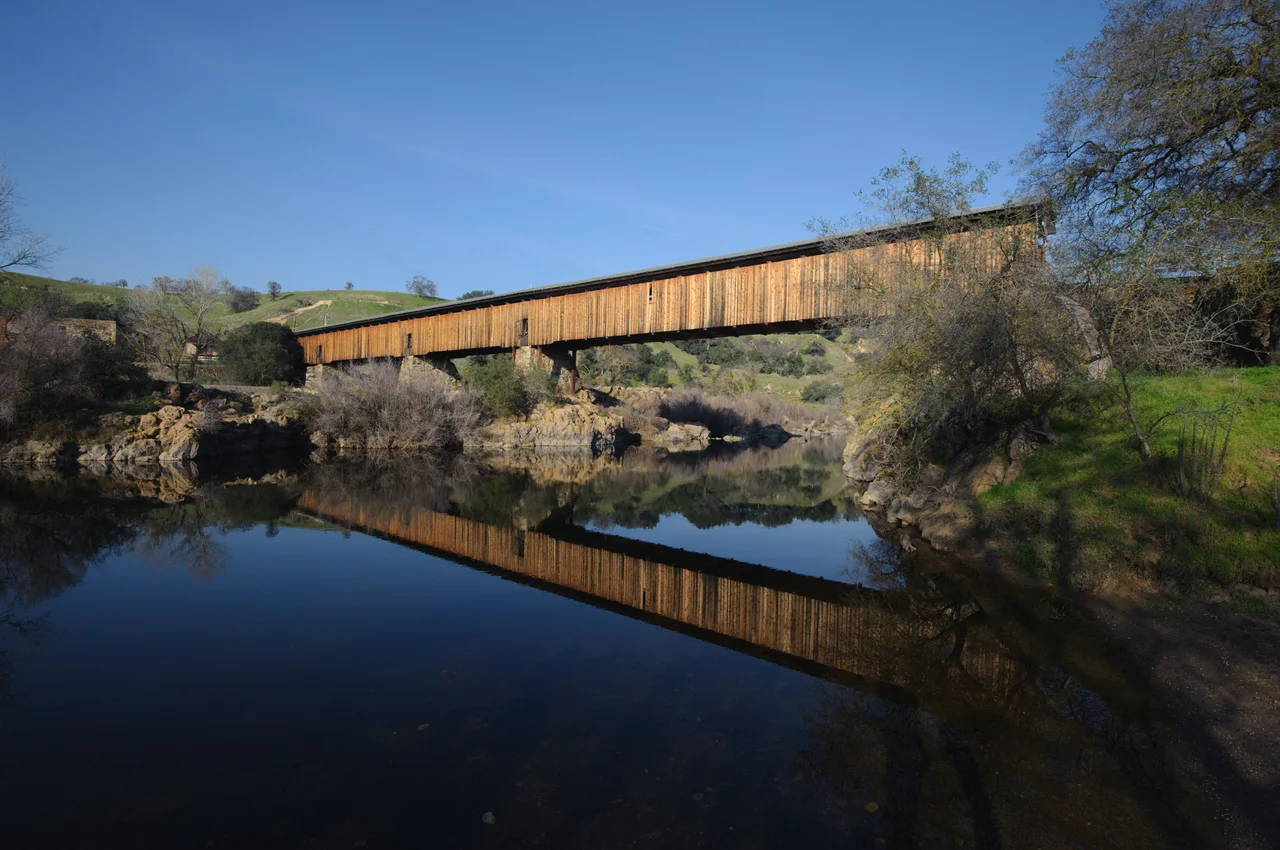

The Covered Bridge That Outlasted Everything
Floods destroyed its predecessor. Time claimed the ferry that came before that. The Gold Rush town around it lost the county seat, the railroad, and most of its population. But the Knight's Ferry Bridge still stands, its wooden trusses and wrought iron rods spanning the Stanislaus River just as they did in 1863. At nearly 379 feet long, it is one of the longest covered bridges west of the Mississippi and one of the best-preserved examples of 19th-century Howe truss engineering in the United States. The bridge earned National Historic Landmark status in 2012, a recognition that places it among a handful of covered bridges considered nationally significant.
Born from Catastrophe
The bridge exists because of disaster. In 1852, a toll bridge replaced the original ferry crossing that Dr. William Knight had established during the Gold Rush. For a decade, that bridge carried miners, ranchers, and freight wagons across the Stanislaus River. Then came the Great Flood of 1862, the most devastating flood event in California's recorded history. Weeks of continuous rain transformed the Central Valley into an inland sea, and the toll bridge at Knights Ferry was swept away. When the community rebuilt in 1863, they built higher, stronger, and with a covered design to protect the wooden structure from future weather. That decision to shelter the bridge's timber framing from the elements is the primary reason it survived while so many other 19th-century bridges rotted and collapsed.
Anatomy of a Howe Truss
The bridge's engineering tells a story of American ingenuity at a crossroads between wood and iron. A Howe truss uses diagonal wooden compression members braced by vertical wrought iron tension rods, a hybrid approach patented by William Howe in 1840. At Knight's Ferry, the trusses are formed from wooden planks bolted together, with iron rods pulling the structure tight and iron bearing blocks joining the connections. Four spans rest on stone abutments and piers that anchor the bridge at both banks and at intermediate points in the river. The exterior is sheathed in vertical board siding beneath a metal roof. One span even crosses a historic millrace on the north bank, a reminder that the river here was harnessed for milling as well as crossing. The entire assembly is a textbook example of mid-19th-century bridge construction, preserved with unusual completeness.
A Bridge That Carried Generations
For over a century, the Knight's Ferry Bridge was a working crossing. Wagons carried grain from the surrounding foothills. Automobiles eventually replaced the wagons, and the bridge adapted. It continued to carry car traffic well into the 20th century, an astonishing run for a wooden structure built during the Civil War. In 1985, the bridge was finally closed to vehicles to prevent further damage. By then, it had served as a road for 122 years. Walking through it today, the interior is dim and cavernous, light filtering through gaps in the siding. The wooden planks underfoot are worn smooth by more than a century of passage. Outside the covered portal, the Stanislaus River runs clear and cold, its water released from New Melones Dam upstream.
Last of Its Kind
Covered bridges were once common across the American landscape. Thousands were built in the 19th century, their roofs and walls designed not for quaintness but for structural survival. Exposed wooden bridges lasted about twenty years before rot weakened them beyond repair. A covered bridge, protected from rain and direct sun, could last indefinitely with basic maintenance. Despite this advantage, most covered bridges fell to floods, fires, modernization, or neglect. Of the hundreds that once existed in California, only a small number remain. Knight's Ferry Bridge stands out even among survivors because of the completeness of its original fabric. The stone piers, the iron hardware, the wooden trusses, the siding, and the roof all retain their 1863 character to an unusual degree. It is this integrity, as much as its age, that earned the bridge its National Historic Landmark designation.
From the Air
Knight's Ferry Bridge spans the Stanislaus River at 37.8197N, 120.6639W in the Sierra Nevada foothills east of Modesto. The covered bridge is visible from low altitude as a long, narrow, roofed structure at the eastern edge of the small community of Knights Ferry. The modern Sonora Road bridge runs parallel just downstream. Best viewed at 1,000-2,000 feet AGL. The nearest major airport is Modesto City-County Airport (KMOD), approximately 25 nautical miles west. Oakdale Municipal Airport is closer at roughly 15 nautical miles west. The Stanislaus River canyon and surrounding oak-studded foothills provide clear visual reference points.
Nearby Stories
- Groveland and Big Oak Flat 4.6 km away
- Cleveland Elementary: The Shooting That Changed the Law 11 km away
- The River That Nobody Dammed 18 km away
- The Fifty-Dollar Ghost 19 km away
- Camanche Reservoir 23 km away
- Gold from the Sky Over Gold Country 23 km away
- Mount Hamilton (California) 44 km away
- Bodie Ghost Town 107 km away