
Cleveland Elementary: The Shooting That Changed the Law
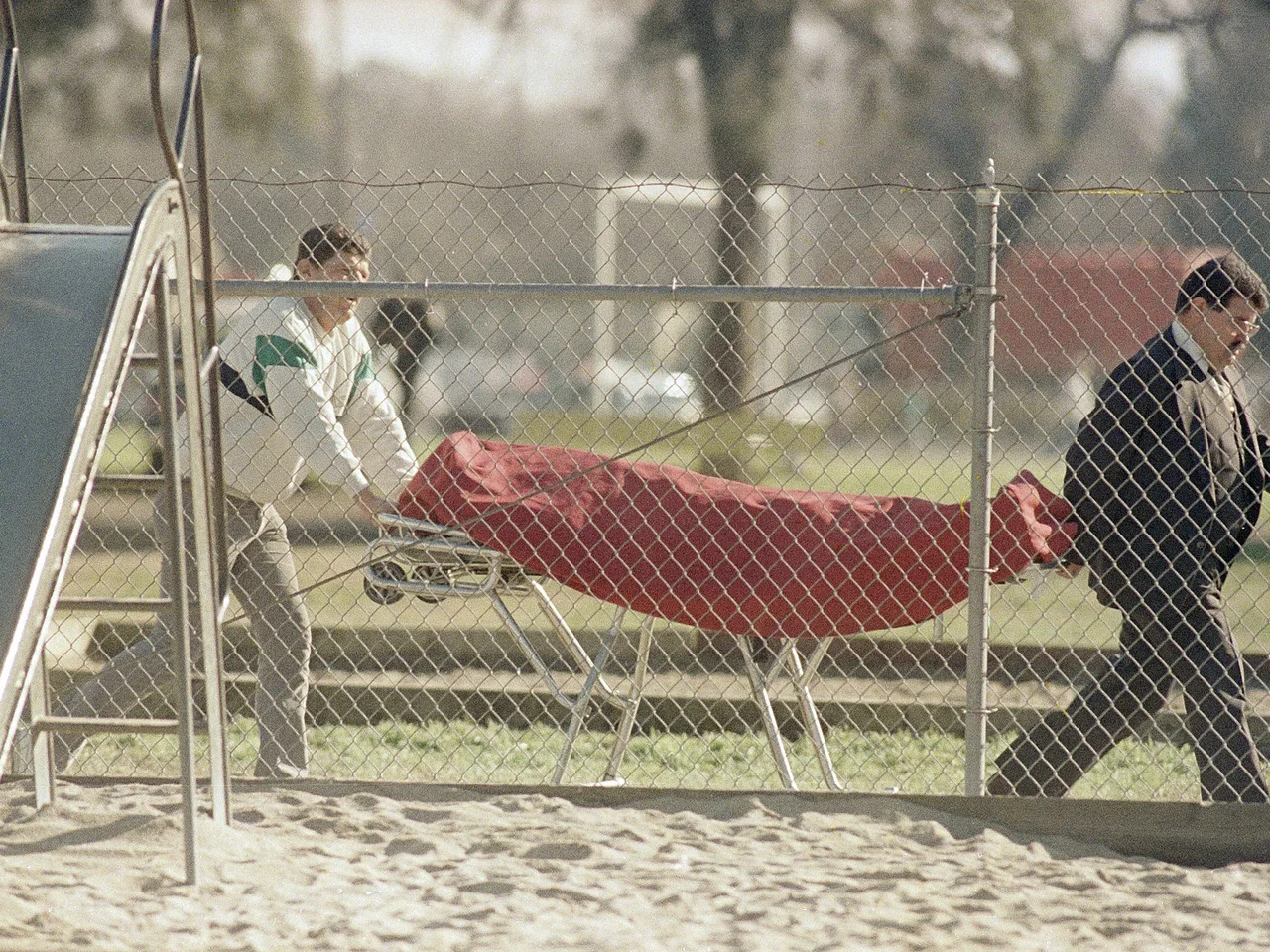
The five children killed at Cleveland Elementary School on January 17, 1989, had already survived more than most adults endure in a lifetime. Their families had fled war and persecution in Southeast Asia -- Cambodia, Vietnam -- crossing oceans to reach the Central Valley of California. Some of the children had been born in refugee camps. They arrived in Stockton, enrolled in school, and began the ordinary work of growing up in a new country. That ordinariness ended in approximately three minutes, the time it took a single gunman to fire 106 rounds into a playground full of children during morning recess.
Three Minutes on the Playground
At approximately 11:40 a.m. on a Tuesday, Patrick Purdy parked a battered 1977 Chevrolet Caprice station wagon behind Cleveland Elementary School. He had placed a Molotov cocktail and two open gasoline containers inside the vehicle; within minutes it would detonate and burn, a diversion or a statement -- investigators were never fully certain which. Purdy entered the school grounds through a rear gate carrying a semi-automatic rifle with a fixed bayonet and two handguns. Roughly 300 children were on the playground. He positioned himself behind a portable building and opened fire, sweeping left to right. A teacher who witnessed the attack recalled that Purdy was expressionless -- "not talking, not yelling, very straight-faced" -- as he fired 66 rounds in his first salvo from about 50 yards. He then moved to a different vantage point, reloaded, and fired the remaining 40 rounds at fleeing children before taking his own life. Emergency responders reached him at 11:50 a.m.
The Children
Rathanar Or was nine years old. Ram Chun was six. Thuy Tran was six. Sokhim An was six. Oeun Lim was eight. All five had families who had emigrated from Southeast Asia; at least one had been born inside a refugee camp. Thirty other children and one teacher, Janet Geng, were wounded. Although the injured included children of all races, more than two-thirds were of Southeast Asian ancestry -- a fact that would later raise questions about the gunman's motivations. Geng, who was shot in the upper leg while running to help wounded children, survived and went on to found the Children's Museum of Stockton before her death in 2005. Six-year-old Robert Young, hit in the foot and chest by a bullet and a ricochet, would later recall the sensation of his feet being "swept up" as the first round struck.
A Community Mourns Across Faiths
On January 23, 1989, more than 2,000 people gathered at the Stockton Civic Center for a two-hour multifaith memorial service. Many attendees wore black and white ribbons -- a traditional Cambodian gesture of mourning. Four flower-draped caskets rested at the front of the hall. The service concluded with five minutes of silence, one for each child. The funerals that followed reflected the breadth of the community's spiritual life: Buddhist rituals for Oeun Lim and Rathanar Or, Baptist services for Sokhim An and Ram Chun. Thuy Tran had already been laid to rest two days earlier in a Roman Catholic burial following Mass. Christian hymns were sung alongside Buddhist prayers. It was, in its grief, an image of the very diversity that had made Cleveland Elementary what it was -- a school where the children of refugees and immigrants and longtime residents learned side by side.
The Law That Followed
The Stockton shooting ignited a national debate over assault weapons that had been smoldering for years. Within four months, California Governor George Deukmejian signed the Roberti-Roos Assault Weapons Control Act of 1989, which banned the ownership and transfer of more than fifty specific models of semi-automatic weapons in the state. It was the first legislation of its kind in the United States. The law did not end the debate -- it intensified it. But the speed of its passage reflected something about the particular horror of Cleveland Elementary: the victims were small children, the weapon was military-style, and the attack lasted just three minutes. At the time, it was the deadliest shooting at a non-college school in American history, a grim distinction it held for a decade until Columbine in 1999. It remained the deadliest attack on an American elementary school until Sandy Hook in 2012.
What Remains
Cleveland Elementary School still operates today, serving the same working-class neighborhood in south Stockton where those five children died. The school was renamed and then, after community protest, given back its original name. A memorial stands on the grounds. Survivors have spoken publicly about the long aftermath -- the nightmares, the difficulty of returning to the playground where it happened, the way a sound or a smell can snap them back to that Tuesday morning. The Southeast Asian communities of Stockton's south side have continued to grow, their presence a living answer to the hatred that motivated the attack. The children who survived Cleveland Elementary are now in their forties, some with children of their own who attend schools in the same district. The shooting is no longer the deadliest of its kind, but for Stockton it remains the defining wound -- the day that proved even a schoolyard is not safe enough.
From the Air
Located at 37.98°N, 121.30°W in south Stockton, California. The school is in a dense residential neighborhood in the southern part of the city, east of Interstate 5 and south of the downtown core. Stockton Metropolitan Airport (KSCK) is approximately 5 miles to the south. The Central Valley landscape is flat agricultural land stretching in all directions, with the Sacramento-San Joaquin Delta to the west and Sierra Nevada foothills visible to the east. Best observed from 2,000-3,000 feet AGL; the school campus is identifiable among surrounding residential blocks.
Nearby Stories
- Port Chicago: The Explosion That Desegregated a Navy 3.3 km away
- The Last Lakes in the Valley 5.6 km away
- From Aluminum to Ammunition to Aviation Fuel 8.6 km away
- Altamont Free Concert 10 km away
- Gold Country 15 km away
- United Air Lines Flight 615 20 km away
- The Night Napa Burned 23 km away
- Knights Ferry: Murder, a President's Brother, and the Town That Refused to Disappear 36 km away