
Knights Ferry: Murder, a President's Brother, and the Town That Refused to Disappear
Dr. William Knight founded the town that bears his name in 1849. He was dead before the year was out. Knight had established a ferry crossing on the Stanislaus River, a spot he and John C. Fremont had identified years earlier as a favorable place to ford. The ferry prospered quickly -- Gold Rush traffic guaranteed that. Knight and Captain James Vantine built a hotel and trading post near the crossing, and for a few months, everything was going well. Then, on November 9, 1849, Knight was killed in a gunfight. His family believed the official story was a cover: they maintained he had been stabbed to death in his bed. Either way, the Dent brothers -- John and Lewis -- immediately took possession of Knight's property. The town kept his name anyway.
The Dent Brothers and a Presidential Connection
John and Lewis Dent were not ordinary opportunists. Their sister Julia had married a young army officer named Ulysses S. Grant. After Knight's death, Captain Vantine operated the ferry alone until partnering with the Dent brothers. By 1852, Vantine sold his remaining interests to the Dents and moved on. John Dent laid out a new townsite and tried to rename it Dentville. The inhabitants refused. Knights Ferry and Knights Crossing were the names that stuck. Grant himself visited Knights Ferry in 1852, when he was an army captain stationed at posts in Benicia and Eureka. He stayed in the Lewis Dent House, built in 1851, which still stands as the oldest home in the community. A future president walked these streets when the town was barely three years old and California was not yet a decade into statehood.
Flood, Bridge, and the Rise and Fall of a County Seat
In 1852, a toll bridge replaced Knight's original ferry. For a decade it served the growing community. Then the Great Flood of 1862 destroyed it, along with much of the infrastructure in California's Central Valley. The replacement covered bridge, built in 1863 at a higher elevation, still stands -- at 330 feet, the longest covered bridge west of the Mississippi and a National Historic Landmark since 2012. That same year, 1862, Knights Ferry became the Stanislaus County seat, replacing La Grange. The honor was short-lived. When the railroad bypassed Knights Ferry in favor of a new boomtown called Modesto, the county seat followed in 1871. It was a blow from which the town never fully recovered in population, though what it lost in size it gained in preservation. Without the pressure of growth, buildings from the 1850s and 1860s survived.
Sandstone, Wells Fargo, and a General Store from 1852
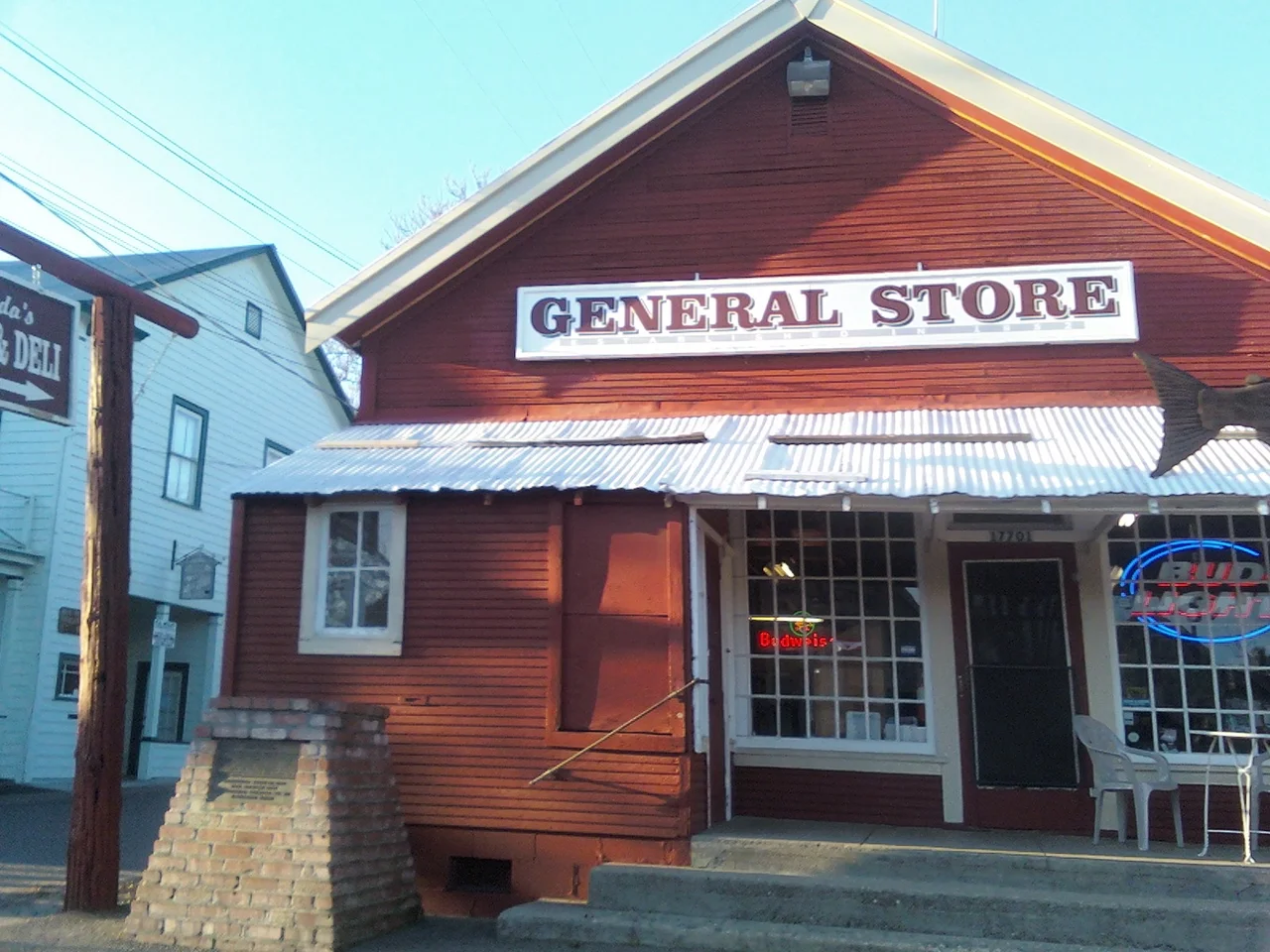
The Knights Ferry Historic District reads like a timeline of Gold Rush California. The Abraham Schell House, built in 1856 from locally quarried sandstone, was home to the owner of Rancho del Rio Estanislao. Millers Hall, constructed in 1863, operated as a restaurant, pool parlor, and poker hall downstairs with a dance hall above -- it was restored in 1984 and now houses the post office, community library, and an ice cream parlor. The Knights Ferry Community Church dates to 1890 but preserves the original 1860 pews, altar, and upper windows. Most remarkably, the general store built in 1852 by Moulton and Drew -- the second structure erected in the town -- still operates as California's oldest general store. George Valpey bought it and became the town's Wells Fargo agent in 1867.
River, Ranch, and the Ponderosa
The Stanislaus River remains the life of Knights Ferry. Downstream from the covered bridge, the Knights Ferry Recreation Area offers Class I-II whitewater rafting from April through October. The water runs clear and cold year-round, discharged from the base of New Melones Dam upstream. Beyond the river, the surrounding foothills carry their own history. The Willms Ranch, California Historical Landmark number 415, has been in the same family since John R. Willms and John H. Kappelmann arrived in 1849 and built a 3,600-acre spread bearing the first cattle brand registered in Stanislaus County. The ranch landscape attracted Hollywood as well: the nearby Williams Ranch served as a filming location for both Bonanza and Little House on the Prairie. Vertebrate fossils from the Pliocene epoch have been found near the town, a reminder that this river crossing has been significant for far longer than human memory.
From the Air
Knights Ferry sits at 37.8197N, 120.6644W in the Sierra Nevada foothills, about 30 miles east of Modesto. From the air, the community is identifiable by the narrow covered bridge spanning the Stanislaus River at the town's eastern edge, with the modern Sonora Road bridge just downstream. The river corridor and surrounding oak woodlands are visible at low altitude. Nearest airports include Modesto City-County Airport (KMOD, approximately 25 nm west) and Oakdale Municipal Airport (closer, roughly 15 nm west). The area is typically clear with good visibility, though summer haze from the Central Valley can reduce contrast.
Nearby Stories
- Groveland and Big Oak Flat 4.6 km away
- Cleveland Elementary: The Shooting That Changed the Law 11 km away
- The River That Nobody Dammed 18 km away
- The Fifty-Dollar Ghost 19 km away
- Camanche Reservoir 23 km away
- Gold from the Sky Over Gold Country 23 km away
- Mount Hamilton (California) 44 km away
- Bodie Ghost Town 107 km away