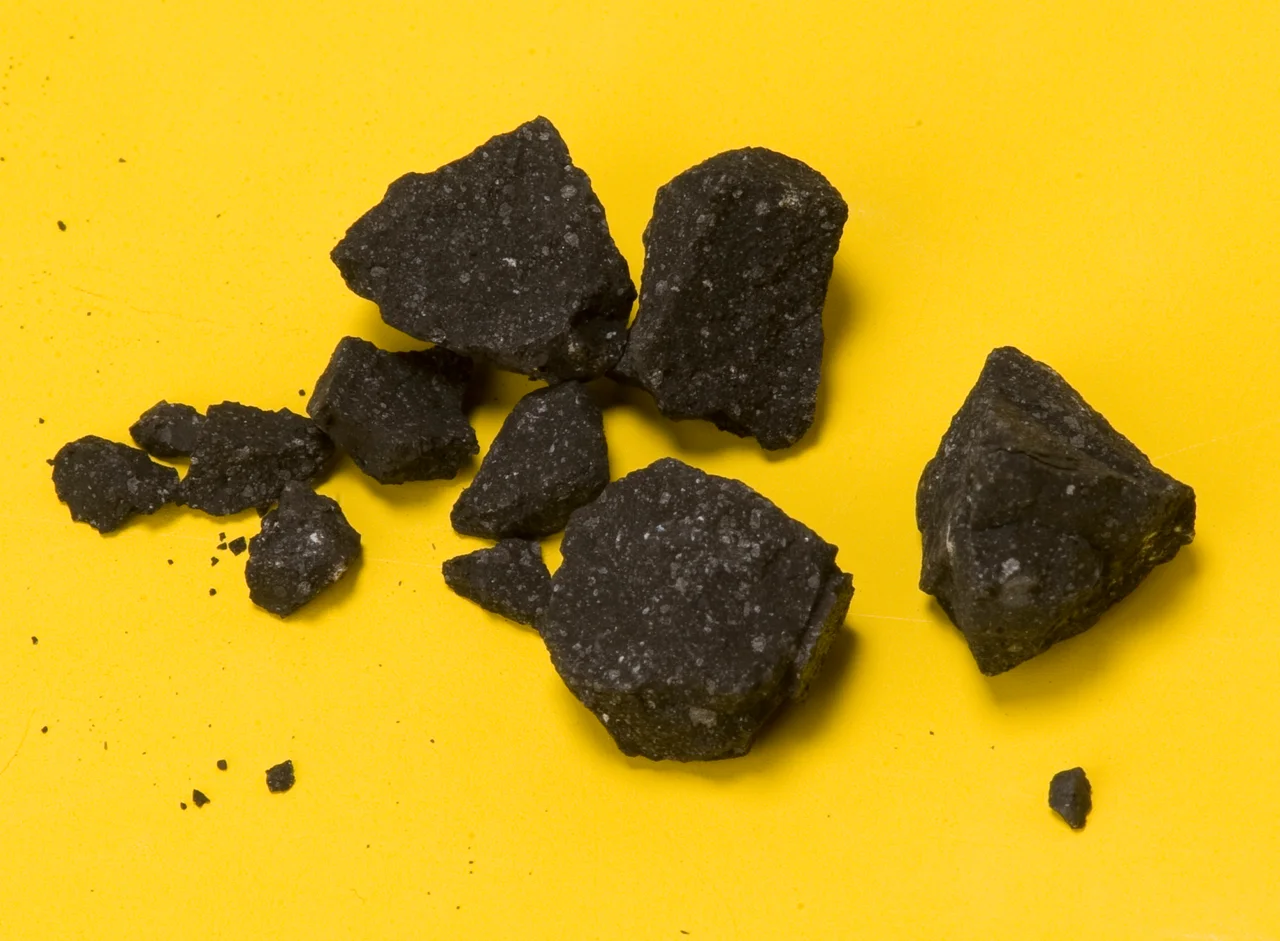

Gold from the Sky Over Gold Country
At 7:51 on a Sunday morning in April 2012, the sky over the Sierra Nevada foothills ripped open. A fireball brighter than the sun streaked across northern California and Nevada, trailing smoke and shedding fragments as it decelerated from 64,000 miles per hour. The sonic boom that followed rattled buildings from Sacramento to Reno. When the pieces were found scattered across the hills near Coloma, scientists realized the cosmic intruder had landed in one of the most symbolically loaded landscapes in American history: the same stretch of Gold Country where James Marshall's 1848 discovery at Sutter's Mill launched the California Gold Rush. This time, the treasure falling from the sky was far older than gold.
The Fastest Fireball on Record
The meteoroid that became the Sutter's Mill meteorite entered Earth's atmosphere at approximately 28.6 kilometers per second, making it the fastest fireball on record from which meteorites were subsequently recovered. It detonated with the energy of roughly four kilotons of TNT, equivalent to a small nuclear weapon. The breakup began at an altitude of 48 kilometers, the highest such event ever to produce recoverable fragments on the ground. Doppler weather radar stations captured the falling debris in real time, creating a map of the strewn field that would guide recovery teams in the days ahead. The bolide arrived during the annual Lyrid meteor shower, but this was no wisp of cometary dust burning up harmlessly. This was a chunk of rock roughly the size of a minivan, and it had announced itself with a boom heard across two states.
Pieces Older Than the Sun
What made the Sutter's Mill meteorite extraordinary was not its dramatic entry but what it was made of. Analysis classified it as a CM-type carbonaceous chondrite regolith breccia, a type of meteorite that preserves some of the oldest and most primitive material in the solar system. Fragments recovered before the first rains contained clay and carbonate minerals that had formed through contact with water somewhere in deep space, billions of years ago. Scientists found amino acids, the building blocks of proteins, embedded in the stone. NASA's Ames Research Center discovered 10-micron diamond grains within the matrix, tiny crystals forged by ancient collisions in the asteroid belt. The meteorite became a scientific gold mine, used to test sample collection and analysis procedures for NASA's OSIRIS-REx mission, which would later return samples from the asteroid Bennu.
The Hunt Across the Foothills
Meteor astronomer Peter Jenniskens of the SETI Institute led the recovery effort, piecing together eyewitness reports, photographs, and radar signatures to map the meteorite's trajectory and likely landing zones. The strewn field stretched across the oak-studded foothills around Coloma, Lotus, and the South Fork of the American River. Professional scientists and amateur meteorite hunters fanned out across the landscape, searching roadsides, parking lots, and forest floors. Each fragment received a Sutter's Mill designation number, with its GPS coordinates carefully recorded to preserve information about where it had sat within the original meteoroid. On May 3, NASA and SETI scientists even deployed an airship over the strewn field to scan for impact scars from above. The rapid recovery was critical: rain degrades carbonaceous chondrites quickly, dissolving the delicate organic compounds that make them scientifically priceless.
Lightning Strikes Twice in Gold Country
The irony of the landing site was impossible to ignore. Sutter's Mill, where the California Gold Rush began in January 1848, sits in the heart of the strewn field. The discovery that transformed California and drew hundreds of thousands of fortune seekers west was a chance encounter with precious metal in a riverbed. A century and a half later, another chance encounter deposited fragments of extraterrestrial rock across the same terrain, and a new kind of prospector arrived. This time the searchers carried GPS units instead of gold pans, and the treasure they sought was measured in grams rather than ounces. But the impulse was the same: something rare and valuable had fallen from the sky, scattered across the landscape, and people came to find it. The Sutter's Mill meteorite now resides in collections and laboratories around the world, yielding secrets about the origins of the solar system, one fragment at a time.
From the Air
The Sutter's Mill meteorite strewn field is centered near 38.80°N, 120.90°W, in the Sierra Nevada foothills near Coloma, California. However, the meteorite's Wikipedia coordinates place it at 37.60°N, 120.50°W. From the air, the Coloma area is marked by the South Fork of the American River winding through oak-covered hills. Marshall Gold Discovery State Historic Park is visible along the riverbank. Cameron Park Airport (O61) is approximately 15 nm to the west; Placerville Airport (PVF) is about 8 nm south. Best viewed at 3,000-5,000 ft AGL to appreciate the terrain where fragments were recovered.
Nearby Stories
- The Curve Over the Canyon 5.8 km away
- Camp Mather 9.9 km away
- Twelve Thousand Bolts 10 km away
- Coarsegold, California 16 km away
- Merced National Wildlife Refuge 22 km away
- The Spinach Riot 35 km away
- The Man Who Auctioned a Sack of Flour Across America 59 km away
- Salinas and Steinbeck Country 91 km away