
The Man Who Auctioned a Sack of Flour Across America
It started as a joke. In 1864, in the silver-mining boomtown of Austin, Nevada, a grocer named Reuel Colt Gridley bet a friend on a mayoral election. The terms were simple: the loser would carry a fifty-pound sack of flour through the streets of town. Gridley lost. He hoisted the sack onto his shoulder, the town band struck up a march, and a crowd gathered to watch him trudge through Austin in good-humored defeat. At the end of the parade, someone suggested auctioning the flour off for charity. The winning bidder paid $250 -- and then handed the sack back. Gridley auctioned it again. And again. By the time he stopped auctioning that single sack of flour, he had raised more than $250,000 for the United States Sanitary Commission, the Civil War equivalent of the Red Cross. His old schoolmate Mark Twain made sure the story was never forgotten.
A Schoolboy from Hannibal
Reuel Colt Gridley was born on January 23, 1829, and grew up in Hannibal, Missouri -- the same small town on the Mississippi where a boy named Samuel Clemens was forming the observations that would make him Mark Twain. The two were schoolmates, though their paths diverged sharply after childhood. Gridley fought in the Mexican-American War, then drifted west with the tide of prospectors and opportunists washing toward the Pacific. By the early 1860s, he had landed in Austin, Nevada, a mining town in Lander County that had sprung up around a silver strike in the Toiyabe Range. Gridley did not mine silver. He opened a grocery store, the kind of practical business that thrives wherever miners spend their earnings on beans and coffee. He was, by all accounts, a convivial man -- the sort who made bets on elections and paid up cheerfully when he lost.
The Bet That Became a Movement
The 1864 Austin mayoral race pitted a Republican against a Democrat, and Gridley backed the Democrat. His Republican friend proposed the wager: the loser carries a fifty-pound sack of flour through town. When Gridley's candidate lost, he shouldered the flour and paraded through Austin's dusty streets to the accompaniment of the town band. The spectacle drew a crowd, and the crowd's enthusiasm generated an idea. Someone suggested auctioning the sack to benefit the Sanitary Fund, a newly established organization providing medical care to wounded Union soldiers. The first buyer paid $250, then donated the flour back for re-auction. The cycle repeated until Austin had contributed over $8,000 -- an extraordinary sum from a town of miners. Word reached nearby Virginia City, where a young newspaper editor named Mark Twain was working at the Territorial Enterprise. Virginia City invited Gridley to bring his flour sack. He obliged, and the phenomenon grew.
Coast to Coast with Fifty Pounds of Flour
Gridley took his sack of flour on the road. In San Francisco, bidders contributed $2,800. Sacramento raised $10,000. He traveled to St. Louis, then on to the major cities of the East Coast, auctioning the same sack at every stop. The genius of the stunt was its absurdity -- the flour itself was worth almost nothing, and everyone knew it. What people were buying was the story, the joke, the communal act of generosity dressed up as a carnival. Each new city tried to outdo the last. The cumulative total climbed past $170,000 in the eastern cities alone. Within twelve months, Gridley's sack of flour had raised more than $250,000 for the United States Sanitary Commission, which used the funds to supply hospitals, organize medical transport, and provide care for the tens of thousands of soldiers wounded in the final brutal year of the Civil War.
A Story Twain Could Not Resist
Mark Twain immortalized the flour sack saga in his 1872 book Roughing It, the sprawling memoir of his years in the American West. Twain had witnessed the Virginia City auction firsthand, and the episode was exactly the kind of tale he loved -- democratic, ridiculous, and quietly heroic. In Twain's telling, the sack of flour became a symbol of the mining frontier's peculiar generosity: a place where fortunes were made and lost overnight, where men who had nothing last week might bid lavishly this week, and where a practical joke could transform into an act of genuine patriotism. The passage cemented Gridley's name in American literary history, ensuring that a small-town grocer's lost bet would be remembered long after the mines of Austin played out.
What Remains in Stockton
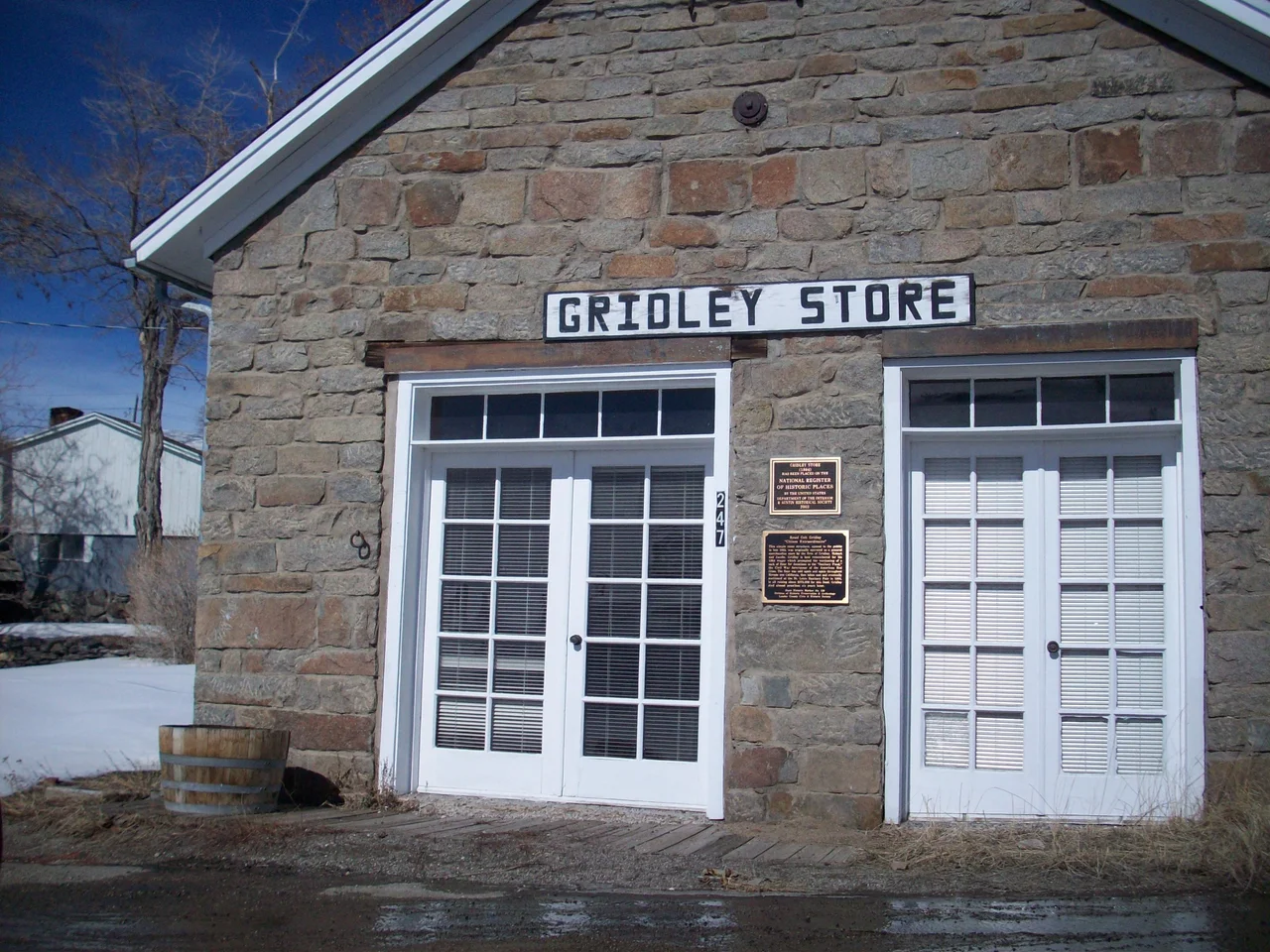
The fame did not translate into fortune for Gridley himself. In 1866, he moved to Stockton, California, already in declining health. He died on November 24, 1870, at the age of forty-one. The man who had raised a quarter-million dollars for others left little for his own family. In 1887, a monument was dedicated in Stockton's Rural Cemetery depicting Gridley standing beside a large sack of flour. California registered it as a historical landmark in 1965. Back in Austin, Nevada -- now a near-ghost town in the empty reaches of Lander County -- Gridley's store still stands, placed on the National Register of Historic Places in 2003. The building is modest, the kind of wooden-fronted storefront that once lined every mining town in the West. It gives no outward sign that it was the starting point for one of the most inventive charitable campaigns in American history, born from a lost bet, a bag of flour, and the willingness of a grocer to be the butt of a joke.
From the Air
The Reuel Colt Gridley Monument is located in Stockton, California, at approximately 37.98°N, 121.29°W. From the air, Stockton sits in the flat Central Valley at the head of the San Joaquin River's deep-water channel, visible as a grid of streets surrounded by agricultural land. The Rural Cemetery is in the older part of the city. Gridley's original store stands in Austin, Nevada (39.49°N, 117.07°W), a remote near-ghost town in Lander County along U.S. Route 50 -- the 'Loneliest Road in America.' Nearest airports to Stockton include Stockton Metropolitan Airport (KSCK). For Austin, the nearest paved airstrip is at Battle Mountain (KBAM, approximately 70 nm northwest). Best viewed at 2,000-4,000 feet AGL.
Nearby Stories
- Rancho Seco Recreational Park 2.5 km away
- The Ditch That Made Sacramento a Seaport 9.1 km away
- New Melones Dam 13 km away
- New Don Pedro Dam 18 km away
- From Aluminum to Ammunition to Aviation Fuel 19 km away
- Wings Mended: The California Raptor Center 24 km away
- Niles Canyon Railway 31 km away
- Donner Pass 113 km away