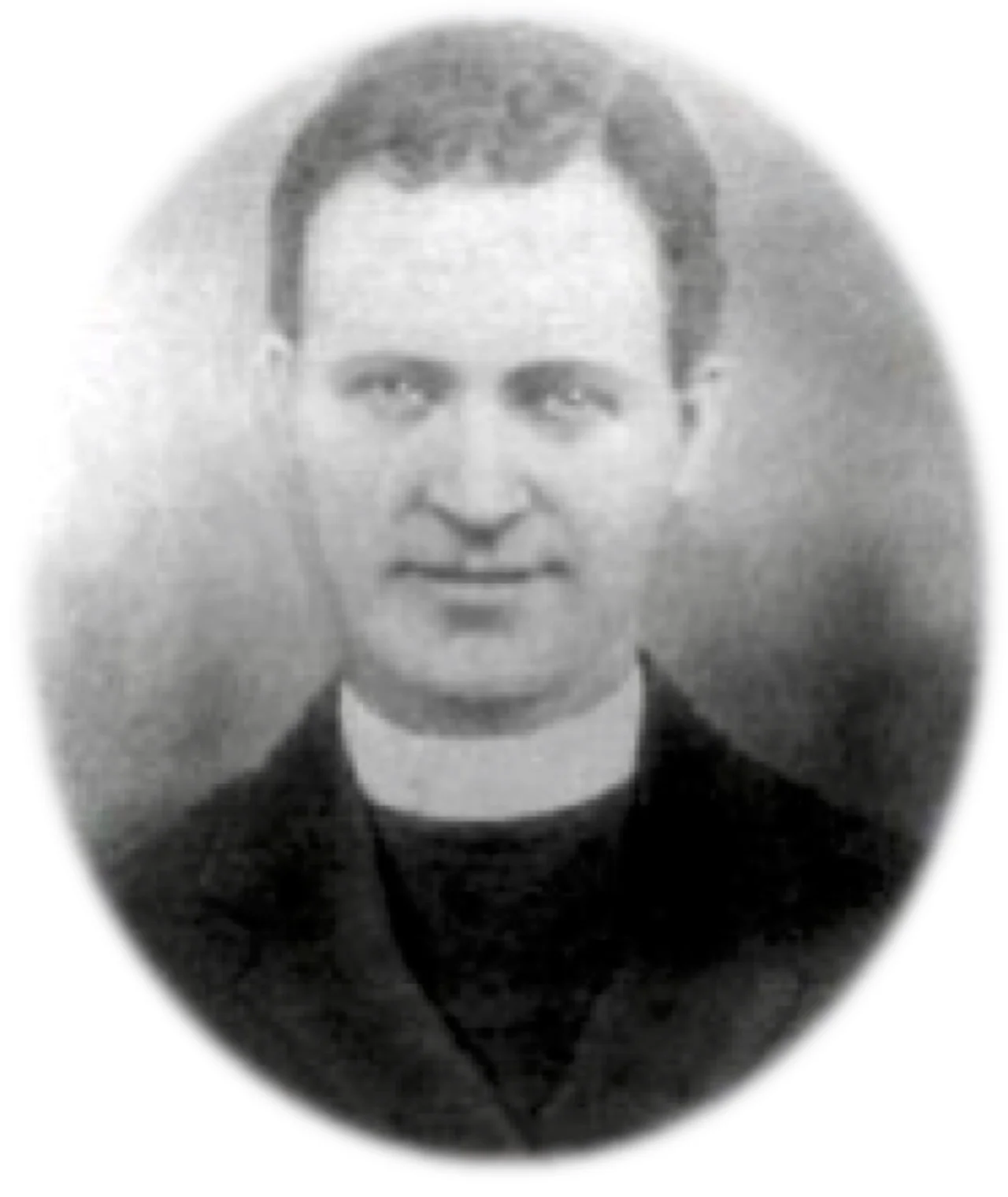

Knights of Saint Columbanus
Eamon de Valera, the most powerful Catholic in twentieth-century Ireland, told the Fianna Fail Ard-Fheis in 1943 that maintaining "an organization for the protection of Catholic interests" in a country where ninety-three percent of the population were already Catholics was "absurd." He was referring, without quite naming it, to the Knights of Saint Columbanus - the fraternal order founded in Belfast in 1915 by a parish priest who had watched Catholics hanged in effigy from buildings in his neighbourhood. De Valera tried, on more than one occasion, to get his ministerial colleagues to resign their membership. They did not always listen.
Belfast, 1915
Canon James Kearney O'Neill of Ballycastle, County Antrim, was parish priest of the Sacred Heart in industrialised Belfast in the early years of the twentieth century. The city was rough on Catholics. Local government in Belfast at the time was entirely Protestant and Unionist; effigies of Catholics were sometimes hung from buildings during what would later be called the Belfast Pogroms; working-class Catholic families had no friend in the corridors of municipal power. O'Neill, deeply influenced by Pope Leo XIII's 1891 encyclical Rerum Novarum (which condemned both unbridled capitalism and revolutionary socialism and encouraged Catholic workers to organise), began arranging regular meetings in his parish where the social teachings of Leo XIII and Pius X could be discussed and applied. The Order was formally announced in the Irish Catholic on 10 April 1915. Within a year four primary councils had formed in Belfast; within a few more, councils existed in Armagh, Cork, Derry, Dublin, Lurgan, Newry, and Portadown. O'Neill died on 18 March 1922 and was buried at Ballyvoy. The Order still holds an annual Mass at his grave.
Ely Place
From its Georgian clubhouse at Ely Place in Dublin, the Order spread out into Irish public life with what one academic study, Church, State and Social Science in Ireland, called "the Irish organisation most durably associated with combating Catholic economic subordination." The founding aim was real: in the wake of independence, Catholic-owned businesses, Catholic professionals, and Catholic candidates for civil service appointments had to push past long-standing Protestant networks for hiring and promotion. The Knights provided an alternative network. They also, less innocuously, became enmeshed with Archbishop John Charles McQuaid - the Catholic Primate of Ireland from 1940 to 1972 - and through him with the closer regulation of Irish public morality. Dublin's chief city planner Michael O'Brien, a Knight, helped McQuaid block a 1940s Dublin Corporation plan for two-bedroom houses in Finglas, on the grounds that good Catholic families needed larger homes for the larger families they were expected to produce. Knights filled the boards of voluntary hospitals. They were credited - or accused - of orchestrating swing votes in non-Catholic institutions whose AGMs Catholic doctors had quietly joined.
The Cold War on Dawson Street
In 1948, with a Communist victory looking possible in the Italian election, Pope Pius XII warned of a stark choice between Christianity and "atheistic communism." Archbishop McQuaid took the message seriously. Within twenty-four hours of asking, he received a cheque for five thousand Irish pounds (about a hundred thousand in 1999 money) from the Knights of Saint Columbanus to fund an Irish contribution to the anti-communist Italian effort. The Knights subsequently helped McQuaid weaken Irish groups he considered Communist-aligned - the Socialist Youth Movement, student organisations affiliated with the International Union of Students - whose aims, the Knights claimed, were "to destroy the Christian faith." In 1955, when Ireland was scheduled to play a soccer international against Yugoslavia, McQuaid mobilised Knights members to lobby against the match (it went ahead anyway). The Knights also helped supply the network through which McQuaid maintained what one historian called his "highly effective homespun intelligence system" of professional middle-class Catholics keeping an eye on government, professions, and politics.
The Hume Exception
Not all of the Order's history runs through McQuaid's office. In May 1960 at a Knights of Saint Columbanus branch meeting in Derry, a young John Hume - later founder of the SDLP and Nobel Peace laureate - proposed the founding of Derry Credit Union, and the Order backed him. Credit unions would prove one of the most genuinely transformative grassroots developments in twentieth-century Irish economic life, putting affordable credit and savings into the hands of working-class families across the island. Since 1924 the Order has run a Christmas Day Dinner for the poor and homeless of Dublin and surrounding areas - a hot meal, served by Knights in their dining rooms, that has continued without break for over a hundred years. The recent youth wing, the Associate Knights of Saint Columbanus - first organised at St Colman's College in Newry in the mid-2000s - now runs apostolic projects like ReKindling Faith in the Housebound, providing tablets to allow elderly Catholics to participate remotely in parish Mass.
Modern Quietude
By the 1990s the Order's influence had visibly contracted. The waves of clerical sexual abuse revelations and the broader collapse of clerical authority in Irish public life had weakened the institutional Catholic Church to an extent few would have predicted in McQuaid's heyday. The number of Knights sitting on hospital, education and government boards is far smaller than it was in the 1950s. The Order still takes public positions: it opposed the 2018 repeal of the Eighth Amendment to the Irish constitution, which had banned abortion in most circumstances. In 2015 the Order celebrated its centenary with a pilgrimage to Rome and Bobbio - where Columbanus himself, the seventh-century Irish monk and missionary for whom the Order is named, spent his final years - and with a Schools Public Speaking Competition that has run annually since. The Order's twenty-first-century scale is local and unremarkable. Its twentieth-century scale, particularly between the late 1940s and the early 1970s, was something the Irish state never quite acknowledged in public and never quite ignored in private.
From the Air
The Knights of Saint Columbanus are headquartered at Ely Place in Dublin city centre, at approximately 53.3375 degrees N, 6.2538 degrees W, just east of St Stephen's Green. From altitude, the clubhouse area is identifiable as part of the Georgian quarter immediately south-east of the Green. Dublin Airport (EIDW) lies about 10 km north. The Liffey provides the most useful east-west reference line.
Nearby Stories
- Wicklow Mountains 12 km away
- Mornington 14 km away
- German submarine U-1051 16 km away
- Abbey of Kells 18 km away
- Irish Military Intelligence Service 20 km away
- HMS Manners (K568) 37 km away
- Templemore 42 km away
- Irish Sea Bridge 43 km away