
Knock Shrine
It was raining at eight o'clock on the evening of 21 August 1879 when Mary Byrne stopped walking. She had been heading home with the priest's housekeeper along the wet road through the village of Knock, in the far east of County Mayo. At the south gable of the small Church of Saint John the Baptist, she saw something that made her run to fetch her family. Within minutes, more than a dozen villagers were standing in the rain, staring at what they described as three life-size figures hovering a few feet above the ground: the Virgin Mary in a white cloak, Saint Joseph at her side, and Saint John the Evangelist holding a book. Behind them, witnesses said, was an altar bearing a cross and a lamb, surrounded by angels. They stayed for nearly two hours, reciting the Rosary in the wind and rain. They would later swear that the ground beneath the figures stayed completely dry.
The Witnesses on the Wet Gable
Fifteen people gave testimony, ranging in age from five to seventy-five. Mary Byrne was twenty-nine. Her niece Catherine Murray was eight. Five-year-old John Curry was lifted up so he could see better. The most detailed description came from eleven-year-old Patrick Hill, who walked close enough to study the faces. A farmer half a mile away saw what he called a great globe of golden light hanging over the gable, circular and steady. The vision did not flicker. The figures did not move or speak. The wind blew from the south, soaking the witnesses through their clothes, yet the wall behind the apparition remained dry. Within days, pilgrims arrived chipping mortar and stone from the gable for relics and cures. By the time anyone thought to protect it, the wall had been dismantled piece by piece.
An Investigation in Famine Country
The Archbishop of Tuam moved quickly. In October 1879, Most Rev. Dr. John MacHale convened an ecclesiastical commission to take depositions. The commissioners were senior clergy, including Canon Ulick Bourke, a respected scholar, and the parish priest Archdeacon Bartholomew Aloysius Cavanagh. They concluded that the witnesses were trustworthy and that the apparition could not be explained by natural causes or fraud. Skeptics were not so sure. The investigator Melvin Harris later suggested that someone might have used a mirror and a magic-lantern projector to throw the image onto the church wall from inside. The witnesses themselves had no reason to lie - the Land War was tearing the west of Ireland apart, the famine years still cast their long shadow, and a vision of comfort cost the villagers only a soaking. Most believers were content to take them at their word.
From Country Parish to Europe's Shrine
For decades, Knock remained a modest local devotion. Then, during the Second World War, peace pilgrimages began drawing crowds. Pope Pius XII blessed the Knock banner from St. Peter's Basilica on All Saints' Day in 1945. The numbers kept growing. In 1979, on the apparition's centenary, Pope John Paul II flew in and prayed at the shrine - an event Monsignor James Horan had pushed for, and one that helped Horan justify building an airport a few miles north so future pilgrims could land directly. In August 2018, Pope Francis came for the World Meeting of Families. Today around one and a half million pilgrims arrive each year, placing Knock in the company of Lourdes and Fatima as the great Marian destinations of Western Europe.
The Apparition Chapel Today
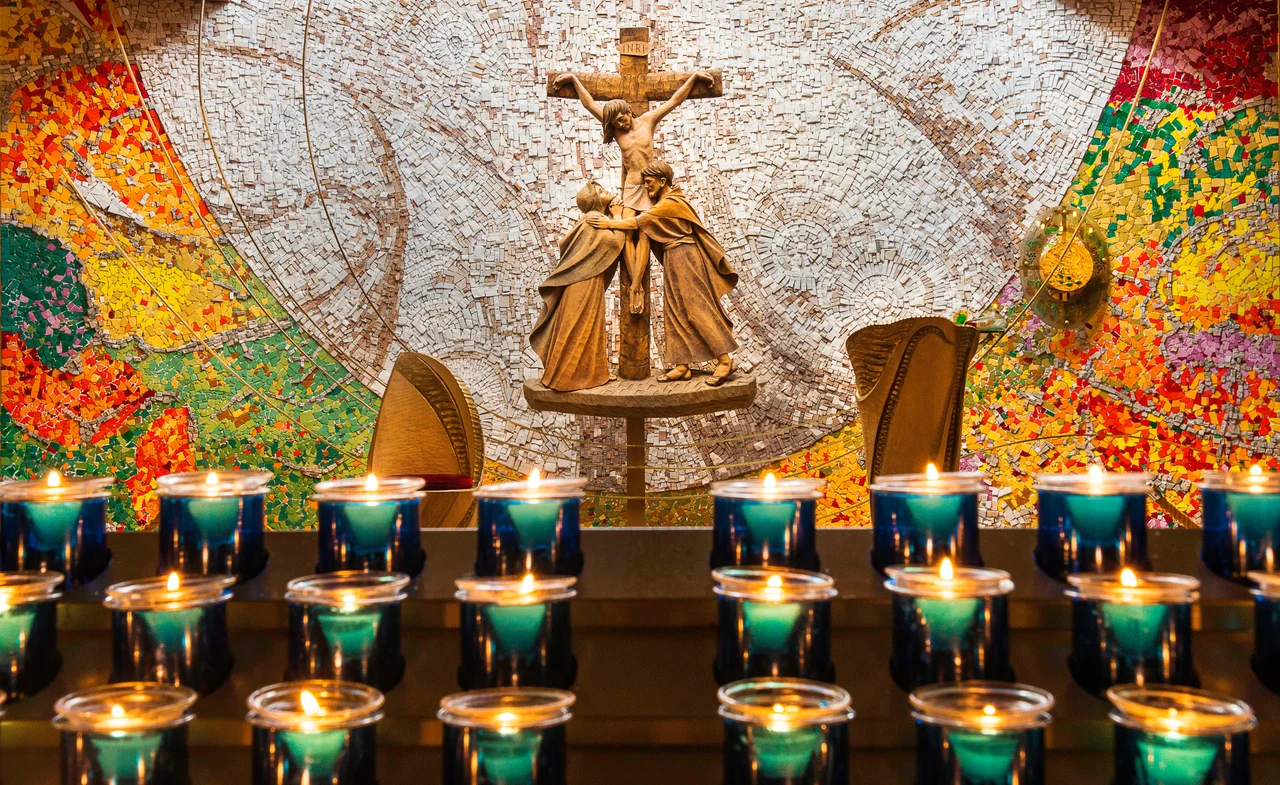
The original church still stands, but it is dwarfed by what surrounds it. A new Apparition Chapel now occupies the spot where the gable once stood, with life-size statues of Mary, Joseph, John the Evangelist, the lamb, and the angels arranged exactly as the witnesses described them. Beside it rises the great Knock Basilica, built in 1976 to hold ten thousand worshipers, with a tapestry of the apparition behind the altar. Pilgrims still leave crutches and walking sticks at the spot where the visions appeared, the way they have for nearly a century and a half. The nine-day novena every August draws crowds that fill the basilica and spill across the grounds, just as the original witnesses once filled the lane in the rain.
What the Villagers Saw
What happened at Knock on that wet Thursday evening will likely never be settled. The Catholic Church accepts the witnesses' testimony as worthy of belief without declaring the apparition itself a doctrine. Skeptics have their projector theory. Believers have their unbroken century of pilgrimage. What is not in doubt is the quality of the testimony - fifteen ordinary people, of widely different ages, standing for two hours in the rain and describing the same vision in compatible detail. That, more than anything, is what carried Knock from a parish curiosity to a destination drawing pilgrims from every continent. The village remains small. The basilica is vast. The gable wall is gone, taken away in fragments by the faithful before the church could think to save it.
From the Air
Located at 53.79 degrees north, 8.92 degrees west, in the east of County Mayo. Ireland West Airport (EIKN) sits 19 km to the north and was built specifically to serve pilgrims to the shrine. Best viewed at lower altitudes - the basilica's circular roof and surrounding car parks make it unmistakable from the air. The Marian shrine complex covers a large green area surrounded by the village of Knock and farmland.
Nearby Stories
- Newport, County Mayo 3.7 km away
- Bellanagare Bog 5.5 km away
- Ballygar 13 km away
- Leenane 13 km away
- Creevelea Abbey 13 km away
- St Mary's Cathedral, Tuam 13 km away
- Bangor Erris 16 km away
- Easky 17 km away