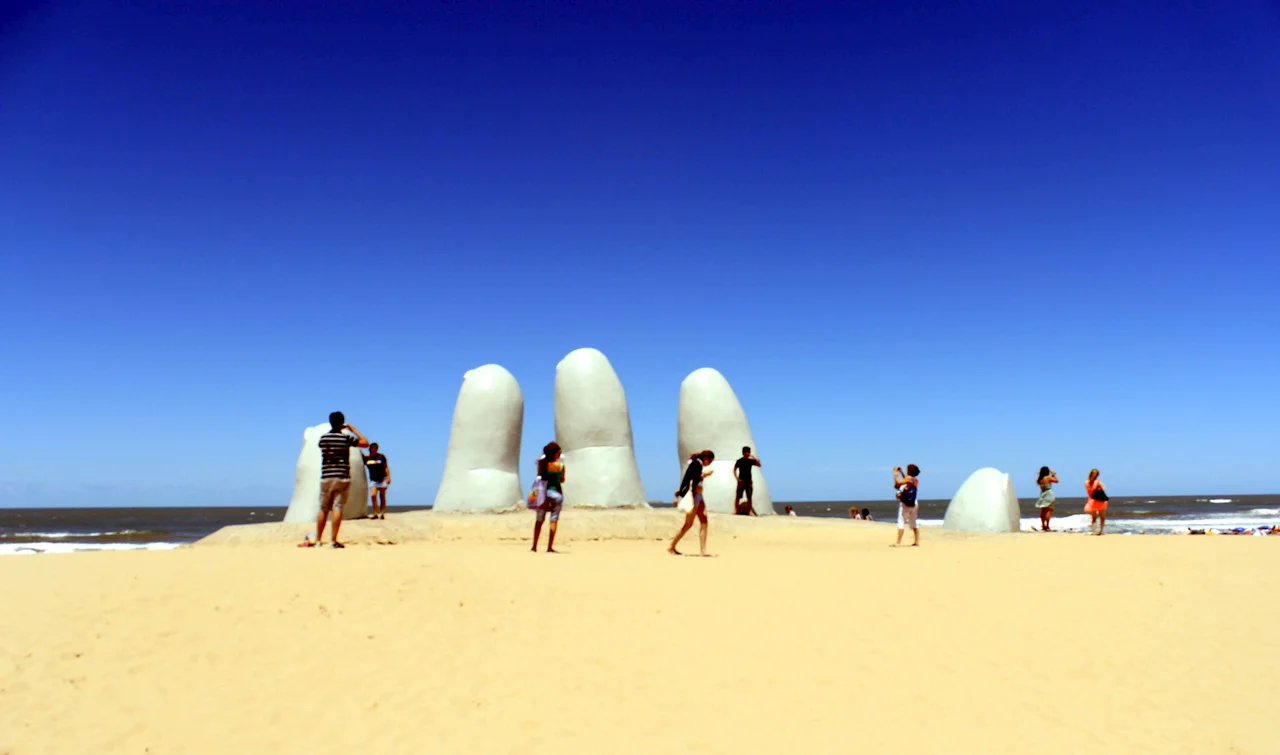

La Mano de Punta del Este
Five enormous fingers break the surface of the sand, as if a giant lay buried just beneath the beach and was reaching for the sky. The thumb tilts. The fingertips curl. From a distance the shape reads as playful, a sculpture made for selfies. Up close, the gesture is harder to dismiss, because the man who built it meant it as a warning. La Mano has greeted bathers at Parada 1 on Brava Beach since the summer of 1982, and in the four decades since, this single piece of concrete has done what no tourism campaign could: it has become the face of Punta del Este, instantly recognizable, endlessly copied, and still rising from exactly the spot where it was poured.
The Youngest Sculptor on the Beach
In early 1982, Punta del Este hosted its first International Meeting of Modern Sculpture in the Open Air, and nine artists arrived to compete for space. Mario Irarrázabal, a Chilean, was the youngest of them. When a dispute broke out over the plots assigned in a public square, he made a contrarian choice and walked down to the sand instead. Given the entire summer to work, he finished in six days, fighting the strong southeast wind that funnels across the peninsula. The fingers are concrete and plastic over a skeleton of steel bars and metal mesh, the outer surface sealed against the salt and sun. Of all the works begun on the beach that summer, only Irarrázabal's stayed. It has never moved from its original place.
A Hand That Means Danger
The sculpture is often read as whimsy, but Irarrázabal carved it as a message about the sea. The waters toward La Barra, up the coast, throw rough surf that suits board riders but punishes swimmers; the calmer side toward Solanas is the safer place to wade. So he shaped a hand the way a drowning person's hand might look in the instant before the water takes them, fingers spread, grasping at air. It is a memento mori disguised as a photo opportunity. Most visitors clambering between the fingers never sense the second meaning, and that double life, beloved landmark and quiet caution, is part of why the piece endures.
The Hand That Multiplied
Worldwide acclaim followed quickly, carried on postcards and snapshots long before social media existed. Irarrázabal returned to the form again and again, casting near or exact relatives of the Punta del Este original in distant places. A version went up in Madrid in 1987. In 1992 came the most famous descendant of all, the Mano del Desierto, a lone hand thrusting from the emptiness of Chile's Atacama Desert, hundreds of kilometers from any coast. Venice received its own in 1995. The fingers on Brava Beach are the source from which all the others spring, the first time the artist tried this strange, arresting idea, and the one place where the hand still rises out of the sand it was made to warn about.
Many Names, One Gesture
The world settled on La Mano, the Hand, but the sculpture answers to other names too. Locals often call it Los Dedos, the Fingers, for the most literal reason. Irarrázabal himself gave it a loftier title that reframes the whole thing: Hombre emergiendo a la vida, Man Emerging into Life. Read that way, the figure is not drowning but being born, climbing up out of the earth into the light. The two readings, death by water and the first breath of living, share the same five fingers, and the sculpture refuses to choose between them. That ambiguity has helped make it one of the most photographed landmarks in Uruguay. It has not aged untroubled. Standing exposed on a public beach, it endures sun, salt, and the steady nuisance of graffiti, and it has needed repeated cleaning and care to stay the bright icon the postcards promise.
From the Air
La Mano sits at 34.96°S, 54.94°W on the eastern, Atlantic-facing side of the Punta del Este peninsula at Parada 1 on Brava Beach. From the air the resort peninsula is unmistakable: a slender finger of land with a marina and high-rise skyline jutting into the Río de la Plata estuary where it meets the open Atlantic. The sculpture itself is small from cruising height; descend for a clear look at the beach. The nearest airport is Capitán de Corbeta Carlos A. Curbelo International (SULS / PDP) at Laguna del Sauce, roughly 20 km west. Montevideo's Carrasco International (SUMU / MVD) lies about 130 km to the southwest. Coastal haze is common on summer mornings; clearest light comes with afternoon onshore breezes.
Nearby Stories
- Laguna de Rocha 19 km away
- Minas 34 km away
- 2012 Air Class Líneas Aéreas Fairchild Swearingen Metroliner crash 37 km away
- La Paloma 40 km away
- Battle of Sarandí 141 km away
- Tronador (rocket) 154 km away
- Mundo Marino 204 km away
- South Georgia Island 2539 km away