
The Last Cathedral of Trees
Count 1,173 tree species in a single plot of forest. That is what researchers found when they measured every trunk wider than a finger in a 52-hectare rectangle of Lambir Hills National Park, a lowland rainforest in Sarawak, Malaysian Borneo. No comparable patch of Old World forest has yielded a higher number. Yet this extraordinary concentration of botanical life occupies a park smaller than many cattle ranches, a remnant surrounded by oil palm plantations and logged-over hills. Lambir is both a treasury and a warning, a place where the richness of tropical evolution presses against the consequences of its destruction.
A Forest Measured to the Centimeter
In 1991, the Sarawak Forest Department, Harvard University's Center for Tropical Forest Science, and Osaka City University launched one of the most ambitious botanical inventories ever attempted. They staked out 52 hectares of Lambir's mixed dipterocarp forest and set about measuring, mapping, and identifying every tree with a trunk at least 1.5 centimeters across at breast height. The result was staggering: 356,501 individual trees belonging to 1,173 species across 286 genera and 81 families. The Dipterocarpaceae family alone, whose massive timber trees dominate the canopy, accounted for 87 species and 42 percent of the plot's total basal area. Researchers return every few years to census these trees again, tracking births, deaths, and growth in a living database that stretches back more than three decades. The Lambir Hills Forest Dynamics Plot remains one of the most intensively studied patches of tropical forest on Earth.
Giants and Their Tenants
The tapang tree, Koompassia excelsa, punches through the canopy and keeps climbing. Specimens in Lambir exceed 80 meters, their smooth, pale trunks rising without branches for dozens of meters before spreading into the open sky above the forest. That slippery bark is no accident of evolution. Sun bears, formidable climbers, cannot gain purchase on it, which makes the tapang irresistible to giant honey bees. Apis dorsata colonies hang their massive combs from the uppermost branches, sometimes dozens of hives festooning a single tree. For generations, indigenous honey collectors have scaled these giants using bamboo pegs hammered into the trunk, working by torchlight and smoke. Logging a tapang is taboo in parts of Sarawak, and only naturally fallen trees are used for timber. Below the tapang canopy, other partnerships flourish: several Macaranga species have hollowed their own stems to house colonies of ants, which patrol the plant's surfaces and attack herbivorous insects in exchange for shelter.
The Emptying
Lambir's botanical riches make its faunal losses all the more jarring. Biologists have recorded 237 bird species, 64 mammal species, 46 reptile species, and 20 frog species in the park, but those numbers describe a past that is slipping away. Surveys conducted between 2003 and 2007 failed to detect 20 percent of the park's previously recorded bird species and 22 percent of its mammals. Half the primate species had disappeared. Six of seven hornbill species could no longer be found. Gibbons and sun bears, once present, are now absent or vanishingly rare. The culprit is not a mystery: Lambir is small, roughly 6,952 hectares, and it sits in a sea of cleared and planted land. Illegal hunting compounds the problem, picking off the large animals that a fragment this size cannot replenish. Scientists have called the collapse an ecological disaster, a term rarely applied to a place that still looks, from above, like unbroken green.
Wings and Waterfalls
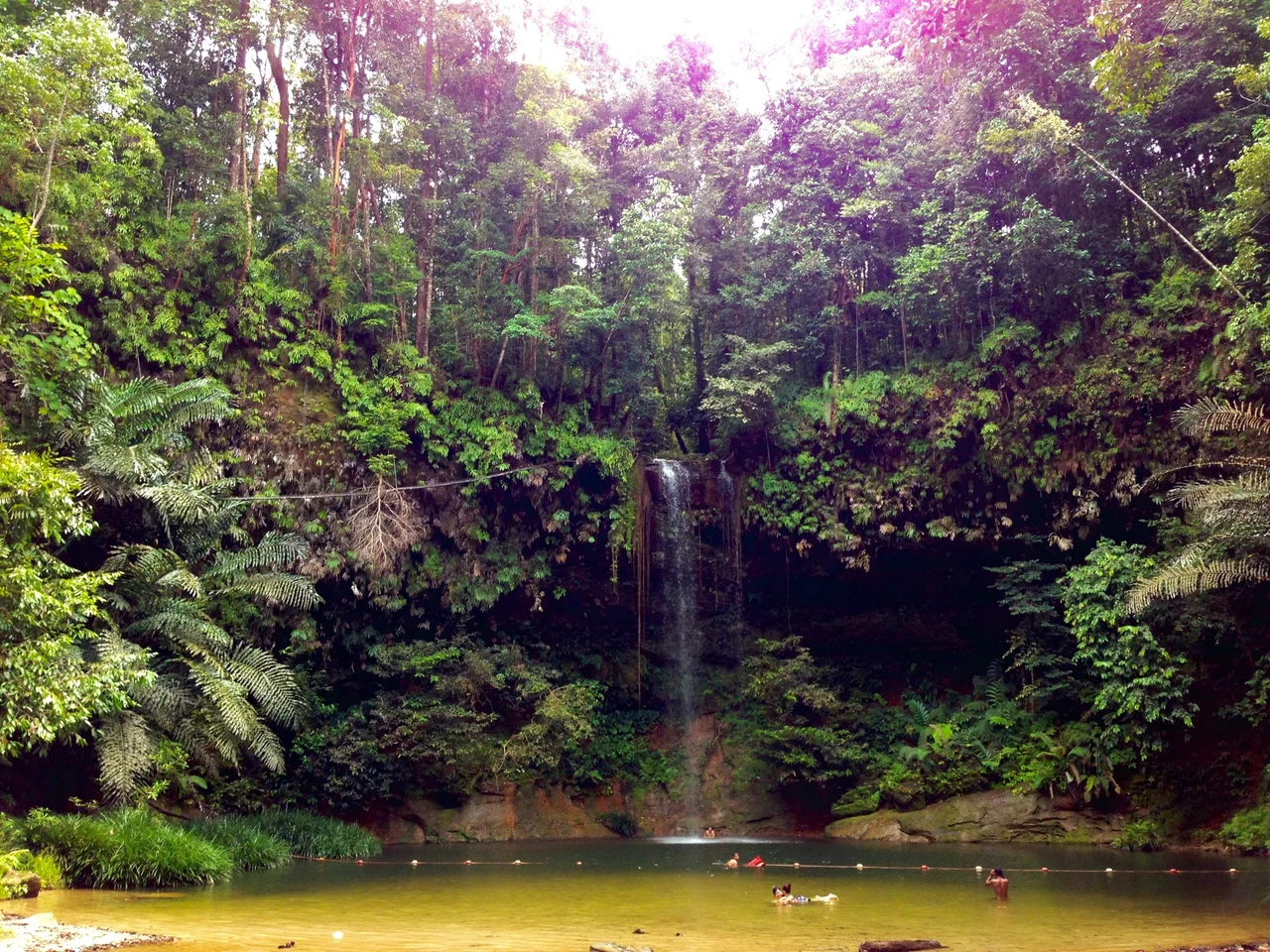
Not everything at Lambir is measured in data sets. The Rajah Brooke's Birdwing, Malaysia's national butterfly, still drifts through the understory on black wings slashed with electric green. Alfred Russel Wallace named the species in 1855 for James Brooke, the first White Rajah of Sarawak, and the butterfly remains a protected species under international treaty. On weekends, families from the nearby city of Miri drive the 30 kilometers to the park for its waterfalls, a series of cascades tumbling over sandstone ledges into clear pools. Trails range from short, flat walks along the stream to the steep climb up Bukit Lambir, the park's highest point. A canopy walkway and research towers offer glimpses of the upper forest, where the Nepenthes hispida pitcher plant, found nowhere else on Earth but this park and its immediate surroundings, traps insects in its fluid-filled cups. Above it all, the tapang trees stand like sentinels, their bee-laden crowns catching the last equatorial light.
From the Air
Lambir Hills National Park lies at 4.21°N, 114.03°E in Sarawak, Malaysian Borneo, roughly 30 km south of the city of Miri. The nearest airport is Miri Airport (ICAO: WBGR), which is about 24 km to the north. From the air, the park appears as a compact block of intact lowland forest surrounded by oil palm plantations and secondary growth. Look for the contrast between the dark, textured canopy of the primary forest and the uniform rows of the plantations. The park sits at roughly 150 meters above sea level, with Bukit Lambir rising modestly above the surrounding ridgeline. Best viewed at altitudes between 3,000 and 6,000 feet.
Nearby Stories
- Miri 8.4 km away
- The Black Lake and the White Crocodile 24 km away
- Sarawak Chamber 30 km away
- Niah National Park 34 km away
- Similajau National Park 61 km away
- Our Forests, Our Name 86 km away
- Crown Colony of Sarawak 167 km away
- Luconia Shoals 201 km away