
Langdon Abbey
When Dr Layton arrived at Langdon Abbey in 1535 to inspect it on Thomas Cromwell's orders, he reported back to his master with a particular satisfaction: he had caught the abbot with his mistress. The visitation, the arrest, and the report were the opening moves of Henry VIII's Dissolution of the Monasteries, the massive seizure of England's religious houses that would transform the country's economic and physical landscape. Langdon Abbey, near West Langdon in east Kent, was reputedly the very first religious house dissolved. The abbot's misbehaviour gave Henry exactly the excuse he needed. Within a few years the abbey itself was rubble, mined for stone, and a farmhouse had been built on its site.
Founded by a Crusader's Son-in-law
Langdon Abbey was founded around 1192 by William de Auberville the elder of Westenhanger in Kent. His wife Matilda, called Maud, was the daughter of Ranulf de Glanville - Chief Justiciar of England under Henry II, who had died at the Siege of Acre during the Third Crusade only two years before. William was himself a King's Justiciar and a knight in the service of Simon de Avranches. He had been involved in his father-in-law's earlier religious foundations: the Premonstratensian abbey at Leiston in Suffolk, founded in 1182, and Butley Priory, of which he was a patron. Langdon Abbey was set up as a daughter house of Leiston, under the hand of Leiston's abbot Robert, dedicated to the Blessed Virgin Mary and to Thomas the Martyr - Thomas Becket, murdered at Canterbury just over twenty years earlier and already drawing pilgrims from across Europe.
The Premonstratensian Order
Langdon's monks were Premonstratensians - sometimes called Norbertines, sometimes White Canons. The order had been founded in 1120 at Premontre in northern France by Norbert of Xanten. Premonstratensians were canons rather than monks in the strictest sense - they followed the Rule of St Augustine, lived in communities, but also engaged in pastoral and missionary work outside the cloister. Their distinctive white woollen habit gave them their popular nickname. By the late 12th century they had spread across western Europe. Langdon was a modest house. In 1491 it was reported to hold about 300 acres of grain and a good supply of animals - prosperous enough but never wealthy, never famous. Its life was small-scale, parochial, predictable.
An Ailing King and a License to Crenellate
In 1325 the abbey hosted royalty. King Edward II had fallen ill on the road to Dover and stopped at Langdon to recover. The abbey nursed him for a time. Edward's reign would end badly - he was deposed in 1327, very probably murdered in custody - but in 1325 Langdon's hospitality was useful to the crown. Twenty-three years later, in 1348, the Abbot and Convent of Langedon - as the spelling sometimes ran - were granted a license to crenellate, the royal permission required to add defensive battlements to their buildings. The license came in the same year that the Black Death reached England. Whether the monks of Langdon ever actually built crenellations, or whether the plague swept through and emptied the cloisters before they could, is unclear. The order survived the pandemic. The abbey continued in a quiet way for another two centuries.
Cromwell's First Target
Then came 1535 and the visitation of the monasteries. Henry VIII had broken with Rome the year before. Cromwell was systematically inspecting religious houses, gathering evidence - real and confected - to justify their dissolution. At Langdon, Dr Layton found his target quickly. He arrested the abbot along with the abbot's mistress and reported triumphantly to Cromwell. Whatever the truth of the abbot's behaviour, the report was decisive. Langdon Abbey was dissolved, and according to tradition it was the very first of the religious houses to fall. Its annual revenue at the time was estimated at 56 pounds - not a great prize, but useful to the Crown, and a useful demonstration. The abbey's lead, timber, and stone were scattered to other building projects. The monks dispersed.
The Cellars That Remain
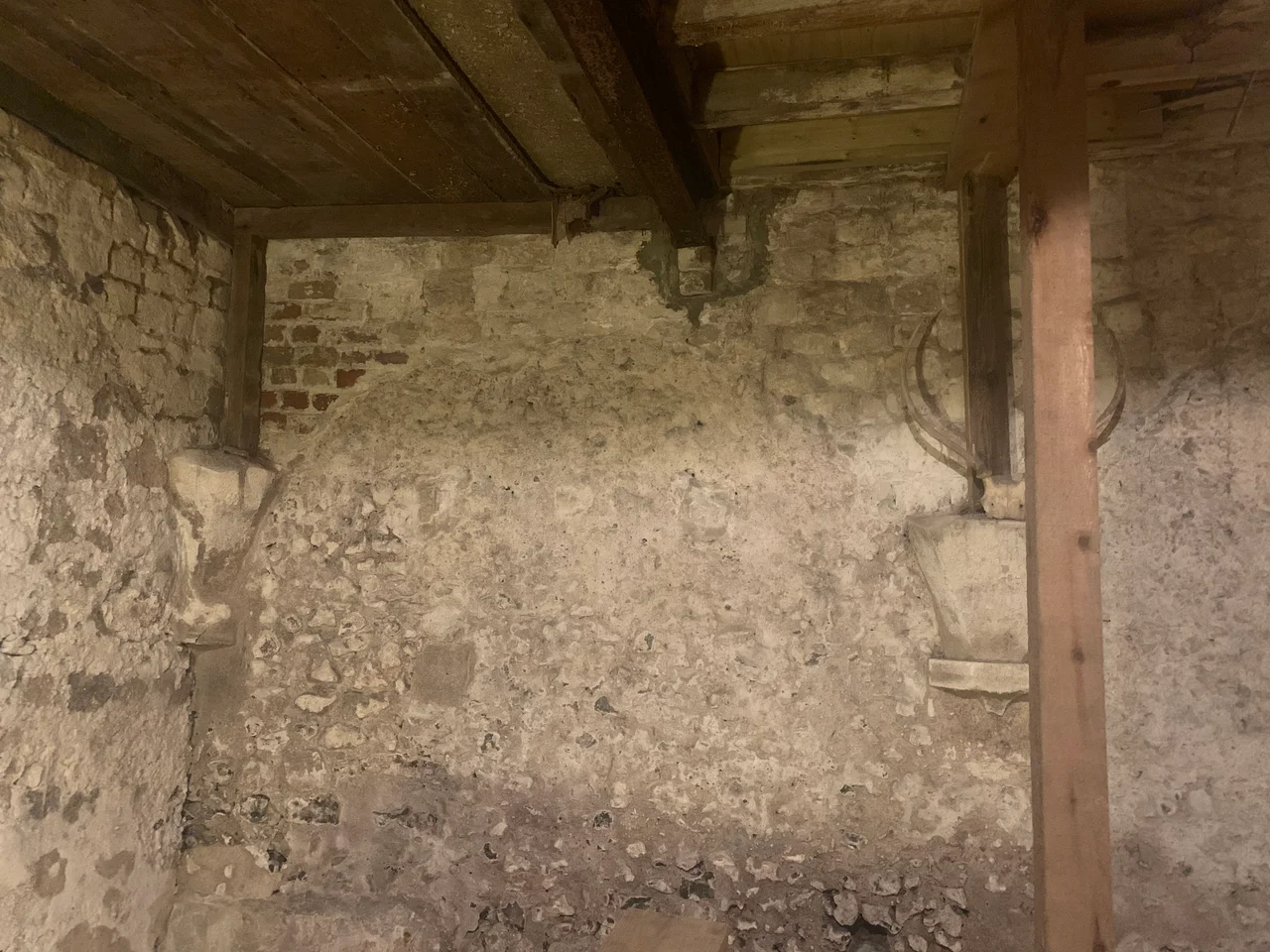
The site of the abbey was acquired in fee simple by John Master, who died in 1588. His son James Master, who died in 1631 aged 84, built a mansion at East Langdon on the abbey grounds. James's eldest son Sir Edward Master became High Sheriff of Kent in 1639. Parts of that 16th-century farmhouse still stand, occupied as a home, and beneath the house lie the monks' cellars - vaulted with their original medieval arches, still intact under the modern floors. The cellars are essentially all that is left of Langdon Abbey: the storage rooms where the canons kept their wine and food, now silent beneath a working family home. A small surviving remnant of a 17th-century ice house also dates from after the abbey's time. In 1828 the farmhouse was reported to have been occupied for years by a respectable family named Coleman. The 1881 census still showed a Coleman farming the land. The continuity is striking: not of religious life, but of agricultural life on the same handful of acres, century after century, with the medieval bones still underneath.
From the Air
Langdon Abbey is at 51.1736 degrees N, 1.3303 degrees E, about three miles north-east of Dover and a mile inland from the cliffs. The site is now a private farmhouse and is not readily visible as a ruin from the air - only the abbey's cellars survive, under modern buildings. The surrounding flat agricultural fields and small village of West Langdon make a useful reference. Dover and the Channel coast are 3 nm south-east. Nearest airfield: Manston (closed) about 11 nm north. Best viewed at low altitude with reference to the village's medieval St Augustine's Church.
Nearby Stories
- Ringlestone Inn 3.4 km away
- Cliffs Pavilion 3.5 km away
- Citadel of Calais 6.5 km away
- 2021 English Channel Disaster 11 km away
- Stag Inn, Hastings 15 km away
- Dungeness Lighthouse 19 km away
- Clacton Pier 32 km away
- Four Days' Battle 54 km away