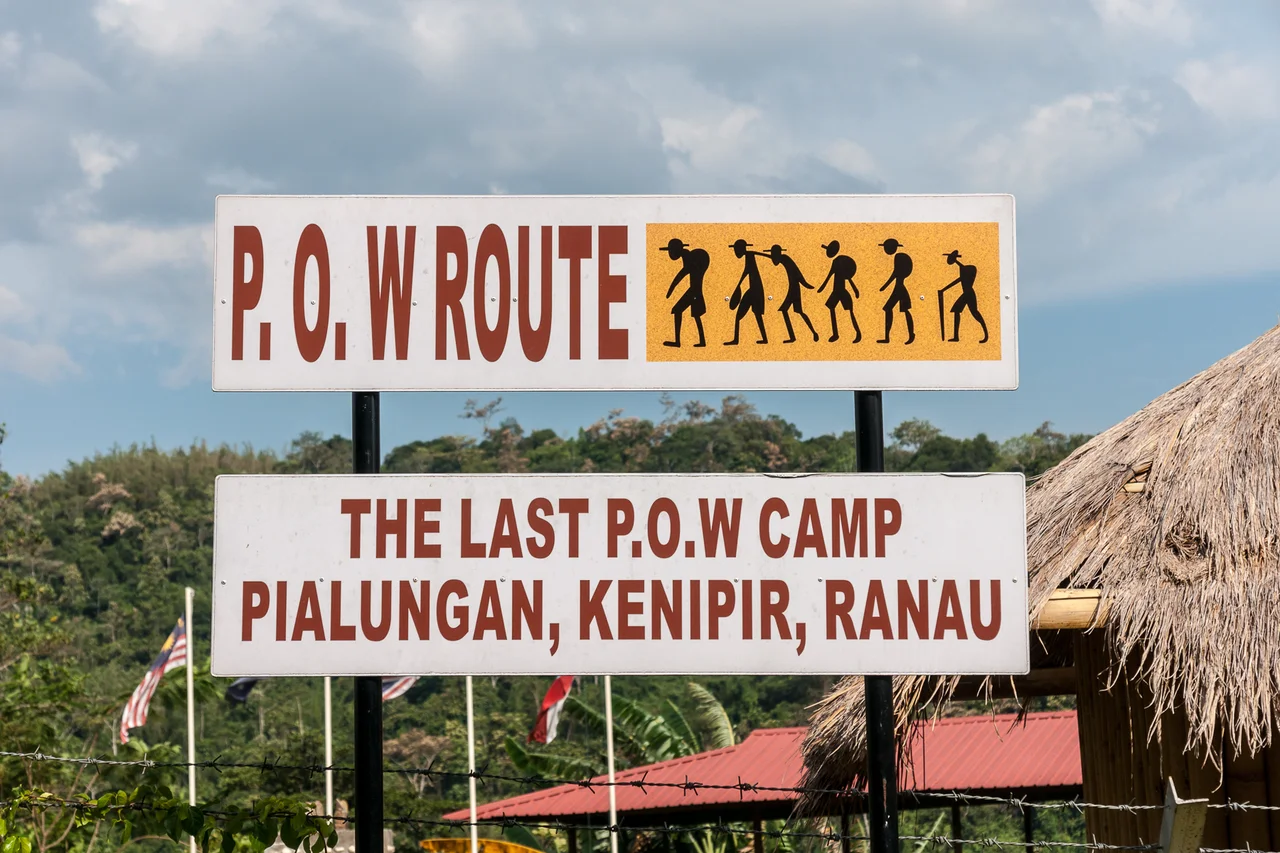

Last POW Camp Memorial
There are 1,047 river stones set into a concrete star on a hillside above the Liwagu Valley. Each one was pulled from the Liwagu River below, and each one represents a human being: a British or Australian prisoner of war who began the Sandakan Death Marches during the final years of World War II. Of the 1,047 who started, only 189 reached this site near Ranau. Of those 189, all but four died within weeks, killed by starvation, disease, or murder. The Last POW Camp Memorial stands where the camp stood, on private land whose owner decreed it should remain a memorial forever.
The Marches That Left No One
The Sandakan Death Marches were among the worst atrocities committed against Allied prisoners of war in the Pacific Theater. Beginning in January 1945, Japanese forces marched British and Australian POWs from the Sandakan camp on Sabah's east coast westward through 260 kilometers of jungle, swamp, and mountain terrain toward Ranau. Three separate marches took place over several months. The prisoners were already weakened by years of forced labor, malnutrition, and tropical disease. Those who fell behind were shot or bayoneted. Those who arrived at the camp above the Liwagu River found no relief, only continued starvation and brutality. Of the 189 who reached Ranau, 153 died in the following six weeks. Another 32 were murdered. Four men, all Australians, managed to escape and survive. They are the only survivors of the entire Sandakan POW camp population of 2,434.
A Historian and a Landowner
The camp's location was lost for decades after the war. Its rediscovery is credited to Australian historian Lynette Silver, who spent years researching the death marches and tracing the route through Sabah's interior. The land where the camp stood turned out to be privately owned by Dr. Othman Minudin, who made a remarkable decision: the site would remain a memorial in perpetuity. The memorial stone was formally erected on 27 August 2009, in a ceremony attended by Sabah's Minister of Tourism Datuk Masidi Manjun, Dr. Othman, and Lynette Silver representing the families and descendants of the dead. The actual camp site, Silver and Dr. Othman agreed, would remain untouched by development, preserved as the jungle slowly reclaimed it.
Stones for the Dead
The memorial's design is spare and devastating. On a large concrete surface shaped like a star, 1,047 boulders from the Liwagu River have been embedded, one for each prisoner of war who began the marches. Rising from the center, a concrete stele contains 183 additional river stones, one for each prisoner who died at this final camp. Four furrowed stone slabs on the memorial represent the four men who escaped. Polished granite panels on each face of the stele present the history of the death marches in English, Chinese, and Malay; the fourth panel lists the names of all 183 who died here. The materials are deliberately simple: river stone, concrete, granite. Nothing imported, nothing polished beyond necessity. The stones come from the same river the prisoners would have heard from their camp, the Liwagu running below in a valley that, on any other day, would be beautiful.
The Route That Remembers
The Last POW Camp Memorial is the final station on the marked POW Route, a series of signposted locations tracing the path of the death marches from Sandakan to Ranau. The route passes through some of Sabah's most remote terrain, crossing rivers and climbing ridgelines that would challenge a healthy person with modern equipment. The prisoners crossed this same ground barefoot, starving, and under guard. Eight kilometers south of Ranau on the road to Tambunan, the memorial is open to the public from 9 a.m. to 5 p.m., enclosed by a fence that marks the boundary between the present and what happened here. The Liwagu River flows below, indifferent and constant. Its stones, carried up the hill and set in concrete, have become the only gravestone most of these men will ever have.
From the Air
Located at 5.91°N, 116.65°E, approximately 8 km south of Ranau on the road to Tambunan, above the Liwagu Valley. The memorial is a small fenced site on a hillside and not easily visible from high altitude. The surrounding terrain is mountainous, with the Crocker Mountains to the west. Nearest airports are Kota Kinabalu International (WBKK) to the west and Sandakan Airport (WBKS) to the east. CAUTION: mountainous terrain with rapidly changing weather. The Liwagu River valley below the memorial is a useful navigation reference. Best viewed at low altitude in clear conditions.
Nearby Stories
- Tunku Abdul Rahman National Park 8.8 km away
- Mount Trusmadi 8.8 km away
- Battle of Beaufort (1945) 43 km away
- Jambongan Island 70 km away
- Operation Agas 94 km away
- Agop Batu Tulug Caves 99 km away
- Tip of Borneo 101 km away
- Tango Maru 194 km away