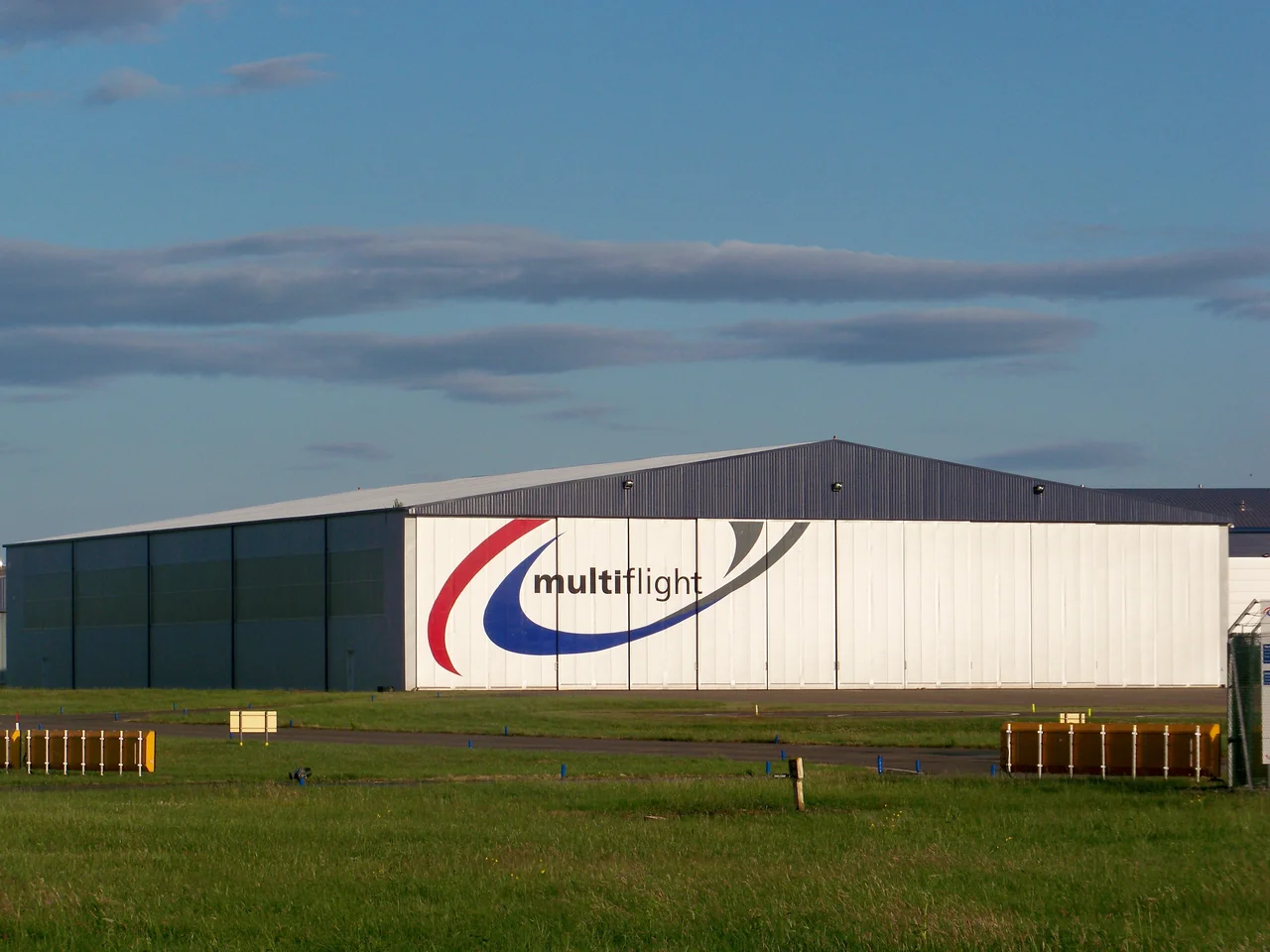

Leeds Bradford Airport
From the air during the war, Yeadon looked like farmland. The roof of the Avro shadow factory was painted to resemble fields, dummy cattle were placed on top, agricultural buildings were faked in canvas and timber, and somewhere underneath it all the workers were building Lancasters. About 5,515 aircraft came out of the camouflaged factory between 1942 and 1946: roughly 4,500 Avro Ansons, 695 Lancaster bombers, plus York transports, Lincoln heavy bombers, Bristol Blenheims. It was the largest free-standing structure in Europe at the time, and nobody flying over saw a thing.
Yeadon Aerodrome
Leeds and Bradford Corporations jointly bought 60 acres of grassland next to the old Bradford-to-Harrogate road in 1930 and opened Leeds and Bradford Municipal Aerodrome on 17 October 1931. Locals still call it Yeadon. The Yorkshire Aeroplane Club ran the place at first, mostly for training and general aviation. By 1936 the London-Yeadon-Newcastle-Edinburgh service was operating three times a week, and by 1939 work had started on a proper terminal building. Only the first wing was finished before the war shut civil aviation down.
The Avro Shadow Factory
When the RAF requisitioned Yeadon in 1939 it became part of 13 Group Fighter Command and then 12 Group. The 609 (West Riding) Squadron, an auxiliary unit, had already been based here since 1936 flying Hawker Harts and then Hinds, and they left for Catterick before the worst of the bombing. In January 1942 the Ministry of Aircraft Production took control and Avro built the famous shadow factory north of the airfield. The Ansons rolled out by the thousand: training aircraft for Commonwealth pilots. The Lancasters were the heavy hitters that carried Bomber Command's load over Germany. Hawker also did development work here on its Tornado design. The factory closed in December 1946, civil flights resumed the next year, and the RAF stayed on with Mosquitos, Spitfires and later Chipmunks until RAF Yeadon finally closed in 1959.
From Yorkshire Council Airport to AENA
The civilian airport ran for decades as a five-council collective: Leeds and Bradford each owning 40 percent, with Wakefield, Calderdale and Kirklees sharing the remaining 20. The 1984 runway extension brought transatlantic charter flights, Wardair flying Boeing 747s to Toronto, and the occasional Concorde charter from British Airways right up to June 2000, a month before the Paris crash ended the type. In 2007 the five councils sold to Bridgepoint Capital for £145.5 million. Bridgepoint sold to AMP Capital in 2017, who later renamed themselves InfraBridge and in December 2025 sold a 51 percent stake to AENA, the Spanish national airport company. The councils still hold a special share to protect the airport's name and its role as the Yorkshire gateway.
Jet2 and the 13th-Busiest in Britain
By 2024 Leeds Bradford was the 13th busiest airport in the United Kingdom by passenger numbers, with Jet2.com headquartered here and operating as the dominant carrier. The single runway, aligned 14/32, sits on a ridge above the surrounding countryside, sloping enough that it once gave RAF Mosquito pilots a fright on takeoff. When Doncaster Sheffield closed in November 2022, much of Wizz Air and TUI's Yorkshire business shifted up the road to Yeadon. New routes followed: Agadir with Jet2, Marrakesh with Ryanair, fresh destinations across Romania and Poland. A £100 million regeneration scheme, LBA:REGEN, began in autumn 2023 to refit the 1965 terminal and bring it toward net-zero by 2030. The plan, announced in August 2024, is to push passenger numbers from 4 million to 7 million a year by the end of the decade, and to reintroduce long-haul. Whether the local objections, the night-flight disputes, and the climate questions that have followed every expansion plan can be reconciled with that growth remains the airport's open question.
From the Air
Leeds Bradford Airport (ICAO: EGNM, IATA: LBA) sits at 53.866°N, 1.661°W in Yeadon, 7 miles northwest of Leeds city centre and 9 miles northeast of Bradford. Elevation roughly 681 feet, making it one of the higher airfields in England. Single runway 14/32, 7,382 feet long. The airport sits on a ridge above the Aire valley, and surface winds funnel through the surrounding moors; instrument approaches deal regularly with Yorkshire weather. Jet2.com is the home carrier.
Nearby Stories
- Hovingham Hall 6 km away
- RAF Elvington 7.6 km away
- Battle of Hatfield Chase 9.1 km away
- Wentworth Castle 11 km away
- Murder of Suzanne Capper 12 km away
- Pendle Hill 13 km away
- RAF Topcliffe 15 km away
- Hawes Junction Rail Crash 26 km away