_001.jpg)
Leeds Cathedral
Leeds is a city with no Anglican cathedral. The Church of England's Diocese of Leeds keeps its seats in Ripon, Wakefield and Bradford, and Leeds itself makes do with a Minster on a parish-church model. The Catholic Diocese of Leeds, by contrast, has a proper cathedral on Cookridge Street, opened in 1904 in an unusual Arts and Crafts take on Gothic Revival. The Cathedral Church of St Anne is small for a cathedral, hemmed in by a tight city-centre site, but the reredos of its lady chapel altar was designed by A.W.N. Pugin in 1842 and the 1904 Norman and Beard organ has been restored and expanded by Klais. The building does more with less square footage than almost any other English cathedral.
Two St Anne's
Leeds got its first post-Reformation Catholic worship space in 1786, the Lady Lane Chapel. In 1838 a more substantial St Anne's Church replaced it on the corner of the Headrow and Cookridge Street, only the third Catholic place of worship in the city after St Patrick's of 1831. When the Diocese of Leeds was created in 1878 St Anne's was granted cathedral status, and its altar reredos, designed by the towering Gothic Revival figure A.W.N. Pugin in 1842, became one of the most important pieces of mid-19th-century Catholic furnishing in Yorkshire. The building was demolished around 1900 to make way for the Headrow widening scheme. Some of its architectural fragments ended up at the Castle-by-the-Sea Hotel in Scarborough, the former house of the painter Atkinson Grimshaw, whose son Arthur was the cathedral's first choir master.
Eastwood and Greenslade
The replacement cathedral, finished in 1904, was designed by John Henry Eastwood, a Leeds-born and London-based architect with experience in church work. Much of the detail was carried out by his assistant Sydney Kyffin Greenslade. They worked in an unusual register: Arts and Crafts Gothic Revival, marrying the medievalising bones of the Gothic Revival with the handcraft sensibility of the William Morris generation. The cathedral is Grade II* listed, with the saved Pugin reredos rebuilt into the lady chapel and the rest of the interior worked through in a quieter, more domestic Gothic than a Victorian high-Gothic enthusiast would have produced fifty years earlier.
Building on a Tight Plot
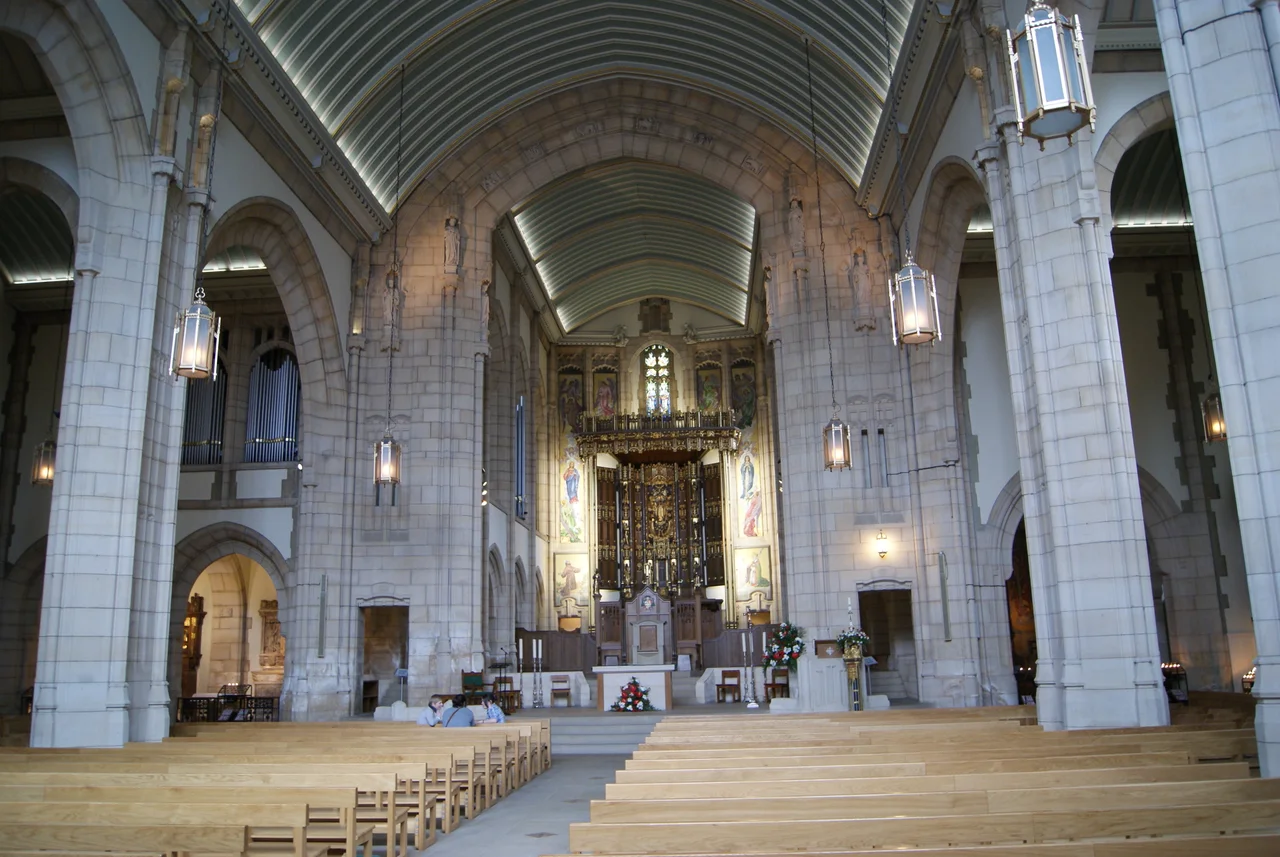
The cathedral is small because Cookridge Street did not give it much room. Eastwood worked the site hard. The western face carries a large ornate crucifix sculpture. The northern face turns sideways into a kind of mock-Georgian, with leaded bay windows looking out over the street. A small tower stands at the northwest corner, and the flag of Vatican City flies from it on feast days and on state visits. Inside, the layout is conventional cathedral plan: rows of pews facing east toward the altar, two rows of stone pillars marking the nave aisles, a barrel-vaulted ceiling with only a faint apex. There is no soaring height, no medieval ribbed vault. There is, instead, a sense of a working parish church scaled up just far enough to do diocesan work.
The Organs
Music is central to the cathedral's daily life. The main organ was built in 1904 by Norman and Beard, the great Edwardian builders, and rebuilt and enlarged in 2010 by Klais Orgelbau of Bonn. It now has seven divisions and 55 ranks, big enough to support large choral performances. A second, smaller chamber organ sits between the choir stalls in the Sanctuary, built by Peter Collins in 1992. It is portable, modest, and used daily to accompany Gregorian chant. The cathedral and the Church of the Holy Rosary on Chapeltown Road together serve the parish of Our Lady of Unfailing Help, which means Sunday by Sunday this surprisingly compact cathedral functions as both a diocesan seat and a working city-centre parish.
From the Air
Leeds Cathedral sits at 53.80°N, 1.55°W on Cookridge Street in central Leeds, near Millennium Square and the Town Hall. From above, look for the small tower at the northwest corner and the tight city-centre footprint just east of the civic quarter. Leeds Bradford Airport (EGNM/LBA) is 7 miles northwest. The cathedral is a short walk from Leeds railway station.
Nearby Stories
- Hovingham Hall 6 km away
- RAF Elvington 7.6 km away
- Battle of Hatfield Chase 9.1 km away
- Wentworth Castle 11 km away
- Murder of Suzanne Capper 12 km away
- Pendle Hill 13 km away
- RAF Topcliffe 15 km away
- Hawes Junction Rail Crash 26 km away