.JPG)
Leeds City Museum
The Leeds Tiger arrived in 1862, shot by Colonel Charles Reid in the Doon Valley below Mussoorie hill station two years earlier. It was first shown in London as a flat skin at the 1862 International Exhibition, which is why its taxidermy mount has always looked slightly odd, and then Edwin Henry Ward, father of the famous Rowland Ward, stuffed it. William Gott donated it to the Leeds Philosophical and Literary Society, and it has been on display in some version of Leeds City Museum almost continuously for over 150 years. Victorian taxidermists preserved skins with arsenical soap, which means the tiger may now be more genuinely dangerous than it ever was in the Indian forests.
From Philosophical Hall to Brodrick's Institute
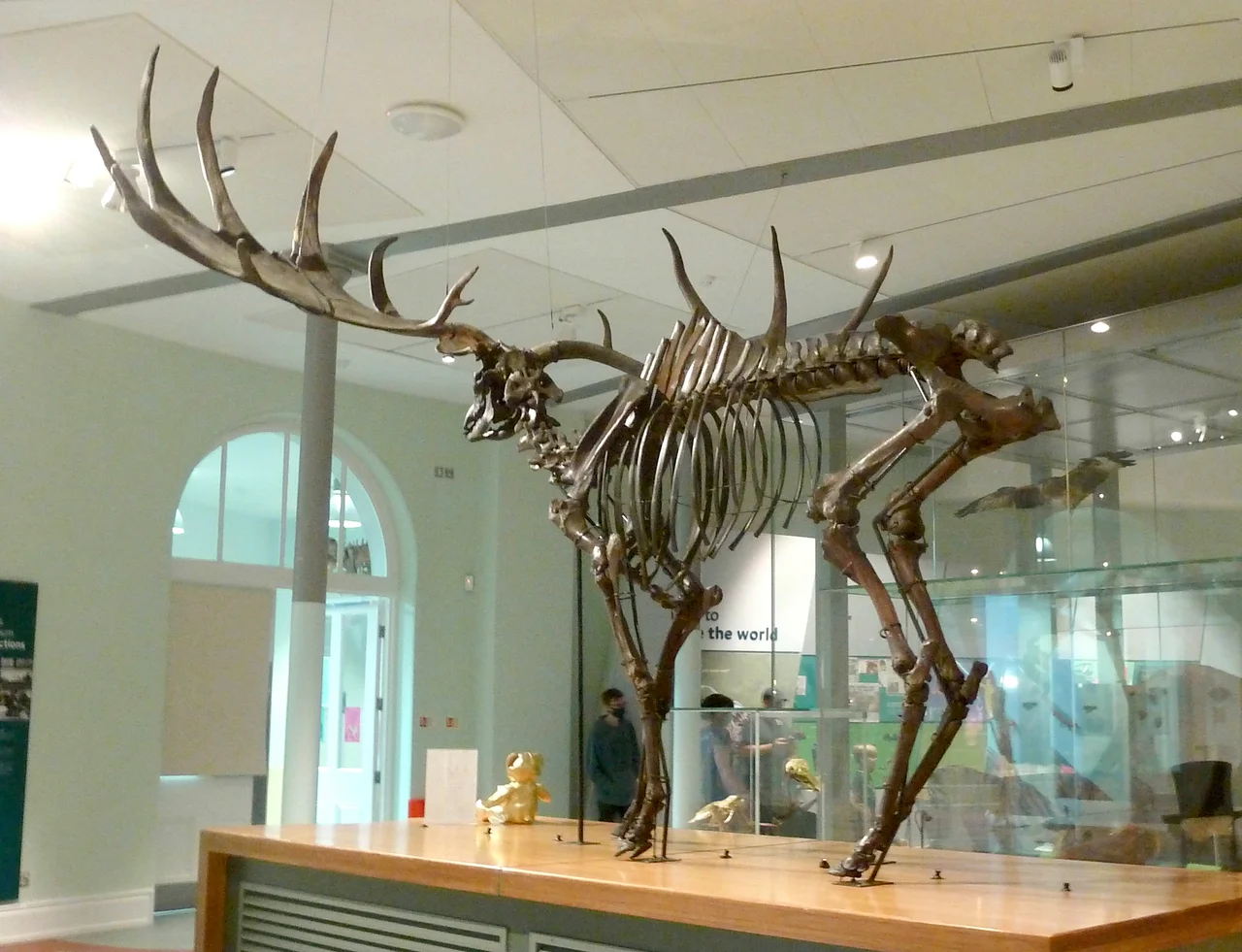
The museum was founded in 1819 by the Leeds Philosophical and Literary Society and opened to the public in 1821 at Philosophical Hall on Bond Street. In 1862 the Hall was rebuilt in Park Row, where its stone portico still stands on the west side of the road. In 1921 control passed to the Corporation of Leeds, the predecessor of the modern city council. Then in 1941 the Luftwaffe blitzed Leeds and the museum building took heavy damage, with many artefacts lost. By 1965 the museum had closed altogether, with a handful of star objects, the Leeds Tiger, the giant moose skeleton and a carved wooden cart, kept in a couple of cramped rooms in the central library. The collection went into storage in 1999, accessible only by appointment.
A Mechanics' Institute Becomes a Museum
The rebirth came from the National Lottery. Leeds City Council bid for funding in 2001 and was awarded £19.5 million in 2004. The chosen home was the former Leeds Mechanics' Institute on Cookridge Street, designed by Cuthbert Brodrick, the Hull architect responsible for Leeds Town Hall, and built between 1865 and 1868. Mechanics' institutes were a peculiarly Victorian creation: working-class adult education, libraries and lecture halls for self-improvement. Leeds's was a particularly grand example. Austin-Smith:Lord architects and Buro Happold engineers reworked the building from 2005, with gallery design by Redman Design, and the museum finally reopened in 2008. Brodrick's old Albert Hall, which had seated 1,500 for plays and concerts from the 1880s and become the Leeds Civic Theatre in 1949, was incorporated into the new layout.
The Survivors
Walking the galleries, you meet a cast of vintage taxidermy that the conservator James Dickinson rescued and restored in 2008. The Armley Hippo, dug up in the brick clay pits of Armley in 1851, is the partial skeleton of an actual hippopotamus that lived in the Aire Valley about 130,000 years ago when Britain's climate was warmer. The Leeds Polar Bear is a Victorian taxidermy specimen, looming above the gallery. The Leeds Irish Elk is the giant antlered skeleton of a long-extinct deer, a piece of Pleistocene Europe assembled in a Yorkshire vitrine. And there is the Salford tiger, mounted by Harry Ferris Brazenor in 1914, a second tiger to keep the famous one company. All of them have outlived the rooms that once held them, and several of the people who once owned them.
The Tiger Keeps Watch
Of all the museum's objects, the Leeds Tiger has the most lives. The Yorkshire Evening Post once wrote that we will never know whether the Leeds Tiger truly lived up to its reputation in the forests of Uttarakhand, but it still sends a shiver down visitors' spines. The pelt has slumped a little over the decades, the awkward result of starting as a flat exhibition skin in 1862 before being remounted. But the tiger remains, alongside the Aphrodite-head bronze with its possible connection to the British Museum, the Voices of Asia gallery, the Egyptian mummy that turned out to contain a wasp, and the Malham Pipe whose 2018 reassessment changed its dating. Leeds City Museum is, among other things, an archive of how a Yorkshire city has chosen what to keep, for over two centuries.
From the Air
Leeds City Museum sits at 53.80°N, 1.55°W on Cookridge Street facing Millennium Square in central Leeds. From above, look for the Italianate Brodrick facade adjacent to Leeds Cathedral. Leeds Bradford Airport (EGNM/LBA) is 7 miles northwest. The museum is a short walk from Leeds railway station, the Art Gallery and the Central Library.
Nearby Stories
- Hovingham Hall 6 km away
- RAF Elvington 7.6 km away
- Battle of Hatfield Chase 9.1 km away
- Wentworth Castle 11 km away
- Murder of Suzanne Capper 12 km away
- Pendle Hill 13 km away
- RAF Topcliffe 15 km away
- Hawes Junction Rail Crash 26 km away