
Leeds Corn Exchange
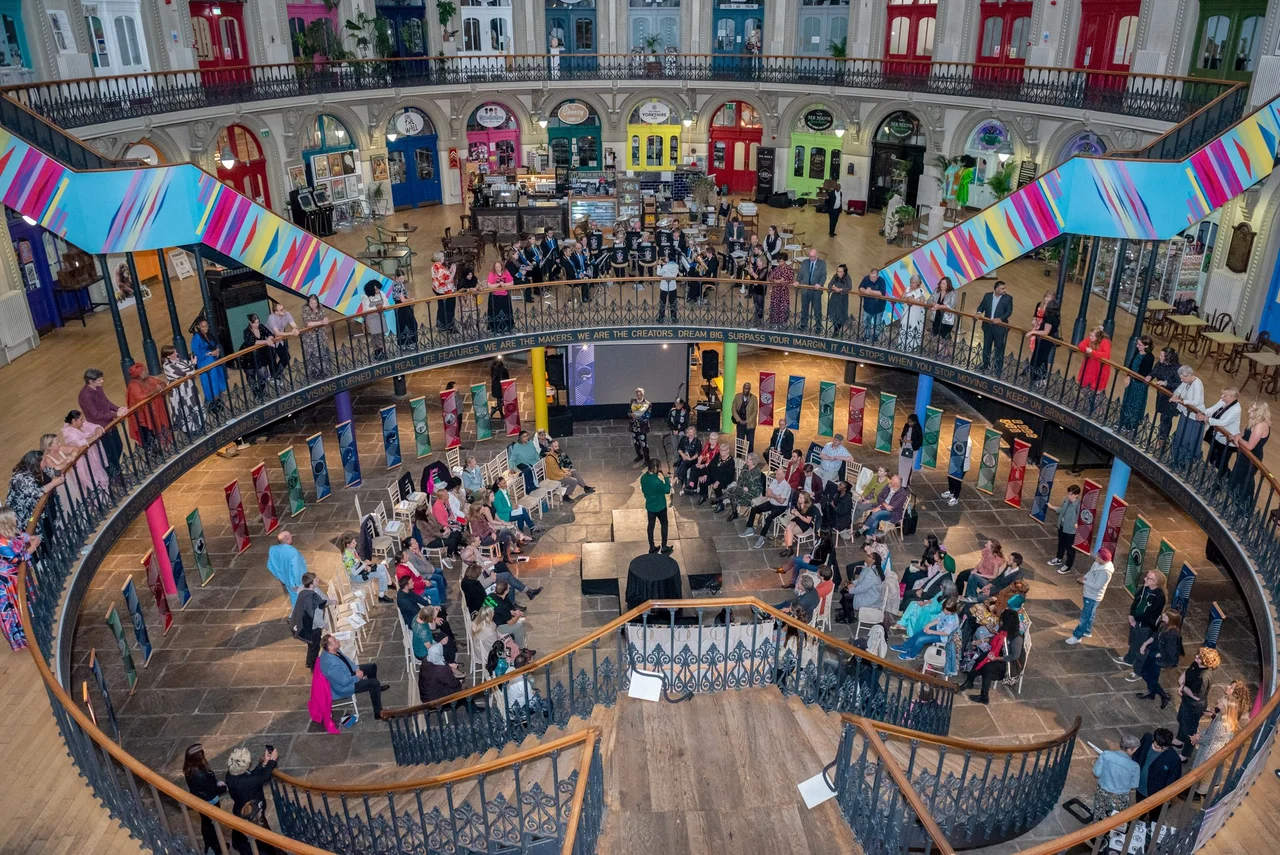
Cuthbert Brodrick gave Leeds its Town Hall and then he gave it the Corn Exchange, and the second one might be the more loveable of the pair. He chose Italianate for the design, finished it in 1864, and gave the building diamond-shaped rustication on the outside and a soaring iron-and-glass dome inside. The architectural historian Nikolaus Pevsner, normally austere in his praise, called the design remarkably independent and functional. Cereal merchants no longer trade beneath the dome. About thirty independent shops and food outlets do. But Brodrick's geometry still pulls light through the glass every morning, and the curve of the building still rewards walking around it.
Why Leeds Needed One
Britain's corn exchanges were the trading floors of the 19th century grain economy: places where farmers, millers, and merchants met to sample wheat and barley, settle prices, and write contracts. The first Leeds corn exchange opened in 1829 at the north end of Briggate. By the 1850s it was too small for the booming Yorkshire grain trade and the civic authorities decided to commission something on a different scale. Cuthbert Brodrick was already at work on Leeds Town Hall when he was given the corn exchange brief. He produced an elliptical building with diamond-rusticated stonework on the exterior, completed in 1863 and opened for trade in 1864. It was listed Grade I in 1951, the highest category of protection.
Pevsner's Praise
The interior is what makes the building. Brodrick covered the elliptical trading floor with a wrought-iron and glass dome whose ribs spring from the walls and meet at the lantern above. Light pours down on the floor below. Wooden offices line two upper galleries that run around the inside, originally let to grain dealers, now to clothing boutiques, tattoo studios, vinyl shops, and coffee bars. Nikolaus Pevsner, writing his Buildings of England guides in the 20th century, was not given to enthusiasm. He called Brodrick's design remarkably independent and functional, the architectural equivalent of a standing ovation. The Yale University Press updated edition of his Leeds volume in 2005 still treats the exchange as one of the city's defining Victorian buildings.
When the Grain Trade Ended
The Great Depression of British Agriculture, which began in the 1870s and dragged on into the 1890s, broke the corn exchange economy. Cheap North American grain flooded into Liverpool, prices collapsed, and the great Yorkshire grain traders thinned out. By the 20th century the Leeds Corn Exchange was a working trading floor in name only. Speciality Shops plc restored the building in the late 1980s and converted it into a retail facility, threading small independent shops around Brodrick's galleries. Zurich Financial Services took it over and reopened it in November 2008 as a boutique shopping centre, with the 13,200 square foot ground level given over to a restaurant called Piazza by Anthony. Piazza closed suddenly in June 2013. The shops kept going.
Independent, Still
In 2017 the property company Rushbond acquired the building and continued the independent-retail model. The Corn Exchange today houses about thirty small businesses: clothes, records, books, tattoos, jewellery, coffee, vegan food. It is now described as one of only three corn exchanges in Britain still functioning as a centre for trade, even if the trade is no longer cereal. The dome has also become a venue: in June 2023 the South Asian Arts UK Summer Solstice Festival filled the floor with music and dance until 5 am, part of the Leeds 2023 cultural programme. The BBC used the building as a backdrop in its 2021 Rugby League World Cup trailer, in honour of Leeds being one of the host cities. Brodrick's exchange has outlived its original purpose by a century and a half, and looks set to outlive several more reinventions.
From the Air
The Leeds Corn Exchange sits at 53.80°N, 1.54°W on Call Lane in central Leeds, in the southern part of the city centre just east of the river. From above, look for the elliptical roof and dome shape distinct from the rectangular blocks around it. Leeds Bradford Airport (EGNM/LBA) is 7 miles to the northwest. The exchange is a short walk from Leeds railway station and Briggate.
Nearby Stories
- Hovingham Hall 6 km away
- RAF Elvington 7.6 km away
- Battle of Hatfield Chase 9.1 km away
- Wentworth Castle 11 km away
- Murder of Suzanne Capper 12 km away
- Pendle Hill 13 km away
- RAF Topcliffe 15 km away
- Hawes Junction Rail Crash 26 km away