
Leeds Industrial Museum at Armley Mills
The fibres in the air would ignite without warning. That was the problem with woollen mills in 1804 - the dust drifting between the looms made the buildings themselves combustible, and when the original Armley Mills burned to the ground that year, Benjamin Gott decided he would rebuild with cast iron columns and brick arches that fire could not climb. The mill he raised between 1804 and 1805, wedged on its island between the River Aire and the Leeds and Liverpool Canal, became the largest woollen mill in the world. Two suspension waterwheels named Wellington and Blucher - after the heroes then fighting Napoleon - turned 18 fulling stocks and 50 looms beneath floors of shallow brick arches. The mill ran for another 164 years before the looms finally stopped.
Before the Fire
Long before Gott, the mill had a quieter life. A clothier named Richard Booth leased 'Armley Millnes' from Henry Saville in the middle of the sixteenth century, and by 1707 a single building housed two waterwheels, four fulling stocks, and a corn grinder. Fulling was the dirty heart of woollen finishing - hammers pounded soaked cloth in vats of water, urine, and Fuller's earth, the ammonia helping to felt the fibres into something durable. Householders along the lane saved their urine in jars and sold it to the mill. By 1788 five waterwheels powered eighteen stocks, and Colonel Thomas Lloyd, a Leeds cloth merchant, bought the operation and built it into the largest woollen mill on Earth. He never lived there himself. The Burrows brothers, who ran the place day-to-day, built semi-detached cottages on the far bank of the canal so they could watch the wheels turn from their windows.
Stone and Iron
After the 1804 fire, Gott rebuilt to fireproof principles pioneered just years earlier. The new mill is L-shaped on sloping ground, varying between two and four storeys, twenty-three bays of ashlar stone running north to south above the millrace. Inside, slender cast-iron columns carry shallow brick arches instead of timber floors. The six finely detailed arches at water level, with their wrought-iron grills, are still visible from the riverbank. The wheels Wellington and Blucher were suspension wheels with rim-gearing - a technique developed by the engineer Thomas Hewes - rated at 70 horsepower between them. A beam engine joined them in 1855, and by the 1860s steam had quietly replaced moving water. The wheels themselves were dismantled in 1885, though photographs survive of them turning in the dark.
The Botany Bay Connection
Walk along the canal towpath toward the canal-side wharf called Botany Bay Yard, and you find a piece of trade history hiding in plain sight. This was the first place in England where wool shipped from Botany Bay - the new colony at Sydney, half a world away - was unloaded. A wharf shed still stands here in ruins, and beside it, sunk into the canal mud, sits what looks like the remains of a wooden barge. The mill at the end of the wharf was Gott's. Australian fleeces travelled fourteen thousand miles by sail, were dragged up the canal by horse, and were combed and woven into cloth that left Leeds again for markets across the British Empire. The world of the mill was small and very large at once.
The Long Quiet
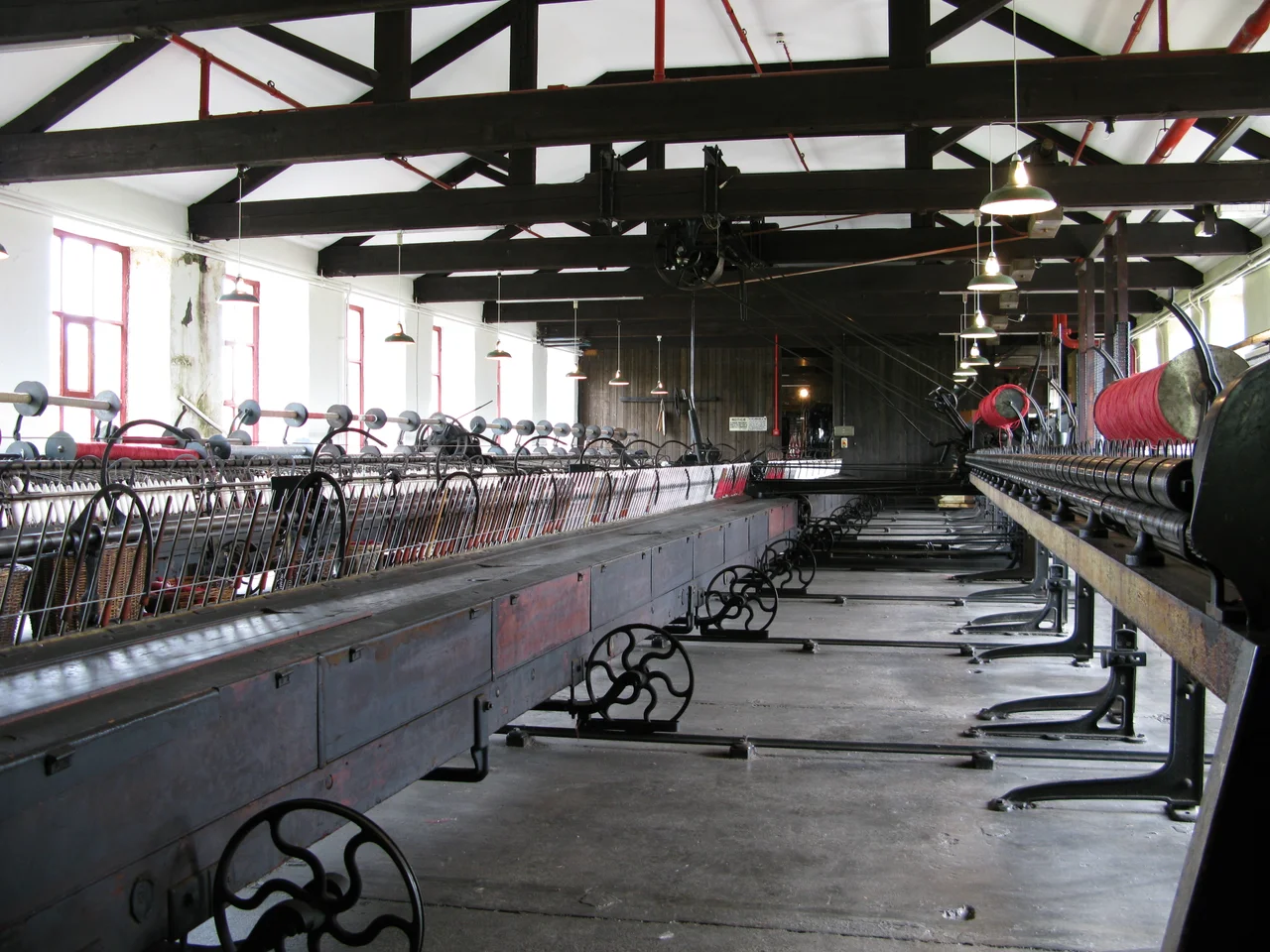
By 1907 part of the mill had been let to tenants under a 'room and power' agreement - small clothing manufacturers renting floor space and shaft drive from a single mill engine. The firm Bentley and Tempest worked the looms here for decades; their accident book, still in the museum's collection, records the small daily violence of textile work. The mill closed for commerce in 1969. Leeds City Council took over the buildings, and in 1982 reopened them as a museum of industrial heritage. The Grade II* listed structure now houses textile machinery, railway equipment, locomotives, and the printing presses, sewing machines, and engines that powered Victorian Leeds. The wooden corn-mill wheel still stands inside, in need of repair but unmistakeably there - the older bones of the place, visible if you know where to look.
What the City Made
Leeds in the eighteenth and nineteenth centuries was the city of a thousand trades, and Armley Mills tells the story from the bottom up. The collections cover wool, worsted, ready-made clothing, locomotives, printing, and cinema - the industries that paid for the Town Hall and the arcades. Among the holdings is the world's oldest surviving model locomotive, a piece of engineering history hiding in a Yorkshire suburb. The mill flooded in 2015 when the Aire burst its banks - a reminder that the same river that powered the looms can still rearrange the place when it wants to. The museum reopened, the looms came back online for demonstration, and the wheels of Wellington and Blucher, now phantoms, still tug at the imagination of anyone walking the towpath.
From the Air
Armley Mills sits on an island in the River Aire at 53.803°N, 1.583°W, about a mile west of Leeds city centre. The mill lies between the river and the Leeds and Liverpool Canal, 150 ft above sea level, with the long ashlar-stone main range visible from low altitude. Leeds Bradford Airport (EGNM) is 6 nm to the north-northwest and serves as the nearest VFR reference. Approaching from the east, the mill island makes a distinctive linear feature parallel to the canal cut. Recommended viewing altitude 1,500-2,500 ft AGL. Yorkshire skies are often hazy; clearest visibility is typically morning after frontal passage.
Nearby Stories
- Hovingham Hall 6 km away
- RAF Elvington 7.6 km away
- Battle of Hatfield Chase 9.1 km away
- Wentworth Castle 11 km away
- Murder of Suzanne Capper 12 km away
- Pendle Hill 13 km away
- RAF Topcliffe 15 km away
- Hawes Junction Rail Crash 26 km away