_012.jpg)
Leeds Minster
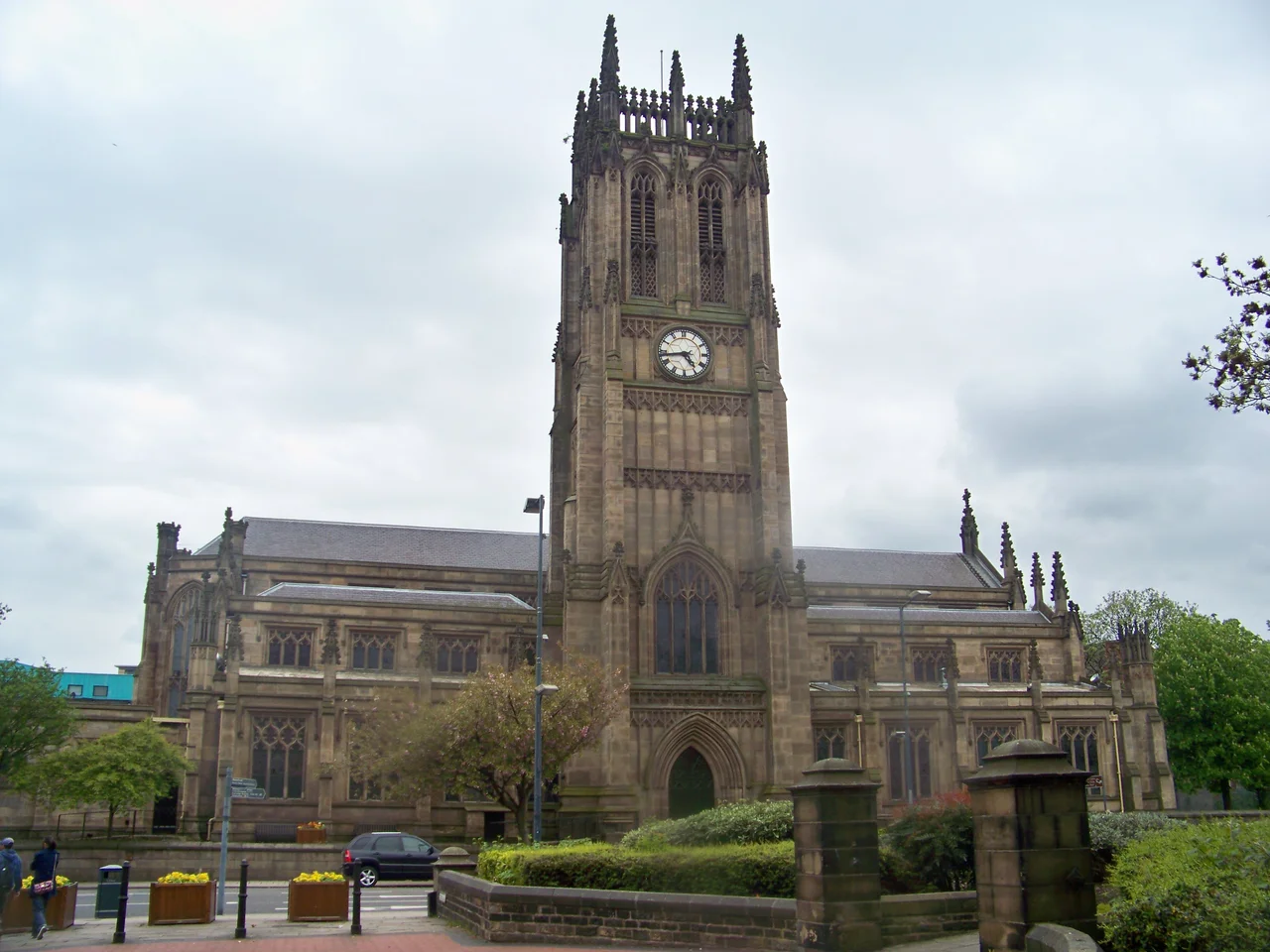
There is High Church, Low Church, and Leeds Parish Church - that was John Betjeman's quip, broadcast on the BBC and still funny to anyone who knows the building. The Minster and Parish Church of Saint Peter-at-Leeds stands at the easternmost edge of the medieval city, on a site where a church is recorded as early as the seventh century. The current Gothic Revival structure, completed in 1841 by the Hull-born architect Robert Dennis Chantrell, was the largest new church built in England since Christopher Wren's St Paul's Cathedral rose from the ashes of the Great Fire. It cost over £29,000, raised by subscription from the people of Leeds. Florence Nightingale sat in the congregation at the consecration. Samuel Sebastian Wesley played the organ. In September 2012, on the 171st anniversary of that day, the parish church became a minster.
What Was Found in the Walls
The plan in November 1837 was modest. Move the tower from the crossing to the north side, widen the chancel to match the nave, raise the north aisle roof. But when workmen began to take the medieval church apart in 1838, they found the structure perilously rotten - and decided the only honest course was to start again. In the rubble they uncovered the fragments of an Anglian stone cross, carved sometime before the Norman Conquest. The Leeds Cross now stands inside the present minster, south of the marble altar pavement, a thousand-year-old survival from a church older than any record of it.
Chantrell's Cruciform
The new church is cruciform in plan, built of ashlar stone with slate roofs, its tower planted firmly at the crossing where Norman builders had put theirs centuries before. Chantrell designed the apse windows specifically to fit the Flemish stained glass he had acquired - the glass came first, the architecture wrapped around it. The organ, partly dating from 1841, is essentially a Harrison and Harrison from 1914, incorporating earlier pipework by the German master Edmund Schulze. A long line of organists have presided over it, from Wesley himself through Edward Bairstow to Simon Lindley, who served as Master of the Music for forty-one years. Outside the churchyard, facing Kirkgate, stands the Leeds Rifles War Memorial - designed by Edwin Lutyens, unveiled on 13 November 1921, a Grade II listed monument in its own right.
The Parish That Swallowed a City
The medieval parish of Leeds was vast - twenty-one thousand acres, including the out-townships of Allerton, Armley, Beeston, Bramley, Farnley, Gipton, Headingley, Holbeck, Hunslet, and Wortley. For centuries every christening, wedding, and funeral required a trek to Kirkgate. One by one the townships built chapels of ease to shorten the walk: Bramley's, founded by monks at Kirkstall Abbey, may have been first; Farnley's by about 1240; Headingley's in 1616; Armley and Wortley's in 1649. The right to appoint the parish priest, granted by Ralph Paynel to the Benedictine Priory of the Holy Trinity at York in 1089, passed between owners after the Reformation until 1588, when a group of parishioners simply bought it themselves. The advowson has been in the hands of the people of Leeds ever since.
Voices in the Nave
The choral tradition here is one of the great unsung English histories. Samuel Sebastian Wesley arrived in 1842 - grandson of the hymn-writer Charles Wesley - and laid down a standard that still shapes services today. The Boys' and Men's Choir sang almost daily until 2015; a Girls' Choir founded by Jonathan Lilley in 1997 ran in parallel. Today the Minster Choir is an adult chamber group of about two dozen, volunteers and choral scholars drawn from the Universities of Leeds and York and Leeds Conservatoire. Friday lunchtime organ recitals run from September through July. Sir John Betjeman's joke about three kinds of Anglicanism still holds: this building, illuminated at night by floodlights once donated by Tetley's brewery, has always done things its own way.
Quiet Connections
Among the memorials is a brass for Captain Lawrence Oates, who walked out of Scott's tent into an Antarctic blizzard in 1912 saying he was just going outside and might be some time. Oates had Leeds connections - the family tablet sits among those of the Kitchingmans, Fentons, Lodges, Milners, Cooksons, and Ibbetsons, families whose mercantile fortunes built much of the city. The 1997 Angel Screen at the north tower porch, an engraved glass piece by Sally Scott, was given by the family of Lord Marshall of Leeds. Outside in Penny Pocket Park, where the churchyard once stood, the burials were closed off in the 1830s and the ground turned to public use - a small green crossing of Kirkgate that few visitors notice, a thousand years of Leeds underfoot.
From the Air
Leeds Minster stands at 53.795°N, 1.536°W in the eastern city centre, bordered by Kirkgate to the north and The Calls to the south. The cruciform stone church with its central crossing tower is visible from low altitude amid the surrounding modern blocks of central Leeds. Nearest airport is Leeds Bradford (EGNM), 7 nm to the north-northwest. From altitude, the Minster anchors the eastern end of the medieval street grid - look for the curved Inner City Loop Road wrapping around it. Best viewing altitude 1,500-3,000 ft AGL. The Leeds Rifles War Memorial in the churchyard is a small but distinctive Lutyens pylon visible from the south.
Nearby Stories
- Hovingham Hall 6 km away
- RAF Elvington 7.6 km away
- Battle of Hatfield Chase 9.1 km away
- Wentworth Castle 11 km away
- Murder of Suzanne Capper 12 km away
- Pendle Hill 13 km away
- RAF Topcliffe 15 km away
- Hawes Junction Rail Crash 26 km away