.jpg)
Leeds Town Hall
Cuthbert Brodrick was twenty-nine and unknown outside Hull when Charles Barry plucked his anonymous entry from the pile and recommended it to win. The design was for a town hall in Leeds - a building that did not yet exist as a category in England, combining moot hall, concert room, courthouse, council chamber, and ceremonial suite under one Roman roof. The brief asked for space for eight thousand people. The budget attracted ridicule, and the costs duly rose. Construction began in July 1853, with the foundation stone laid by mayor John Hope Shaw, who placed coins and newspapers in its cavity and spread mortar with a silver trowel still kept at the City Museum. Five years later Queen Victoria came north to open the building. Local reporters declared that on that day, with the head of Empire present, Leeds was briefly the capital.
A Tower That Wasn't Planned
The clock tower that defines the Leeds skyline was an afterthought. Brodrick added it in 1856, three years into construction, as the civic leaders sought to outdo Bradford and make a grander statement. To support a tower they were not originally building, the entrance hall had to be cramped down to a vestibule rather than the screen of columns Brodrick had imagined. He thought it worth the trade - the tower would give 'extra drama and power.' It rises 225 feet, a baroque cupola of Corinthian columns supported on the structure beneath, with clock dials by Edmund Beckett Denison and a mechanism installed by Dent of London. For 108 years from 1858 until 1966 it was the tallest thing in Leeds, only overtaken when the Park Plaza Hotel was built eight metres higher. The Pevsner verdict was hedged - the architect, Pevsner wrote, 'has not quite made up his mind whether he wanted a dome or a tower.'
Wool, Stone, and the Sheep at the Gates
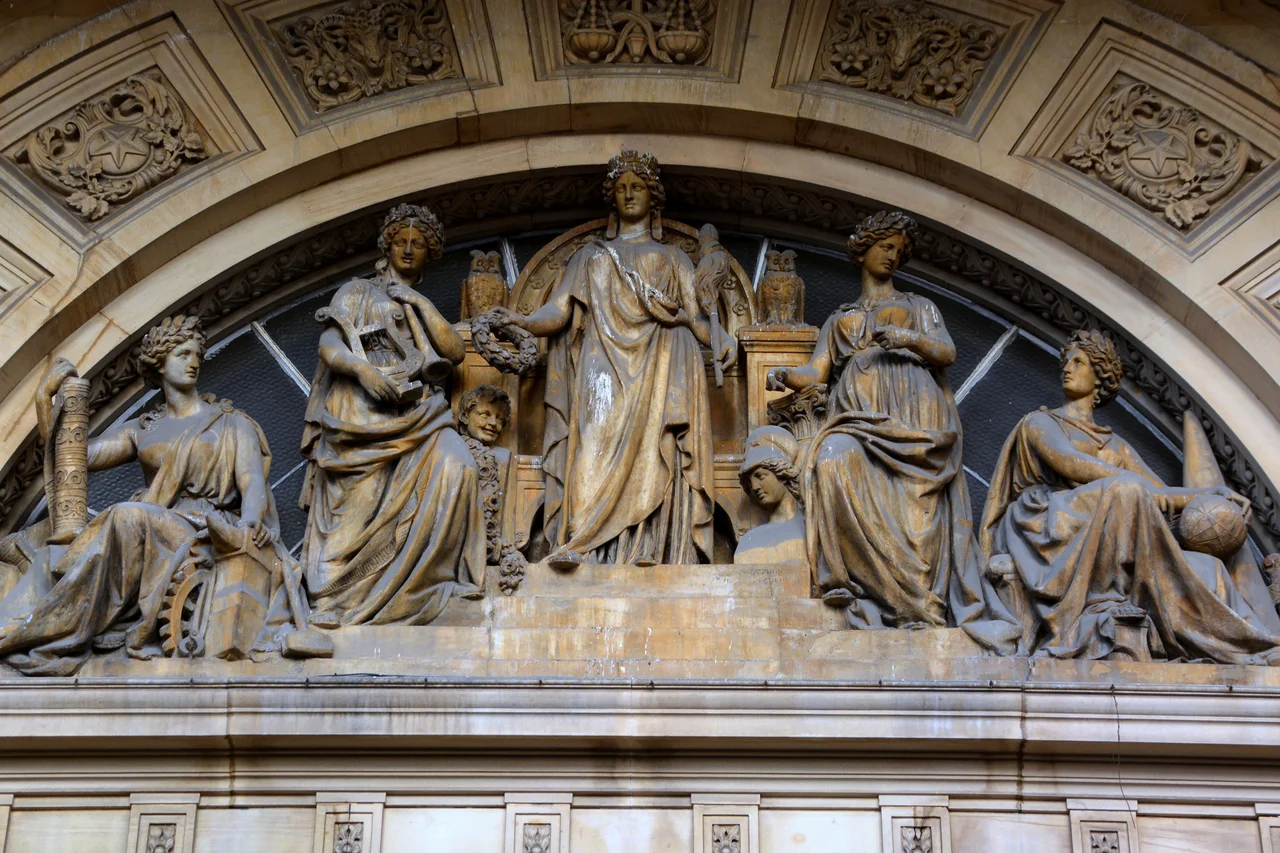
Walk around the building and look up. The masks, the putti on the side panels of the main entrance, the cherubs on the clock tower - the sculptor Catherine Mawer did all of those. Her nephew William Ingle ran the stoneyards and carved every sheep-head relief, the fleeces nodding to the wool money that paid for the Town Hall. The tympanum above the south entrance - figures of Progress, Art, and Commerce - is by John Thomas. The four Portland stone lions added along the frontage in 1867 by William Day Keyworth Jr were modelled at London Zoo. Their soft stone has eroded over a century and a half of Yorkshire weather, and you can read the wear in their manes - sandstone city, Portland faces, slowly returning to surface.
Victoria's Day, 7 September 1858
Vast crowds gathered - thirty-two thousand schoolchildren assembled on Woodhouse Moor alone. Victoria stayed the night before at Woodsley House on Clarendon Road, the home of Mayor Peter Fairbairn, under tight military security. Leeds City Police were reinforced with officers from the West Riding, Bradford, London, and Birmingham. The route from the mayor's house to the city centre was carefully planned so the Queen would see much of Leeds without glimpsing the new Town Hall until the moment she rounded into East Parade and a temporary triumphal arch framed it for her. William Sterndale Bennett conducted the music festival timed to the opening, with Mendelssohn's Elijah opening proceedings and Handel's Messiah closing them. Victoria knighted Mayor Fairbairn on the steps. The Earl of Derby, the Prime Minister, declared the hall open on her behalf. Then she boarded a train at Wellington Station and rode north to Balmoral.
Cells Under the Steps
What looks like a temple was for over a century also a prison. The borough courtroom sits inside still, its wooden benches intact, with stairs leading down from the dock into the basement bridewell - cells located directly beneath the front steps. Major Victorian trials happened here, including the murderer Charles Peace in 1879 and Kate Dover in 1882. During the Blitz on 14 and 15 March 1941, the Luftwaffe hit the east side of the building, damaging the Calverley Street walls and roof. Evidence of the damage still remains in Victoria Gardens. The crypt became an ARP post and, from 1942, a British Restaurant serving cheap hot food, which proved so popular it survived until 1966.
Black Stone, Then White
For much of the twentieth century the Town Hall stood blackened by soot from the mills and chimneys that had funded it. The Leeds Civic Trust argued the blackness should remain - a 'symbol of the city's industrial past and a reminder to future generations of the air pollution which the city is so successfully combatting.' The 1972 clean-up went ahead anyway, revealing detail nobody alive had seen in colour. A more recent refurbishment began in 2019 - Page\Park Architects redesigning the interior, NPS Group replacing the entire roof in Welsh slate. On the dome, contractors found a plaque dated 1861 reading 'This dome was stripped and old lead put on after by Herbert Westcombe and Joseph Nett.' A new time capsule went in during 2019, packed by young people working with Leeds Museums and Galleries - including a Nando's menu, Lego minifigures, a mobile phone, and a Refugee Education Training Advice Service cookery book donated by a woman who had moved from Syria to Leeds the year before. The civic palace keeps adding its own layers.
From the Air
Leeds Town Hall stands at 53.800°N, 1.550°W on The Headrow in the city centre. The 225-foot baroque clock tower is the defining landmark of central Leeds and is the subject of a protected view in local planning policy - no new tall buildings are permitted to block long-range sightlines from the west. Leeds Bradford Airport (EGNM) is 7 nm to the north-northwest. From altitude the tower stands roughly at the centre of the rectangular Victorian street grid, with Park Square greenery to the southwest and Millennium Square to the north. Best viewing altitude 1,500-3,500 ft AGL. The Portland stone lions on the south frontage are visible only from very low approach.
Nearby Stories
- Hovingham Hall 6 km away
- RAF Elvington 7.6 km away
- Battle of Hatfield Chase 9.1 km away
- Wentworth Castle 11 km away
- Murder of Suzanne Capper 12 km away
- Pendle Hill 13 km away
- RAF Topcliffe 15 km away
- Hawes Junction Rail Crash 26 km away