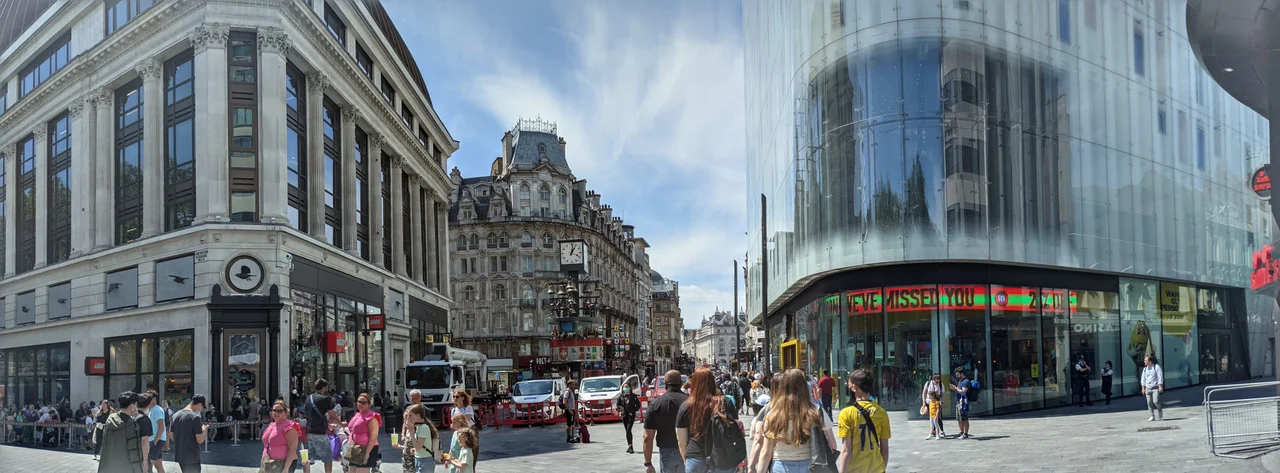

Leicester Square
Premiere nights at Leicester Square pull in two crowds at once. The first arrives in black cars at the kerb, slips out into chairs of camera flashes and red carpet, and disappears through the brass doors of the Odeon. The second crowd is held back behind crash barriers along Charing Cross Road - thousands of people standing four-deep on a Wednesday night to see whichever Marvel or Bond cast has flown in. They get an hour or two of mingling, the carpet, and then the lobby doors close. The black cars drive on to dinner. The barriers come down. The square belongs to the tourists again. This is the only place in Britain where this happens with any regularity, and it has been happening here in some form since 1884.
Leicester Fields
The land belonged to Westminster Abbey until 1536, when Henry VIII added it to his portfolio of seized monastic property. In 1630, Robert Sidney, 2nd Earl of Leicester, bought the estate and began building himself a vast brick house at the northern end. When he fenced off the field in front of it, the parishioners of St Martin in the Fields - who had grazed cattle and washed clothes there on Lammas Day for generations - appealed to Charles I. The king ordered the earl to leave a portion of the field open to the public, and Leicester Fields was born. Houses went up around it in the 1670s, laid out in the Pall Mall style: tall brick townhouses, three windows wide, with a railed garden in the middle. By the eighteenth century it had become one of the smartest addresses in London - Frederick, Prince of Wales lived in Leicester House from 1742 until his death in 1751. William Hogarth lived at number 30, Joshua Reynolds at number 47. Their busts now stand in the corners of the same little park.
Hogarth, Reynolds, and a Hoax
If you walked around the square in 1726, you would have passed a house at number 27 where a woman from Surrey named Mary Toft was being attended by an anatomist named Nathaniel St Andre. St Andre had announced to King George I that Toft was giving birth to rabbits - and not just one or two, but a whole sequence of them, parts and pieces, hour by hour. Sir Hans Sloane, president of the Royal Society, came to look. The royal household sent observers. For several weeks the newspapers carried updates. Then Toft was caught buying a small rabbit in secret, and the entire thing collapsed as a hoax. St Andre's career did not recover. Toft was charged with fraud and eventually released; she was a poor woman who had been put up to it by people who saw a chance to scam the rich. The episode is, in a tidy way, what Leicester Square has always done best: turn a private piece of strangeness into a public event, sell tickets to it, and then move on.
Alhambras and Empires
By the 1850s the square had gone downmarket. New Coventry Street brought traffic through, the gentry moved out to Mayfair, and the houses became shops, museums, and exhibition halls. Wyld's Great Globe was erected in the centre of the park for the Great Exhibition of 1851 - a vast wooden sphere containing a giant scale map of the Earth that visitors climbed inside to see. The Alhambra Theatre arrived in 1854 on the east side, a Moorish fantasy of horseshoe arches and minarets that became famous for ballet. Across the square, the Empire Theatre of Varieties opened in 1884, and gained an unfortunate reputation for the women working in its upper promenade. In 1894 the London County Council ordered canvas screens put up to block access. A young Sandhurst cadet named Winston Churchill, on a night out with friends, helped tear the screens down. The Empire closed in 1927 and the Alhambra was demolished in 1936. Both were replaced by cinemas - the Empire and the Odeon - which still dominate the same corners of the square.
Fester Square
In January 1979, during the Winter of Discontent, the refuse collectors went on strike. Within a fortnight Leicester Square was a knee-deep dump of black bin liners, kebab cartons, and theatre programmes. Newspapers started calling it Fester Square. It became the most-photographed image of British industrial decline that winter - West End nightlife wading through its own rubbish. The strike ended; the rubbish was cleared; the square went on hosting film premieres. It was pedestrianised in the 1980s. In 2010, Boris Johnson's Great Outdoors scheme rebuilt the square at a cost of more than fifteen million pounds, laying 12,000 square metres of grey granite paving and putting a water feature around the Victorian Shakespeare statue. Most of the floor-mounted plaques with film stars' handprints that used to ring the square were quietly removed during that refurbishment, and tourists still occasionally look for them, uncertain why they have gone.
Mr Bean and the Iron Throne
Today Leicester Square has eight permanent bronze statues of fictional film characters scattered around its edges as part of the Scenes in the Square trail, installed in 2020. Mary Poppins floats on the corner of Cranbourn Street with her umbrella raised. Mr Bean sits checking his watch on a bench - tourists queue, sometimes for ten minutes, to take selfies beside him. Paddington reads a newspaper. Wonder Woman stands with her lasso. Laurel and Hardy lean against a lamp post. In June 2021, a replica of the Iron Throne from Game of Thrones was unveiled to mark the show's tenth anniversary; people pose on it as they would for a king. The TKTS booth on the south side has sold same-day discount theatre tickets since 1980. Inside the gardens, the Shakespeare statue (1874) still stands at the centre, framed by Albert Grant's restored Victorian railings. The four corner busts of Newton, Reynolds, Hunter, and Hogarth remember the residents who once owned the square. Around them, the Lego store and M&M's World and the Odeon's neon hold the modern city in place.
From the Air
Leicester Square lies at 51.510N, 0.130W in central London's West End. From the air the pedestrianised square is a distinct rectangular open space about a quarter-mile north of Trafalgar Square and a quarter-mile east of Piccadilly Circus. Look for the rectangular grey-granite plaza with a small central garden, framed on the east by the great brick mass of the Odeon Leicester Square and on the north by the curved neon Empire/IMAX. Heathrow (EGLL) lies twelve nautical miles southwest, London City (EGLC) six nautical miles east-southeast. The Thames helicopter route H4 runs half a mile to the south.
Nearby Stories
- Stevenage 5.7 km away
- Malling Abbey 5.7 km away
- 1952 Farnborough Airshow Crash 7.7 km away
- Ingatestone Hall 8.2 km away
- Hellfire Caves 9.1 km away
- The Carrington Event: The Solar Storm That Could Happen Again 9.8 km away
- Bletchley Park 16 km away
- Castle Hedingham 23 km away