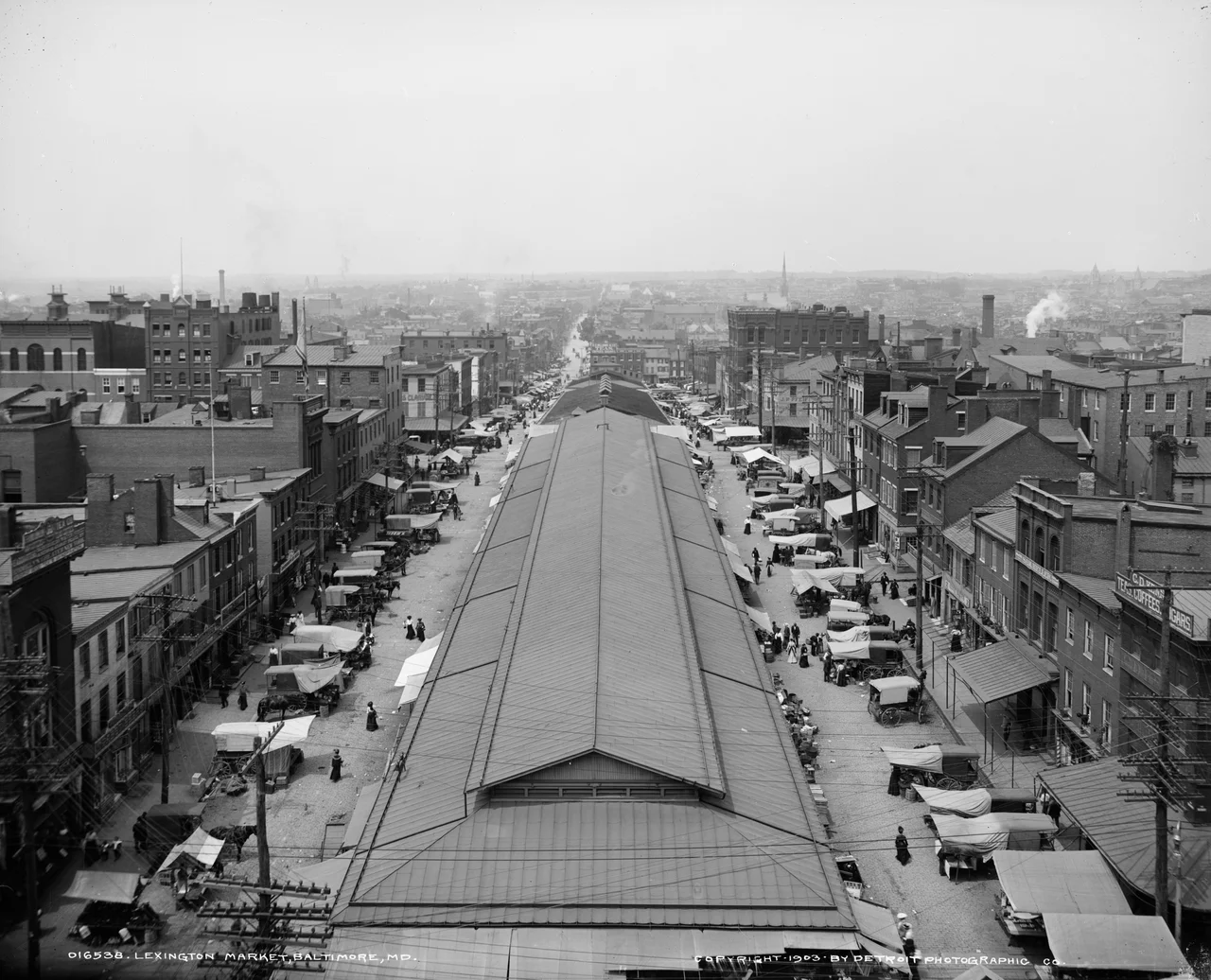

Lexington Market
On Tuesdays, Fridays, and Saturdays in 1782, a bell rang at 2 a.m. on the western edge of what was then Baltimore Town. Farmers from Towson and Reisterstown unloaded their horse-drawn wagons of ham, butter, eggs, and produce. Watermen from the Chesapeake hauled in oysters and crabs from the river. The market ran until noon, when the bell rang again to end the day. The land had been donated by General John Eager Howard, the Revolutionary War officer who had led the Maryland Line at the Battle of Cowpens in January 1781 and would later serve as governor of Maryland. The donation came from his Belvedere estate northwest of town. Lexington Market has been operating in roughly the same spot ever since, making it one of the longest continuously operating public markets in the United States.
Before the Sheds
For its first nine decades the market had no buildings - just open ground where wagons and stalls were set up on market days. Farmers traveled in from the surrounding countryside; watermen came up from Locust Point and Fells Point. The market was the central food distribution point for an entire growing city. Bell-ringing was the timing mechanism; the market officer who controlled the bell controlled the rhythm of the trading day. The first market shed was built in 1871, finally providing roofed shelter for the stalls. It stood until 1949 when a fire destroyed it. The city built a replacement called the East Market at Paca and Lexington Streets, which housed the operation until 2020. A new 60,000-square-foot market shed building opened in late 2022, replacing the East Market and consolidating the market in a single modern facility that holds about 50 merchants and kiosks.
Robert and Rosetta
The market's history includes both enslaved people who worked there and the sale of enslaved human beings at the market site. In 2022, a sculpture called Robert and Rosetta was unveiled at the new market building. The two figures represent specific people. Robert was a man enslaved by former Maryland Governor George Howard who was forced to sell butter at Lexington Market for years before he escaped to freedom. Rosetta was a young girl whose sale at the market was advertised in the Baltimore Sun in March 1838. The advertisement is preserved. The sculpture marks the longstanding refusal of the institution to confront what had happened in its own arcades. Maryland was a slave state until November 1864, when the state constitution finally abolished it, more than a year after the Emancipation Proclamation, which did not apply to Maryland because it had remained in the Union. The market traded in butter and crabs and also, until 1864, in people.
Faidley's
Faidley's Seafood opened a stand at Lexington Market in 1886. The Faidley family has run it ever since, through five generations. Their lump crab cakes - made of just-picked Maryland blue crab meat, mayonnaise, a single saltine cracker crumbled in for binder, and almost nothing else - are widely considered the best crab cakes in Baltimore, and therefore in the country. Adam Richman ate them on the 2012 Mid-Atlantic episode of Adam Richman's Best Sandwich in America. The Faidley's stand looks essentially the way it has for decades: white tile, glass display case, raw bar with oysters on ice. You order at the counter, you stand up to eat - there are tall tables but no chairs - and you understand within about three bites why people drive forty miles to do this. Market Bakery sells Berger Cookies, the Baltimore-specific shortbread cookie topped with thick fudge that has its own dedicated cult following. The market is not subtle. It is exactly what it is.
Real Baltimore
Lexington Market sits about six blocks north of Oriole Park at Camden Yards and the Inner Harbor's tourist district. It is, deliberately, none of that. Baltimore City Paper named it the best way to introduce outsiders to Baltimore in 2001 and the best place to take out-of-town visitors in 2006. The market's clientele includes office workers from the surrounding business district, students at the University of Maryland Baltimore and the University of Baltimore both nearby, jurors from the courthouse, doctors taking lunch breaks from the University of Maryland Medical Center, and tourists who have figured out that the lunch counter on Eutaw Street is more authentically Baltimorean than the chain restaurants on Pratt. The Preakness Crab Derby, an annual fundraiser held in the week before the Preakness Stakes horse race at Pimlico, sends business leaders and local celebrities cheering at live crabs racing across a designated track on the arcade stage.
The 2022 Rebuild
By the late 2010s the East Market building had deteriorated to the point where the city and the Baltimore Public Markets Corporation - the nonprofit that manages Lexington Market and several other historic Baltimore markets - decided a complete rebuild was necessary. Construction began in 2020. The new 60,000-square-foot facility opened in late 2022. The merchants who had been operating in the East Market moved into the new building. The old East Market structure was closed and slated for future redevelopment. The rebuild gave Lexington Market its first significant structural update in seven decades, but the vendor list was largely preserved - Faidley's, Market Bakery, and the historic shoe repair stand are all still there. A market that has been operating since George Washington was alive is now operating in a building that is younger than most of its customers. What stays the same is the bell-ringing 240-year-old idea: a single roof over a city's working food economy, open to anyone who shows up with money or things to sell.
From the Air
Lexington Market is located at approximately 39.2919 N, 76.6234 W on West Lexington Street in downtown Baltimore, between Paca and Eutaw Streets. The site sits well outside the Washington Flight Restricted Zone and Special Flight Rules Area. BWI Marshall (KBWI) is 10 miles southwest. Martin State Airport (KMTN) is 6 miles east. The Lexington Market light rail station and Metro Subway station are immediately adjacent. From altitude, the new 2022 market building is identifiable as a low, modern, gabled structure surrounded by the dense urban grid of downtown Baltimore, six blocks north of Oriole Park at Camden Yards.
Nearby Stories
- Takoma Park, Maryland 5.2 km away
- Annapolis 5.5 km away
- Adkins Arboretum 7.8 km away
- Murders of Katherine and Sheila Lyon 28 km away
- Fort Delaware: The Island Prison Where 33,000 Confederates Waited Out the War 32 km away
- Battle of Gettysburg 35 km away
- Memorial Hall (Delaware State) 36 km away
- Three Mile Island: The Accident That Stopped Nuclear America 71 km away