
Liauckamastate
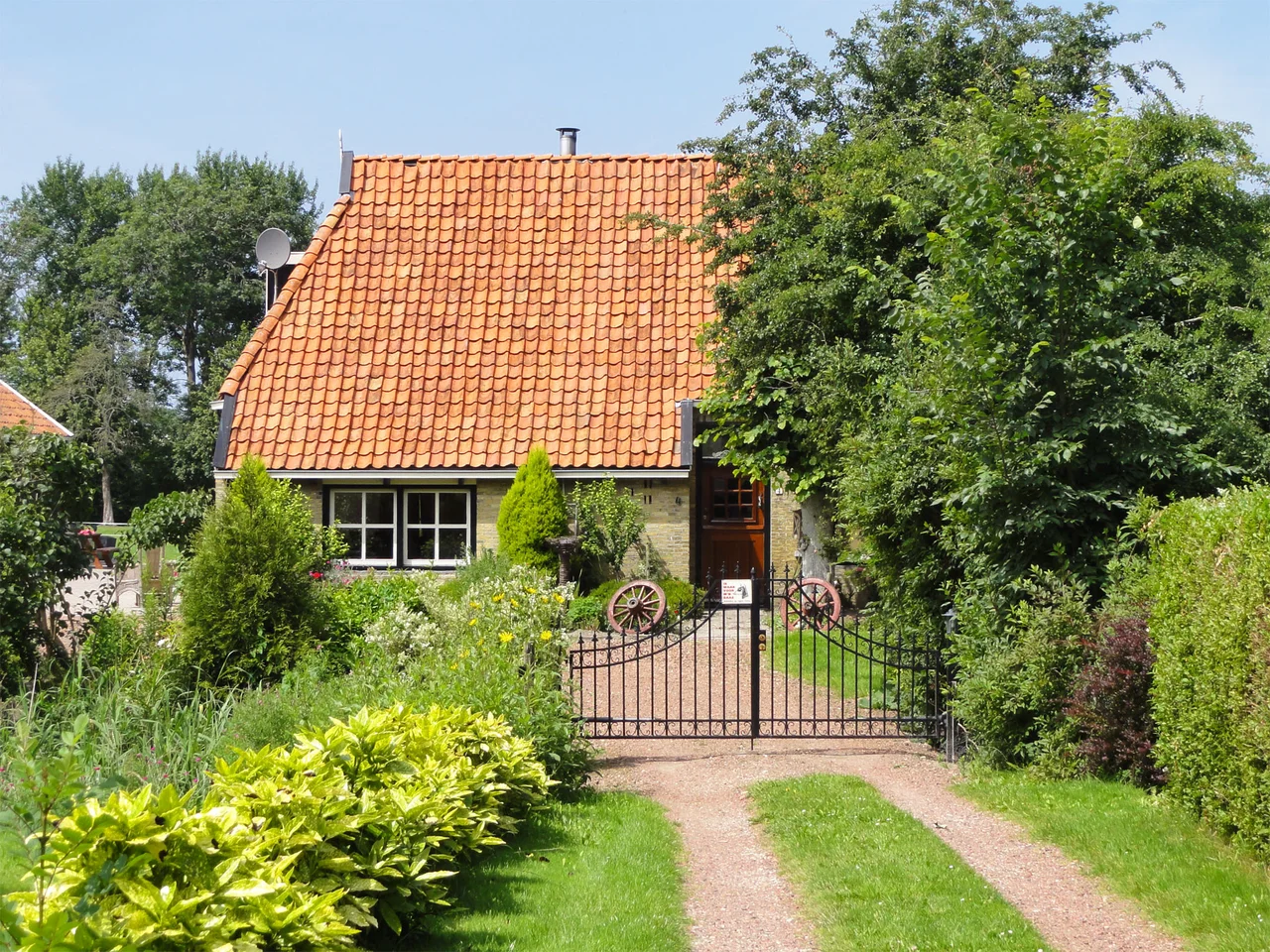
What you see when you arrive is a gate without a castle. The brick gatehouse has a keystone dated 1604, a tiled saddle roof, two gables, and pilasters on top - a small, formal entrance into nothing in particular. Beyond it, where one of Friesland's largest country houses once stood with thirty soldiers on permanent duty, there is a windbreak of trees, a moat, a 19th-century farmhouse, and a day laborer's cottage. The castle was demolished in 1824. Its foundations are still there, filled in with rubble and earth. The well in the front garden is supposedly the original well. Five centuries of Liauckama family power lie quietly under the lawn, and the gate to a vanished house remains a monument in its own right.
A Crusade, Or So They Said
The family liked their origin myth. A sixteenth-century historiography traced the Liauckamas back to two cousins, Eelko and Sicko, who supposedly rode east with the First Crusade in 1096, were knighted after the conquest of Jerusalem, and lost Sicko at the siege of Nicaea the following year. Historians of a more skeptical disposition note that the documentary record begins about two centuries later. The estate itself, by archaeological evidence, was probably founded in the 1200s. The first Liauckama who definitely existed was Eelco Liauckama, born on the estate around 1270, who became abbot of the Lidlum monastery near Tzummarum. His portrait, painted in 1672, hung on the wall at Liauckamastate until the demolition. It was identified during the inventory of 1824 and may well be the same Nicolaas Wieringa canvas that now hangs in the Fries Museum in Leeuwarden.
Vetkopers and Pitchforks
The Liauckamas chose sides early in the Frisian civil wars. Schelte Liauckema, the family's first historically documented head, allied himself with Albert I, Duke of Bavaria, and the Vetkoper faction. The duke rewarded him with the feudal administration of seven villages - Pietersbierum, Wijnaldum, Sexbierum, Minnertsga, Menaldum, Boksum. When the duke was driven out, Schelte went into exile with his wife Ebel Hibbema and was eventually buried in Oosterbierum. A generation later, his grandson Schelte III switched sides - now backing Albert III, Duke of Saxony, as grietman of Wymbritseradeel. The Vetkopers responded by storming Liauckamastate in 1498. The estate, defensively the equal of a small castle with thirty soldiers garrisoned inside, fell to them. They occupied it for a few weeks and burned it on the way out. The Liauckamas rebuilt.
Local Power, In Detail
By 1500, the family controlled most of Sexbierum in a way that the modern word lordship doesn't quite capture. They ran the poor relief - deciding who ate during bad winters. They controlled water management, which on a coast this flat is the difference between fields and tidal flats. They owned the corn mill. They exercised swan rights, an aristocratic perk meaning that every swan on their water belonged to them. They held a prebend in the parish church, an entitlement to a share of clergy income. Strategic marriages kept extending the holdings. The Pipenpoyse bruiloft, a series of paintings commemorating the 1641 wedding of Jel van Liauckama to Eraert van Pipenpoy of Merchten, survives because the Van Grotenhuis family - descendants of the Liauckamas - donated the collection to the Fries Museum in 1963. The paintings outlasted the house.
The Last Heir
The Liauckama name itself ran out in 1670 when Sophia Anna van Pipenpoy died childless. The estate passed to a nephew, Alexander Josephus van der Laen, and then through a series of inheritances that grew more international and more distant from Sexbierum with each generation - a baroness van der Laen van Liauckama, a Maria Walburgia Electa van Ewsum, finally Jhr. Ernestus Jodocus Rudolphus van Grotenhuis van Onstein, who inherited in 1800. By then the estate was an absentee landlord's property. Maintenance fell behind. In 1824 the building was demolished. Before the walls came down, carpenter Baas Schaaf mapped the building room by room, and J. Amersfoordt wrote a detailed report describing the contents, including the many paintings on the walls. The Van Grotenhuis family moved the collection out. Robidé van der Aa later published the inventory in his 1846 Burgen en Kasteelen. The site sold in 1838.
What Survives
The site became a vegetable garden, neatly fitted between the old moats. A farm went up. In 1860 the notary Jacob Wiebes Hanekuyk bought it, tore down the dilapidated farm, and built a new one slightly farther from the moat, so he could keep the old one as a summer house alongside it. The Hanekuyk family kept the property for over a century. In 1947 it was bought by Rients Bruinsma, who during the German occupation had led the Knokploeg Sexbierum - a Dutch resistance group named for the village. His family had been tenants here since the 1840s. Before he retired and passed the working farm to his son, Bruinsma built himself a new house on the old castle's grounds. The cellars of Liauckamastate are still down there, sealed under the lawn. The gatehouse, the farm, and the day laborer's house are all designated rijksmonumenten now. From the road, the gate is the obvious thing. What is missing is, in its way, the more eloquent presence.
From the Air
Liauckamastate sits at 53.22°N, 5.48°E, just south of the small village of Sexbierum on the Friesland coastal plain. From the air the site reads as a near-rectangular moated enclosure ringed by mature trees - a clear windbreak silhouette against the polder grid - with the 1604 brick gatehouse at the entrance. Look for the moat trace and the green-roofed farm buildings inside it. Nearest airport is Leeuwarden Air Base (EHLW), about 24 km southeast. The Wadden Sea coast is roughly 3 km west; the dyke is the obvious visual line. Best viewed at 1,500-3,000 feet AGL in slanted light, when the old moat shadows show.
Nearby Stories
- Stavoren 6.8 km away
- Protestant church of Jistrum 7.4 km away
- Duinen van Texel National Park 8.5 km away
- De Verwachting, Hollum 12 km away
- Battle of Krabbendam 15 km away
- Drenthse Veenkolonien 17 km away
- Schiermonnikoog 18 km away
- West Sole Gas Field 251 km away