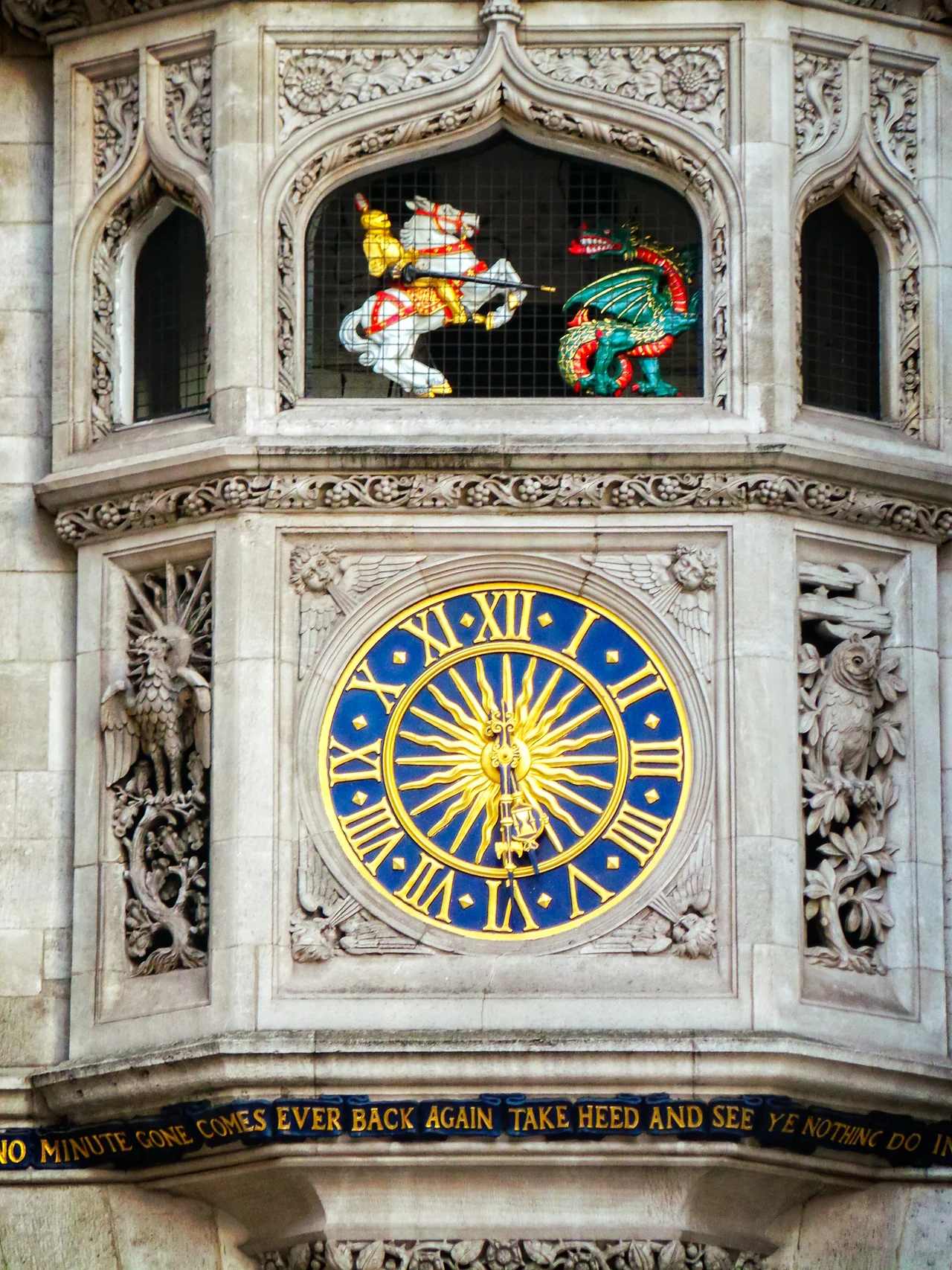

Liberty Clock
Wait at the southern end of Kingly Street on the hour. The crowd flowing between Carnaby Street and Regent Street barely notices the archway above their heads at first - three storeys of dark Tudor-revival timber, leaded windows, and twisted brick chimneys, all set into the western flank of Liberty's department store. But at the chime, the brass mechanism set into the clock face begins to turn. Saint George rises out of his hour-niche and rides at the dragon. The dragon turns. The lance lowers. They duel for about a minute. Then the figures retreat, the bell sounds, the gawkers disperse, and Soho carries on its way. The Liberty Clock has been running this little drama since 1925.
Edwin Hall's Arch
When Arthur Liberty's department store was rebuilt in 1924 as a mock-Tudor emporium, the architects Edwin Thomas Hall and his son Edwin Stanley Hall designed two buildings linked by a three-storey arch. The arch spans the northern end of Kingly Street and contains the Liberty Clock at its centre. It is meant to evoke a Tudor gatehouse - the kind you might find at Hampton Court or Hatfield - dressed in oak beams, mullioned windows, and lead. Around the clock face are four winged heads, one in each corner, representing the four winds: Boreas, Notus, Eurus, and Zephyrus. They look out toward Carnaby Street, toward Great Marlborough Street, toward the lanes of Soho and the hidden courtyards of the West End. The Halls were classicists at heart - they had also built a substantial Italianate frontage for Liberty on Regent Street - but here they were given license to indulge in what the architectural historian Nikolaus Pevsner would later call wrong on every count. He said it with disapproval. Most Londoners said it with affection.
Saint George and the Dragon
The clock face carries an inscription that has become its slogan: 'No minute gone comes ever back again - take heed and see ye nothing do in vain.' On the hour, the mechanical animation above the clock face plays out. A figure of Saint George rides forward; a dragon emerges from its niche; the two duel; Saint George wins. The choreography is small, less than a minute, but it has the charm of a Victorian musical-box trick scaled up to architectural size. Saint George has been the patron saint of England since the late Middle Ages, and his battle with the dragon is one of the oldest visual stories in English iconography - on church frescoes, on coinage, on regimental colours, and now on the side of a department store. The clock is wound by hand. Liberty's clockmakers climb a stair behind the archway to service it. It has been kept running, with brief interruptions for maintenance, for a hundred years.
An Australian Cousin
About ten years after the Liberty Clock was installed, an architect in Perth, Western Australia, built a remarkably similar arch over the entrance to London Court - a Tudor-revival shopping arcade running between St George's Terrace and Hay Street in the city centre. The Perth arch carries an almost identical clock, framed by similar Tudor timbering, and bears the same inscription as the London original: 'No minute gone comes ever back again.' Above the clock face, instead of Saint George and the dragon, a pair of jousting horses charge at each other on the hour. A separate Saint George and dragon scene is set above the southern entrance to the same arcade. London Court was completed in 1937, and its design openly draws on the Liberty Clock as inspiration. Two pieces of London Tudor whimsy, almost exactly nine thousand miles apart, share the same maxim about time. Neither would have existed without the other.
Hidden in Plain Sight
Most people who walk between Carnaby Street and Regent Street pass directly beneath the clock without noticing it. Carnaby Street to the east is a pedestrianised parade of clothing shops and bars that has run its own youth-culture circus since the 1960s. Regent Street to the west is the long arc of John Nash's regency capital, flagship stores in pale Portland stone. Liberty's stands between them, a building that should have been demolished a dozen times in the last century and instead became Grade II*-listed in 1972. The arch is the easiest piece of the building to miss. It looks like a side passage, and it is a side passage - but the timbers were salvaged from two Royal Navy ships of the line, HMS Impregnable (formerly HMS Howe) and HMS Hindustan. The Great Marlborough Street frontage of the main store is exactly the same length as the deck of the Hindustan. The arch and its clock are the smaller, quieter end of one of the strangest pieces of architectural recycling in London.
On the Hour
The four winds keep blowing on the clock face. The dragon keeps emerging from its niche. The lance comes down, the brass figures turn, and the mechanism resets itself for the next hour. Below the arch, the shoppers and the tourists and the office workers heading home from Carnaby Street and the West End pass through, mostly without looking up. The clock does not seem to mind. It is part of a 1920s department store, set into a 1920s Tudor fantasy, built from the timbers of nineteenth-century warships, working a mechanism that retells a story from the Crusades. If you stand still for sixty seconds in the right minute, you can watch all of those layers do their work at once. Then the bell sounds, the figures retreat, and you can return to whatever errand you were on. The clock will run for another hour without you.
From the Air
The Liberty Clock sits at 51.514N, 0.139W on the western archway of Liberty's department store, spanning the northern end of Kingly Street between Great Marlborough Street and Carnaby Street in Soho. From the air the building is a distinctive black-and-white Tudor-revival mass with twisted brick chimneys, set immediately west of Regent Street and the Photographers' Gallery. Heathrow (EGLL) lies twelve nautical miles southwest, London City (EGLC) six nautical miles east. The Thames helicopter route runs half a mile south along the river.
Nearby Stories
- Stevenage 5.7 km away
- Malling Abbey 5.7 km away
- 1952 Farnborough Airshow Crash 7.7 km away
- Ingatestone Hall 8.2 km away
- Hellfire Caves 9.1 km away
- The Carrington Event: The Solar Storm That Could Happen Again 9.8 km away
- Bletchley Park 16 km away
- Castle Hedingham 23 km away