
Liberty (department store)
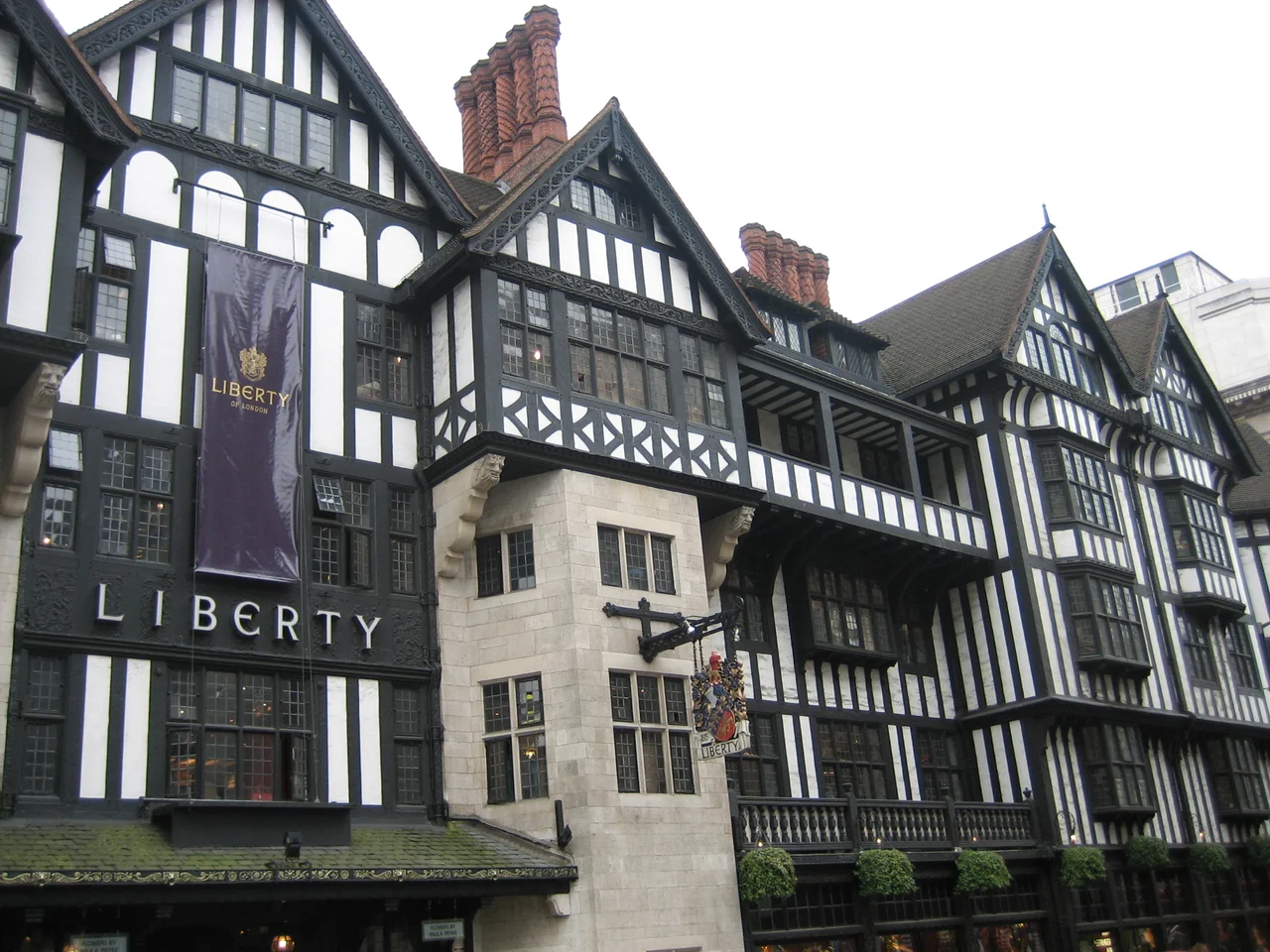
Walk in from Great Marlborough Street on a Saturday afternoon and you are inside a galleon. The atrium climbs four storeys around a central light well; the floorboards are seventeenth-century oak; the staircases creak in a way that no Selfridges or Harrods staircase ever creaks. The story that the building was put together from the timbers of two Royal Navy warships sounds, on the face of it, like a Victorian tour-guide myth. It is not. In 1924 the architects bought HMS Impregnable and HMS Hindustan from the breakers at Devonport and used the deck oak to frame the new Liberty's. The Great Marlborough Street frontage is, deliberately, the exact length of HMS Hindustan's main deck. The store has been here, in some form, since 1875.
Arthur and the Loan
Arthur Lasenby Liberty was born in Chesham, Buckinghamshire, in 1843. He came to London as a young man and worked at a Regent Street shop called Farmer & Rogers, which sold ornaments and silks from Japan and the East. Liberty asked for a partnership in 1874 and was refused. Within a year he had borrowed £2,000 from his future father-in-law and taken the lease of half a shop at 218a Regent Street - three employees, an upstairs office, and a small showroom of Japanese and Chinese objects. Within eighteen months he had repaid the loan and bought the other half of 218. The shop grew through the late 1870s and 1880s, accumulating neighbouring properties one by one. By the 1890s Liberty's was the most fashionable place to buy fabric in London. Oscar Wilde, a regular customer, called it 'the chosen resort of the artistic shopper.' The phrase was kinder than Wilde usually was.
Stile Liberty
Through the 1880s and 1890s, Liberty became the great London promoter of Arts and Crafts, Aesthetic Movement, and what would soon be called Art Nouveau. He commissioned Archibald Knox to design pewter and silver pieces - 'Tudric' and 'Cymric' - that are now among the most collected of all early-20th-century metalwork. He worked with the architect Edward William Godwin on a costume department in 1884, designing clothes that drew on Japanese and medieval English form rather than the corseted Paris standard. Liberty was so closely identified with the new movement that in Italy, Art Nouveau became known as Stile Liberty - the Liberty Style - after the London shop that had popularised it. In 1885, in a piece of Victorian retail theatre that today reads as deeply uncomfortable, Liberty brought forty-two villagers from India to the Regent Street shop and staged a 'living village' of artisans. It was meant to publicise the Eastern import business. The villagers were paid for their time, but the spectacle was unmistakably colonial, and the records of those forty-two people - their names, their families, what they thought of London in November - have not survived.
Tudor Galleon
Arthur Liberty died in 1917, seven years before the new store was finished. The plan had been bold: Liberty's would expand off Regent Street onto Great Marlborough Street, occupying a whole block, with the new building done in the Tudor revival style that was fashionable in the early 1920s. Edwin T. Hall and his son Edwin S. Hall designed it; construction began in 1922 and the store opened in 1924. The structural oak came from two condemned Royal Navy ships of the line, HMS Impregnable (formerly HMS Howe) and HMS Hindustan, both nineteenth-century three-deckers that had spent their later careers as training ships. The Great Marlborough Street frontage matches HMS Hindustan in length. Three light wells climb through the interior, surrounded by rooms with fireplaces - some of them still working. Nikolaus Pevsner, the architectural critic, hated it: 'The scale is wrong, the symmetry is wrong... the goings-on of a store behind such a façade are wrongest of all.' The building was listed Grade II* in 1972. The fireplaces have not been removed.
Ziggy Stardust's Jumpsuit
In the 1960s the design director Bernard Nevill - hired first as a consultant, then promoted - reinvigorated Liberty's textile archive. He pulled vibrant designs from the original Arts and Crafts catalogues and reissued them in new colourways. Yves Saint Laurent walked through the shop in 1970 and bought thirteen designs in thirty-four different colour variations, and then took the entire Chameleon collection for his Paris atelier. One of Nevill's own designs, named 'Corbusier' after the architect Le Corbusier, was sewn into a jumpsuit for David Bowie. He wore it on the cover of The Rise and Fall of Ziggy Stardust and the Spiders from Mars in 1972 - the photograph in front of the Heddon Street alleyway in Soho that became one of the most reproduced album covers of the twentieth century. Liberty's print fabric, on Bowie's body, on a record sleeve, in a million teenage bedrooms. That is the kind of accidental cultural longevity that money cannot quite buy.
Still Here
Liberty has had a turbulent half-century. The company opened twenty regional shops outside London after 1955 - Manchester, Bath, Brighton, York - and closed them all in 1996 when the central business model could no longer carry them. The flagship store was sold and leased back in 2009 to pay off debts. In 2010 it passed to BlueGem Capital, and in 2019 to a consortium led by Glendower Capital. The print fabrics, however, have outlasted every owner. Liberty's textile collaborations now run a long list: William Morris and Dante Gabriel Rossetti in the nineteenth century; Yves Saint Laurent and Vivienne Westwood in the twentieth; Nike, Dr. Martens, Vans, Manolo Blahnik, Adidas, Hello Kitty, Hugo Boss, and Uniqlo in the twenty-first. The Tudor galleon still stands on Great Marlborough Street. The Saint George clock on the Kingly Street arch still chimes on the hour. And the original archive of nineteenth-century print designs, kept under climate control upstairs, continues to feed almost everything the shop sells.
From the Air
Liberty's flagship store stands at 51.514N, 0.140W on Great Marlborough Street in the West End of London. From the air the building is a distinctive black-and-white Tudor-revival mass with twisted brick chimneys, immediately west of Regent Street and just north of Carnaby Street. The store occupies a single block between Great Marlborough Street and Kingly Street, with a connecting three-storey arch over the latter. Heathrow (EGLL) lies twelve nautical miles southwest, London City (EGLC) six nautical miles east-southeast. The Thames helicopter route runs half a mile to the south.
Nearby Stories
- Stevenage 5.7 km away
- Malling Abbey 5.7 km away
- 1952 Farnborough Airshow Crash 7.7 km away
- Ingatestone Hall 8.2 km away
- Hellfire Caves 9.1 km away
- The Carrington Event: The Solar Storm That Could Happen Again 9.8 km away
- Bletchley Park 16 km away
- Castle Hedingham 23 km away