.jpg)
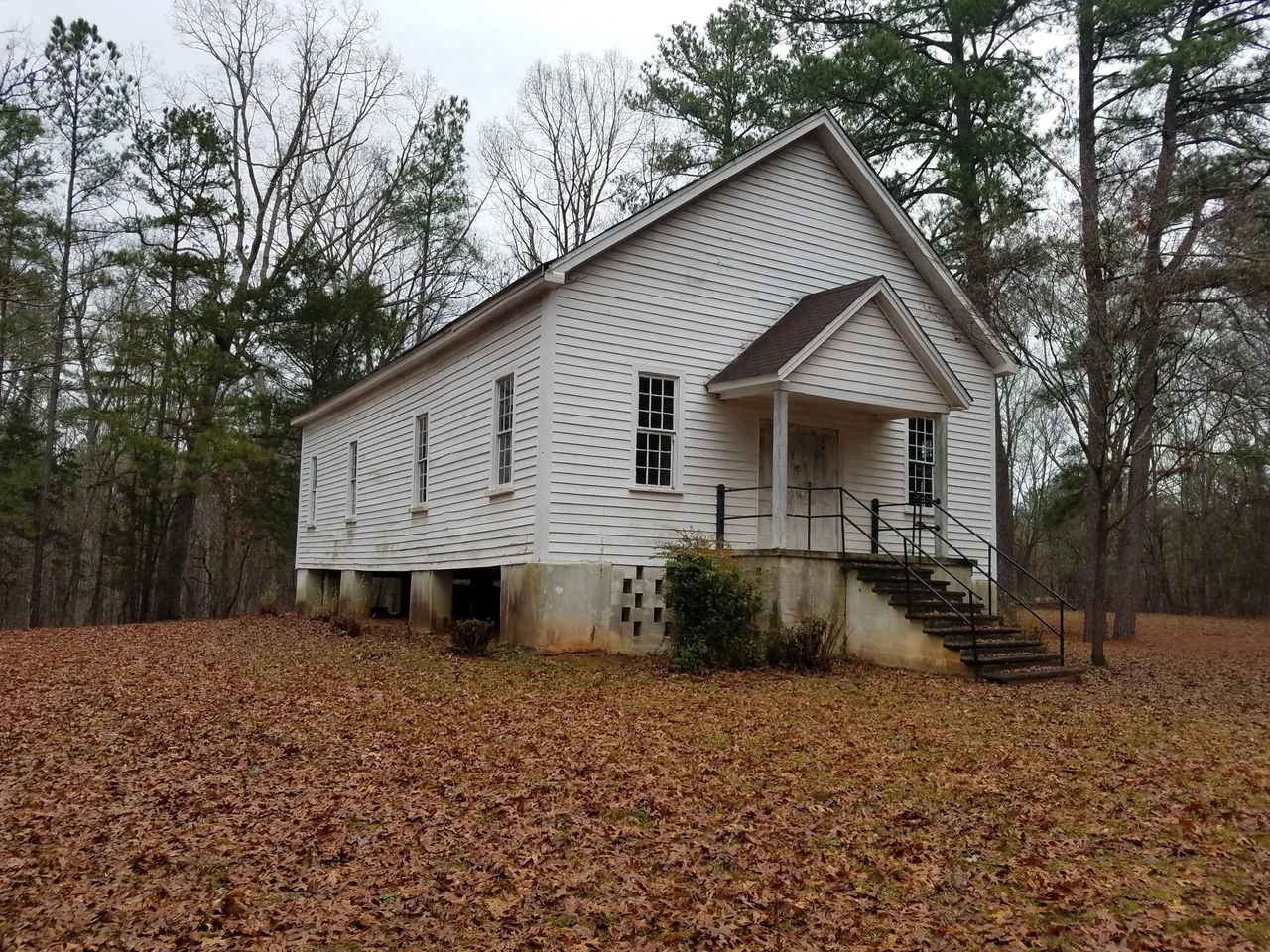
Liberty Universalist Church and Feasterville Academy Historic District
In 1772, a Baptist historian riding through the Beaver Creek country took note of a peculiar congregation: twenty-five families, fifty baptized members, no meetinghouse, and a preacher with a long unshaven beard. The neighbors called them Dunkards, for the three-time immersion baptisms that gave them their name. What that historian could not see was the theological drift already underway in Andrew Feaster's circle - a quiet conviction, passed from father to son, that God's love was wide enough to save everyone. Sixty years later, that conviction would put a small white meetinghouse on a Fairfield County hillside, the only Universalist church South Carolina would manage to build.
The Pennsylvania Family
Andrew Feaster left Lancaster County in eastern Pennsylvania sometime in the 1770s, tried his luck in a Wilkes County, Georgia land grant in 1774, then moved his family north to the Broad River bottoms in Fairfield County. He brought with him the German Baptist Brethren tradition - the Schwarzenau Brethren that Alexander Mack had founded in 1708 - and the habit of letting his beard grow. A local writer in 1880 remembered them as the only men in Beaver Creek who went about with unshaven faces. The Feasters were patriarchs of a large blended family: Andrew's wife Frie brought four children from her first marriage, and together they had six more, including John Feaster, born 1768, who would inherit both the farm and his father's theology.
How Hell Got Empty
The drift away from eternal damnation happened slowly, through three preachers across half a century. David Martin, a Brethren minister who arrived in South Carolina in 1754, encountered the writings of the English clergyman William Law around 1780 and began to doubt the doctrine of endless punishment. Giles Chapman, born nearby in 1748, started preaching in 1782 with what one contemporary called "a full portion of the holy and divine spirit, which taught God is Love." By 1794, Elijah Linch joined the Dunkards as an avowed Universalist - the last person ever received into the Beaver Creek Brethren by the old three-time immersion ceremony. Together these three men, working a circuit through Fairfield, Newberry, and Laurens counties, persuaded their plain-living neighbors that a God of love would not, in the end, abandon anyone.
Building the Meeting House
John Feaster oversaw the construction of the church in 1831, the same year the South Carolina Convention of Universalists held its second meeting in Feasterville. A newspaper account from that September praised the zeal of the local brothers "in building the Liberty Meeting House." The simple white frame building still stands. Fourteen years later, on January 2, 1845, John added a seminary. The story goes that in 1840, his portrait was being painted by an itinerant artist named George Williamson Ladd. Ladd's wife Catharine, herself a teacher, watched the sitting and asked: "Mr. Feaster, there are so many young ladies in the neighborhood, why don't you build a school for them?" Feaster replied, "If I build one, will you teach in it?" She said yes. The boarding house, kitchen, and schoolhouse went up together.
After the Convention Died
The South Carolina Convention of Universalists met for the last time at Liberty Church in 1860, on the eve of secession. Through Reconstruction the church drifted into near-dormancy, and by 1870 a national report noted that Liberty was the only Universalist building left in the state still belonging to the denomination. Revival came slowly. In 1877, twenty-five members - including Jennie Coleman, great-great-granddaughter of old Andrew Feaster - committed to reorganization. By 1887 the congregation had reached fifty-eight. But preaching remained rare; by 1929 only two services were held all year. By the 1950s the church had stopped meeting altogether. The buildings survive because the family kept paying attention - John Feaster's 1847 will had bound them to trustees in perpetuity. Today the Feasters and their descendants gather every year for a reunion on the grounds where their ancestors decided God's mercy had no limit.
From the Air
Located at 34.5036 N, 81.3600 W in Fairfield County, South Carolina, between Winnsboro and the Broad River. The white frame meetinghouse and three academy buildings sit on a rural hillside roughly 25 nm north of Columbia (KCAE) and 50 nm south of Charlotte (KCLT). Best viewed at 3,000-5,000 feet AGL in clear daylight; the cluster is small and easy to miss against the surrounding pine-and-pasture mosaic. Fairfield County Airport (KFDW) lies about 10 nm south-southwest.
Nearby Stories
- Andrew Jackson State Park 6.3 km away
- Hix-Blackwell House 11 km away
- Spartanburg Downtown Memorial Airport 13 km away
- Ninety Six, South Carolina 15 km away
- Battle of Hanging Rock 18 km away
- Huck's Defeat 20 km away
- Newberry Opera House 22 km away
- Camden, South Carolina 23 km away