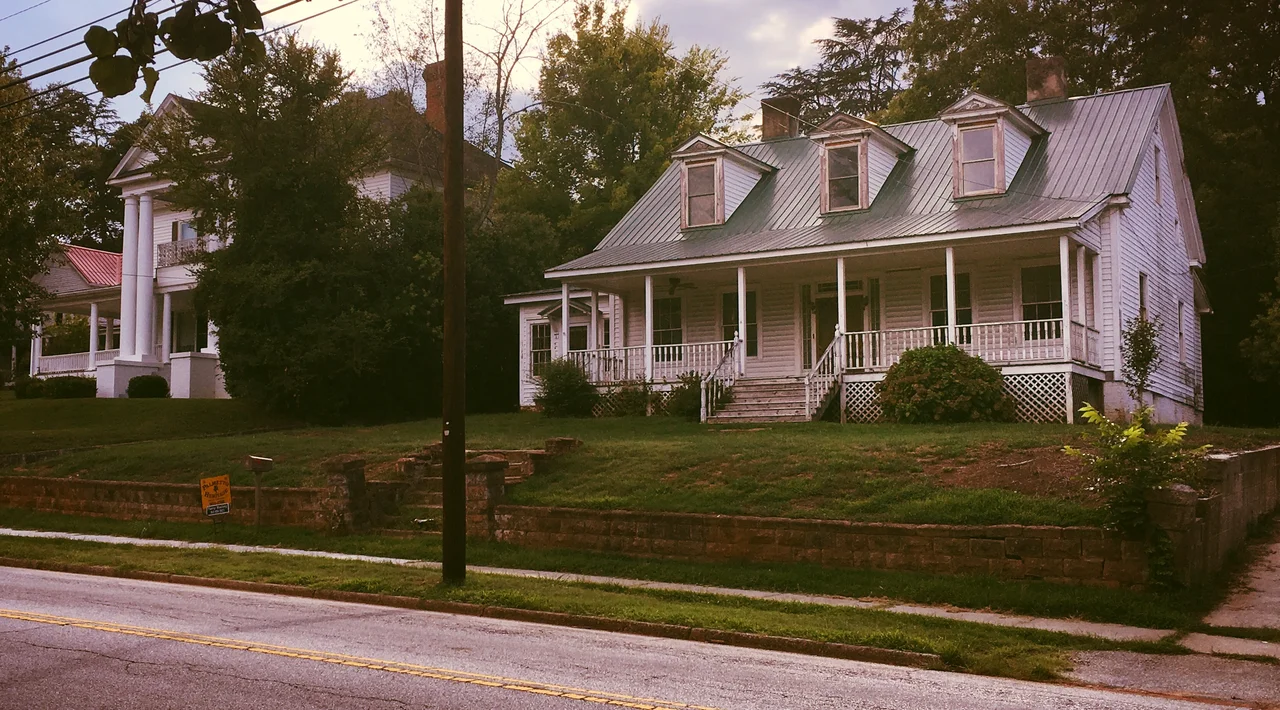

Hix-Blackwell House
William Preston Hix grew up in this house and grew restless. He fought in the Third South Carolina Infantry, learned hand-tinting from a Columbia photographer after his discharge, and ended up partnered in a firm called Wearn & Hix - which produced one of the best-known photographs of Robert Smalls, the formerly enslaved Civil War hero who became a U.S. Congressman. From there 'Press' Hix kept moving north until he was painting full-length portraits of P.G.T. Beauregard in New York and befriending Thomas Edison. In 1884 he installed a two-million-dollar lighting system for the city of Philadelphia, as an agent for the Edison Company. He grew up at 606 South Harper Street in Laurens, in a house his father probably built around 1820.
Edward Hix Buys a Lot
Edward Hix bought the lot in January 1818 from Robert Cresswell, who had served as Lt. Governor of South Carolina from 1814 to 1816. Hix was 26, a War of 1812 veteran, a native Virginian who had spent time in Union County before settling in Laurens. He built carriages and wagons. He ran a furniture factory and grist mill on Hix Creek, just below the house. The deed mentions a 'small house built on the said lott by James Bruster' - probably an older structure that survived alongside the main house until being demolished around 1912. The house Edward built (or expanded) was certainly standing well before 1849, when he placed an ad in The Laurensville Herald offering 'a valuable and desirable house and lot in the Village of Laurens.' Nobody bought it. The Hix family stayed.
Carriages and Steam
Edward Hix served as one of Laurens' first aldermen starting January 1846, when the city was barely a month old. His son Jesse served as the city's first Clerk/Treasurer. By December 1850, the Laurensville Herald was reporting that Edward had bought a lot behind S. R. Todd's store and was erecting 'a steam saw and gristmill.' Within a month the paper noted the addition of 'a planing and mortising machine and a variety of other smaller machines.' The Herald editorialized: 'It will not be long before the dark smoke of the steam horse will be peering aloft over our hitherto quiet little village.' Edward's sons Edward M. and Jesse bought the business from their father on May 24, 1869. Edward M. eventually moved to Johnston, South Carolina, and became the town's fourth settler. Jesse stayed at South Harper, raised five children with his second wife Clara Harlow Boyd, and died in 1905 as the oldest resident of Laurens.
The Blackwells and the Joe Stewart Case
Homer S. Blackwell bought the house in 1918. He was a lawyer who had served in the South Carolina House of Representatives from 1913 to 1914, with a growing practice in the Palmetto Bank Building. He and his wife Jeannie took in boarders early on - the 1920 census shows two in residence. Blackwell's defining case came when he worked the aftermath of the lynching of Joe Stewart, a Black man murdered by a white mob, and tried to bring those responsible to account. In a Southern courtroom of that era, the work mostly ended in frustration. Blackwell would serve as City Attorney for Laurens through the late 1950s and died in 1960 at 83. Jeannie lived in the house until 1975. After her death the home declined into disrepair, then suffered a clumsy 1990s renovation that stripped most of its historic character before careful restoration began.
What the Frame Reveals
The bones tell the age. The beams supporting the house are milled lumber, some 8 by 12 inches, joined with traditional post-and-beam construction and pegged together with hand-shaped wooden pegs - a technique fading rapidly by the mid-19th century. The roof is metal gable, pierced by three pedimented dormers with detailed wood fretwork typical of the early 1800s. Inside, the center hall is wide and tall, with 12-foot ceilings, and a dramatic winding staircase climbs to the second floor. Two central chimneys give each of the four main rooms its own fireplace - originally wood-burning, later converted to coal, then blocked off entirely for gas heaters. The home joined the National Register of Historic Places in 1986 as a contributing resource to the South Harper Historic District. Restoration work continues.
From the Air
Located at 34.49 degrees N, 82.02 degrees W on South Harper Street in Laurens, South Carolina. The house sits in the South Harper Historic District just south of the Laurens Public Square. Best viewed at 1,500-2,500 feet AGL on approach to Laurens County Airport (KLUX, 2 nm north). Greenville-Spartanburg International (KGSP) is 28 nm northeast. The rolling Piedmont landscape around Laurens is dotted with surviving antebellum structures and Revolutionary War sites.
Nearby Stories
- Anderson County, South Carolina 3.1 km away
- 1988 Oakland Elementary School Shooting 7.3 km away
- Pickens County, South Carolina 13 km away
- Battle of Fishdam Ford 14 km away
- Spartanburg Downtown Memorial Airport 17 km away
- Province of Carolina 23 km away
- Georgia Guidestones 26 km away
- Lake Murray (South Carolina) 32 km away