
Province of Carolina
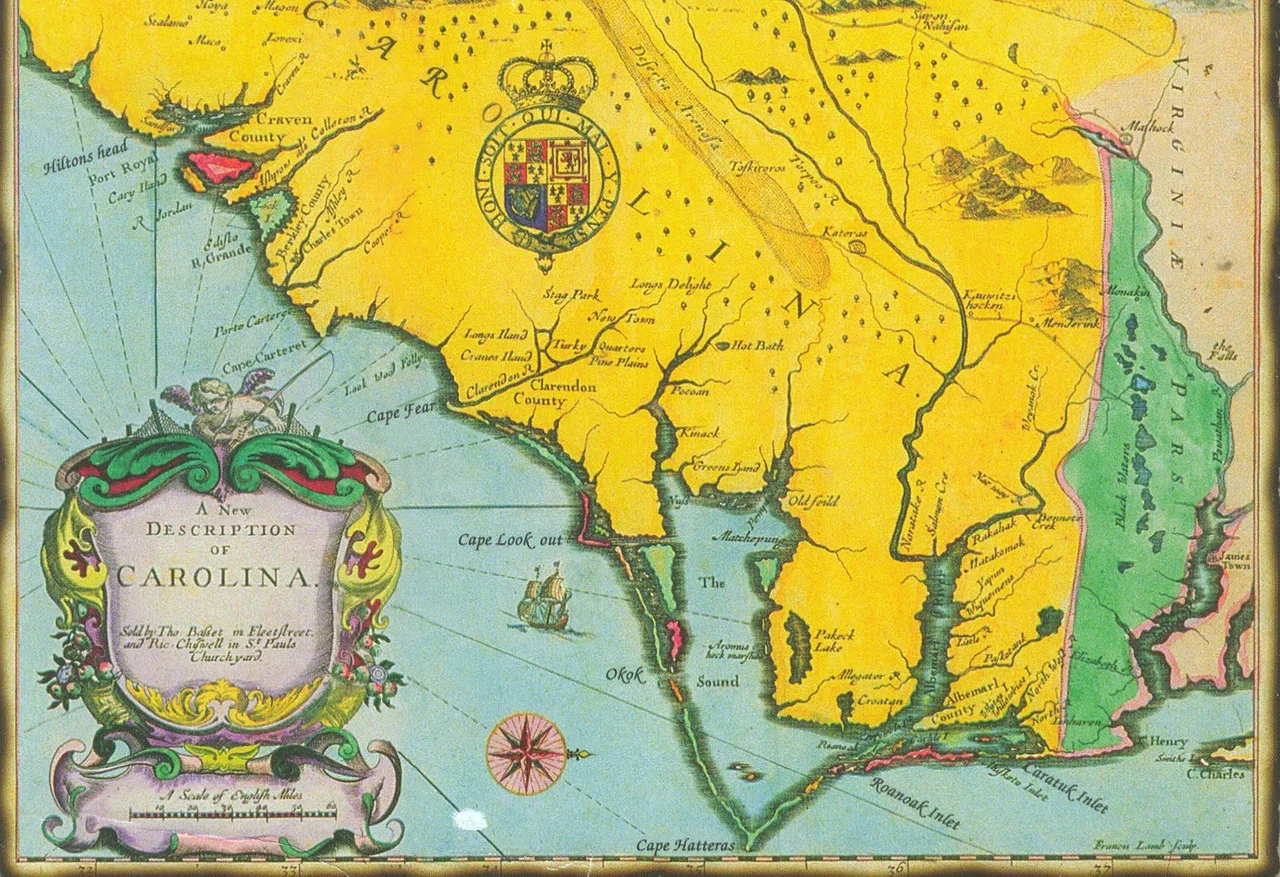
On March 24, 1663, Charles II of England signed a charter that gave eight of his friends a strip of North America running from 36 degrees north all the way down to 31 degrees, and westward - in the casual geographic vagueness of the seventeenth century - from the Atlantic Ocean to the Pacific. The eight men were called the Lords Proprietors, and the land they received was called Carolina, after the king's executed father. None of them had ever seen the place. One of them, however - Anthony Ashley Cooper, Earl of Shaftesbury - thought hard about how to govern it. He hired his secretary, a young philosopher named John Locke, to write the constitution.
A Reward for Loyalty
Charles II had spent his twenties as a king without a kingdom, wandering the courts of Europe while Oliver Cromwell ran England. When the monarchy was restored in 1660, the new king owed favors to the men who had stayed loyal. Three years later he paid one of them: a charter to eight noblemen for the lands south of Virginia. The earlier Carolina claim, granted by Charles I to Sir Robert Heath in 1629, was simply set aside as invalid. The new grantees were Edward Hyde, Earl of Clarendon; George Monck, Duke of Albemarle; William Craven, Earl of Craven; John Berkeley, Baron of Stratton; Anthony Ashley Cooper; George Carteret; William Berkeley; and John Colleton. They received their colony as nearly sovereign rulers - they could appoint governors, raise taxes, levy militias, and operate, the charter said, with "nearly the independence of the king himself."
Locke's Constitution
Anthony Ashley Cooper threw himself into Carolina more than any of the others. With his secretary John Locke - then thirty-seven, the future author of the Two Treatises of Government - he drafted the Fundamental Constitutions of Carolina in 1669. The document is one of the strange documents of American history: utopian, hierarchical, and contradictory. It established a hereditary nobility called "landgraves" and "caciques." It guaranteed religious toleration to every faith except atheism. It enshrined slavery - giving every freeman "absolute power and authority over his negro slaves" - and at the same time gave Indian tribes legal recognition the colony rarely honored. The Constitutions were never fully implemented. The colonists, mostly stubborn Bermudians, Barbadians, and Anglo-Virginians, ignored the philosophical scheme and ran the place as a typical English colony with a powerful governor's council and a weak elected assembly.
Two Heads of One Body
From the start, Carolina was really two settlements with little in common. In the north, around Albemarle Sound, drifters from the Virginia Colony had been quietly squatting since 1653, when emigrants pushed south from the Chowan and Roanoke rivers. The Lords Proprietors blessed this after the fact. In the south, the proprietors built something more deliberate: in 1670 they sent 150 colonists to the south bank of the Ashley River and founded Charles Town - named, like the colony, for the king. By 1680 the settlement had moved across the river to a more defensible peninsula between the Ashley and the Cooper, the two rivers Lord Shaftesbury had immodestly named for himself. Charles Town prospered as a port for the Caribbean trade. The Albemarle settlements stayed agricultural and obscure. The two halves shared a governor in name only. By 1691 the proprietors had to appoint a deputy governor for the northern settlements, and the names "North Carolina" and "South Carolina" entered casual use.
Splitting and Dying
The proprietary system slowly broke down under the strain of distance, religious disputes, and warfare with the Tuscarora and Yamasee peoples in the 1710s. From 1708 to 1710 North Carolina had no recognized government at all, a vacuum that culminated in Cary's Rebellion. In 1719 South Carolina's colonists rose against the Lords Proprietors outright and demanded a royal governor; the Crown gave them one the same year. By 1729 seven of the eight original proprietors sold their interests back to the Crown - the last holdout, Sir George Carteret's great-grandson Earl Granville, kept a sixty-mile strip in northern North Carolina until the Revolution seized it from him. Carolina ceased to exist. In its place stood two royal colonies, twin Charleses, that would each become states, fight a civil war on opposite sides of the Confederate ledger, and eventually trade Locke's hierarchical fantasy for something closer to what he had actually written about elsewhere - the consent of the governed.
From the Air
The Carolina charter coordinates are notional - the article centers at 34.994 N, 81.474 W in the western piedmont of South Carolina, near the historical western frontier of the original colony. Charles Town (modern Charleston, KCHS) lies 165 nm east-southeast; Charlotte (KCLT) 35 nm northeast. The 1663 charter's northern bound (36 degrees) cuts across present-day southern Virginia; the southern bound (31 degrees, after the 1665 revision: 29 degrees) reaches into present-day Florida. Recommended viewing altitude for the piedmont center: 5,000-8,000 feet AGL on a clear day.
Nearby Stories
- Battle of Torrence's Tavern 3.4 km away
- Rutherford County, North Carolina 7.6 km away
- Spartanburg 14 km away
- Charlotte Motor Speedway 16 km away
- Lancaster County, South Carolina 19 km away
- Battle of Ramsour's Mill 20 km away
- Battle of Fishdam Ford 24 km away
- Hix-Blackwell House 36 km away