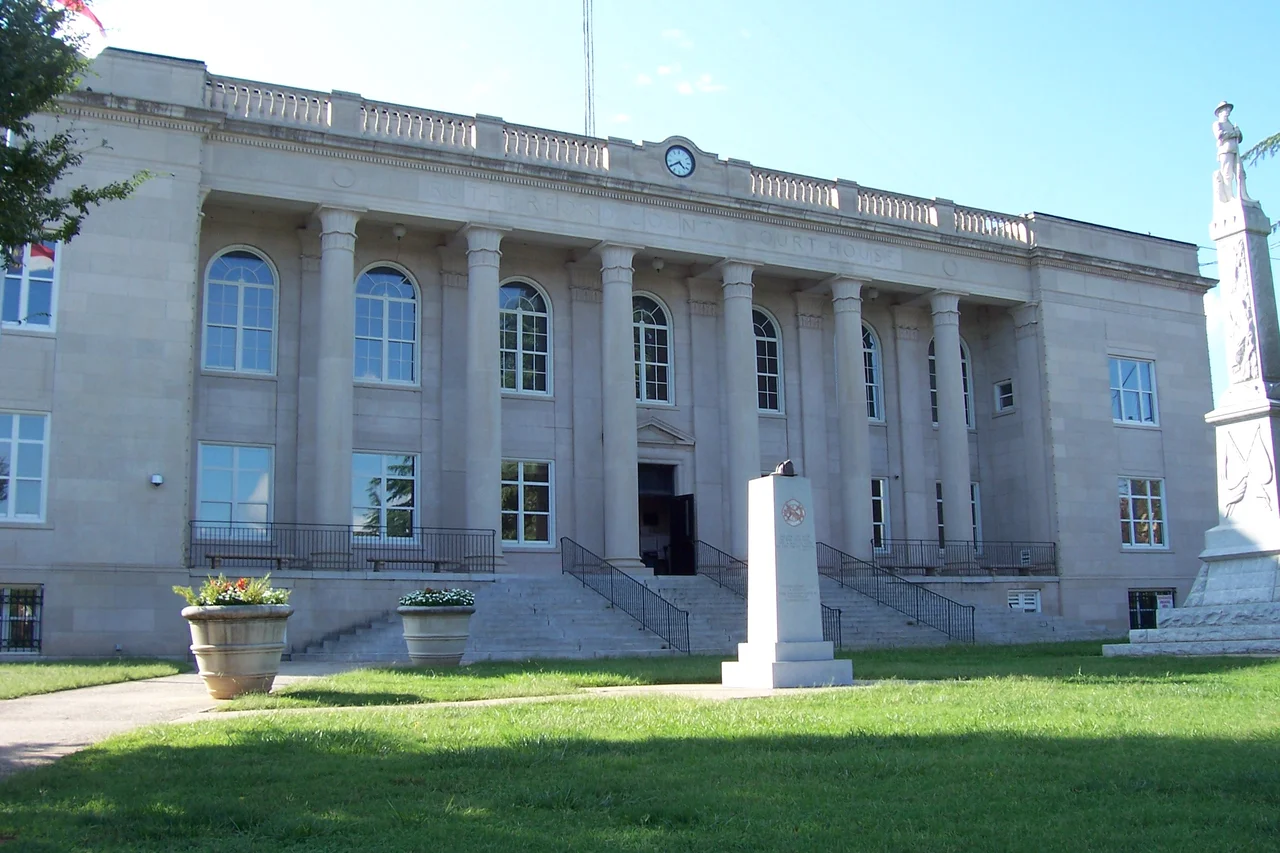

Rutherford County, North Carolina
Christopher Bechtler emigrated from Germany around 1830, set up shop just north of Rutherfordton, North Carolina, and started minting gold coins. Not symbolic ones - actual currency, struck from gold pulled out of streams and shafts in the surrounding hills. Bechtler and his sons produced millions of dollars in coinage, including the first gold dollars ever made in the United States. For half a century, from 1790 to the California Gold Rush of 1849, Rutherford County was the most important gold-producing region in America. A private German immigrant was, in effect, running the country's most active mint, and most Americans had no idea.
Before the Counties, the Cherokee
The land that became Rutherford County was Cherokee territory until colonial expansion pushed the borders west in the 18th century. The county itself was carved out of Tryon County in 1779 and named for Griffith Rutherford, a North Carolina militia general who in 1776 had led an expedition against the Cherokee through these mountains - a campaign that destroyed dozens of towns and contributed to the displacement of an entire nation. The first county seat was Gilbert Town. In 1787 a new seat called Rutherford Town - now Rutherfordton - was founded. Over the next eighty years pieces of Rutherford were split off to form Buncombe, Cleveland, McDowell, and Polk counties; what remained is the 567 square miles where Forest City sits today as the largest community.
Bechtler and the Gold Dollar
The Bechtler Mint operated from about 1831 to 1849, producing $2.50 quarter eagles, $5 half eagles, and the unprecedented $1 gold piece - issued years before the US government's own gold dollar of 1849. The Bechtlers' coins were trusted enough that they circulated widely through the South and were specifically requested in business contracts. The Confederacy paid soldiers in Bechtler gold during the Civil War because it was reliable when paper money wasn't. The mint site is preserved today as Bechtler Mint Site Historic Park. The county's mineral wealth went beyond gold: garnet, tourmaline, slate, wolframite, even samarskite (a rare-earth mineral) have been mined here, along with rock crystal and occasional diamonds - one of which came out of the JD Twitty Gold Placer Mine in 1845.
Militias, Mills, and Mass Violence
Rutherford County had one of the most well-organized militias in 18th-century North Carolina. Its men fought at the Battle of Kings Mountain in 1780 and the Battle of Cowpens in 1781, two of the South's pivotal Revolutionary War engagements. During the Civil War, Rutherfordton and Burnt Chimney (now Forest City) competed to raise Confederate companies. The economic and racial tensions of the late-19th-century South played out here in ugly ways - the Forest City lynching of 1900 was part of the wave of racial violence sweeping the region as the Reconstruction era's possibilities were systematically dismantled. The 1790 census recorded 7,775 residents in the county, including 611 enslaved people. That arithmetic - and what it represented - shaped Rutherford for generations.
Cotton, Cinema, and Lake Lure
Railroads and cotton mills transformed the county in the 1880s and 1890s. The Rutherford Railway Construction Company built a line south to South Carolina, while Southern Railway and Seaboard Air Line ran through the county too. Mill villages sprung up - Cliffside, Caroleen, Henrietta, Alexander Mills - many of which still carry the names of the textile barons who built them. In the 20th century, tourism replaced manufacturing as the rising industry. Lake Lure, an artificial lake built by Lucius Morse in the 1920s, became a resort and later a movie set: *Dirty Dancing* (1987), *The Last of the Mohicans* (1992), and *Firestarter* (1984) were all filmed in Rutherford County. Chimney Rock State Park, with its 315-foot granite monolith overlooking the lake, anchors the region's tourist economy.
A County in Transition
Rutherford County's population was 64,444 at the 2020 census - mostly rural, with about a third living in towns like Forest City (the largest), Rutherfordton (the seat), and Spindale. The economy still leans on timber, textile and construction materials manufacturing, and agriculture: soybeans, wheat, corn, cotton, and livestock. Horsehead Corporation built a state-of-the-art zinc plant near Forest City in 2011. Politically, the county has been reliably Republican since 1980 - no Democratic presidential candidate has carried it since Jimmy Carter in 1976. In May 1989, an EF4 tornado tore through the county as part of a regional outbreak that hit Georgia, the Carolinas, and Virginia. Like much of the southern Appalachians, Rutherford absorbed Hurricane Helene's damage in September 2024. The hills that gave up gold two centuries ago are still here. So is the county that grew up around them.
From the Air
Coordinates 35.40° N, 81.92° W. Nearest airports: Rutherford County Airport (KFQD) at Rutherfordton, Summey Airpark (3NC0) at Caroleen for general aviation; Hickory Regional (KHKY) about 45 nm northeast, Greenville-Spartanburg International (KGSP) about 35 nm south, Asheville Regional (KAVL) about 40 nm northwest. Recommended viewing altitude 4,500-7,500 ft AGL. Look for the foothills topography rolling east from the Blue Ridge Escarpment toward the Piedmont, Lake Lure's distinctive impoundment in the northwest part of the county, and the granite spire of Chimney Rock above it. Forest City sits on the US 74/221A corridor near the county's east-central area.
Nearby Stories
- Cherokee Nuclear Power Plant 14 km away
- Historic Campbell Building 14 km away
- Pisgah National Forest 17 km away
- Black Mountains (North Carolina) 18 km away
- Hickory Museum of Art 21 km away
- Battle of Cowpens 25 km away
- Pickens County, South Carolina 31 km away
- Andrew Johnson National Cemetery 56 km away