
Hickory Museum of Art
Paul Whitener thought a city of 15,000 people in the Catawba Valley needed an art museum. It was the middle of World War II, the furniture factories were turning out ammunition boxes instead of dressers, and Hickory had no collection, no building, no curator. In November 1943, with funding from local industrialist A. Alex Shuford Jr., Whitener borrowed art from neighbors and hung it in the vacant Bradshaw office building downtown. About 600 people came to see it. Three months later, in February 1944, Governor Clyde Hoey held a ceremony in the ballroom of the Old Hickory Hotel and officially chartered the Hickory Museum of Art Association. Charlotte's Mint Museum, founded in 1936, was older. Nothing else in North Carolina was.
The First Painting
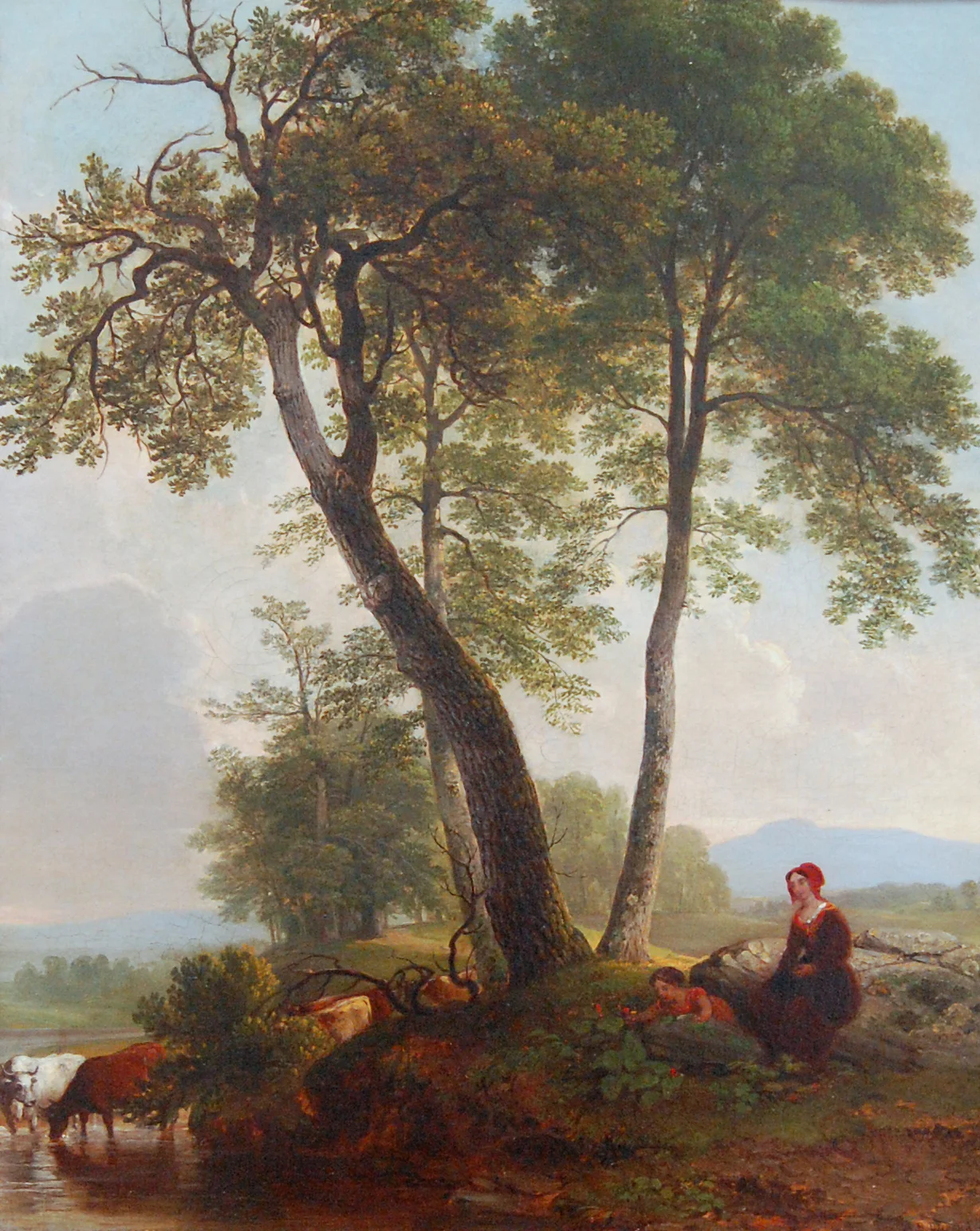
A. Alex Shuford Jr. paid for the museum's first acquisition in March 1944: Burke Mountain, Vermont, by the National Academy of Design officer Frederick Ballard Williams. The price was $140. Whitener, a landscape painter himself, had artistic connections in New York City - the painters Wilford Conrow and Henry Hobart Nichols among them. Many New York artists summered in the North Carolina mountains, and several took an interest in the small museum, donating work. In 1954, the museum acquired a major group of pieces from the collection of Hobart Nichols, president of the National Academy of Design. The donation included works by Thomas Cole, Asher Brown Durand, John Frederick Kensett, Worthington Whittredge, Edward Henry Potthast, and Robert Lewis Reid - a Hudson River School collection that would be remarkable in any museum, but is genuinely surprising in a Catawba Valley furniture town.
Three Buildings
Within a year of its founding, the museum moved into the white clapboard W.W. Bryan house on Third Avenue. It stayed there for fourteen years before relocating to the former Shuford Mills office building on Third Street and First Avenue NW in 1960. By 1984 it had outgrown that space too. Buck Shuford - of the same Shuford family that had funded the first painting - led a $2.6 million campaign to convert the decommissioned Hickory High School building (formerly Claremont High School) into an arts center. In 1986, the renovated structure opened as the Arts and Science Center of Catawba Valley, now known as the SALT Block. The museum has been there ever since, sharing the campus with the Catawba Science Center, the Hickory Choral Society, and the Western Piedmont Symphony.
Face Jugs and Howard Finster
Whitener's stated aim was for the museum to 'embrace all the arts and crafts of the upper Piedmont region of North Carolina.' The third floor of the building is dedicated to Southern folk art - what was once called Outsider Art, now usually called Southern Self-Taught Art. In 2004, Hickory residents Allen and Barry Huffman donated more than 150 contemporary Southern folk art objects, the largest single acquisition in the museum's history. The artists represented are central to the social history of the rural South: James Harold Jennings, Richard Burnside, Miles Carpenter, Raymond Coins, Abraham Lincoln Criss, Minnie Adkins, Howard Finster, Russell Gillespie, Minnie Reinhardt. Catawba Valley pottery sits beside them - the regional tradition of clay vessels and 'face jugs' with anthropomorphic features, made for generations by potters whose names usually do not appear in art history books.
Accredited and Open
Hickory Museum of Art first earned American Alliance of Museums accreditation in 1991. It was re-accredited following a 2014 review - one of only nine museums to make that announcement that year. Of the country's 35,000 museums, only about 1,033 are accredited. To get there, a museum has to conduct a year of self-study and then host a two-person inspection team reporting to the AAM's Accreditation Commission. It is the highest national recognition American museums can earn. A wartime art museum founded in a vacant office building, in a furniture town, has carried that distinction for more than three decades. Paul Whitener's hunch that Hickory needed a visual arts center turned out to be correct in ways that even he probably did not anticipate.
From the Air
Hickory Museum of Art occupies the SALT Block campus at 243 Third Avenue NE in downtown Hickory, North Carolina, at roughly 35.736 N, 81.334 W. Field elevation around 1,160 feet. The campus is a recognizable red-brick complex (the former Claremont High School) in the downtown grid. Nearest airports: Hickory Regional (KHKY) 3 miles west, Statesville Regional (KSVH) 28 miles east, Charlotte Douglas (KCLT) 65 miles southeast. Interstate 40 runs just south of downtown - a clear east-west visual reference.
Nearby Stories
- Perciphull Campbell House 1.7 km away
- Avery County, North Carolina 5 km away
- Rutherford County, North Carolina 12 km away
- Battle of Ramsour's Mill 12 km away
- Marion, North Carolina 13 km away
- Moravian Falls, North Carolina 21 km away
- Charlotte Motor Speedway 24 km away
- Thomas Gillespie 24 km away