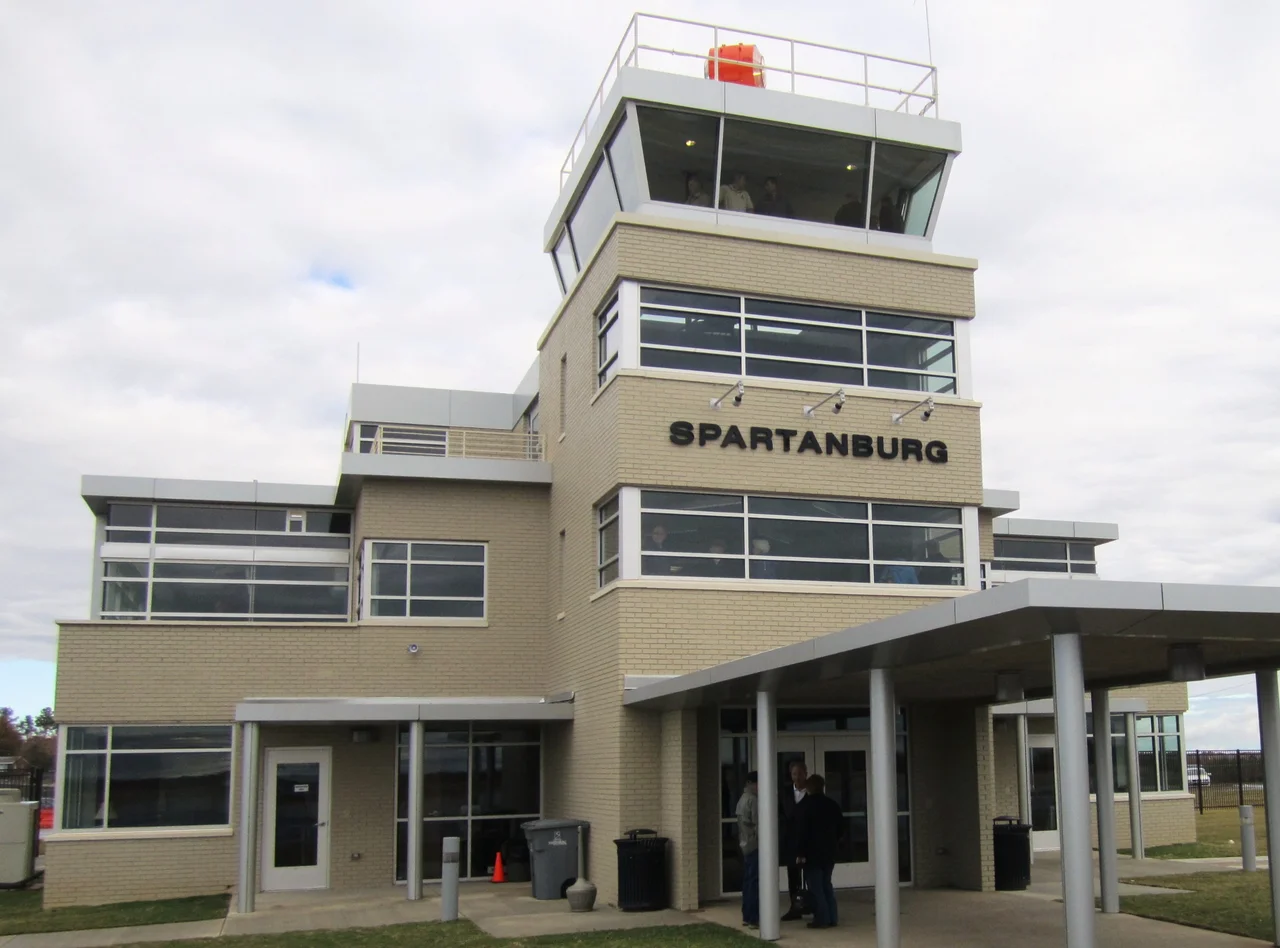

Spartanburg Downtown Memorial Airport
Charles Lindbergh landed at Spartanburg five months after he landed at Le Bourget. The Spirit of St. Louis had crossed the Atlantic in May 1927, making the 25-year-old airmail pilot the most famous human alive. By the time Spartanburg's new airfield held its grand opening later that year, having Lindbergh on hand to christen it had become the bar that aviation-mad American cities tried to clear. Spartanburg cleared it. South Carolina's first commercial airport opened with the Lone Eagle as its dedicating dignitary, and the photographs that survive still anchor the airport's identity nearly a century later.
The Hub City's Runways
Passenger service began that same year. In April 1957, the schedule book showed Eastern operating six weekday departures from Spartanburg, Southern running four, and Delta running three. The arrangement ended in 1962 when the new Greenville-Spartanburg Jetport opened halfway between the two cities and the airlines moved their operations - the jetport eventually became Greenville-Spartanburg International Airport. Spartanburg's downtown field reverted to general aviation. It had been wartime busy in the interim: during World War II it served as a training facility for the U.S. Army Air Corps and a refueling stop for naval aviators heading inland. An FAA-operated control tower ran the field until 1981, when it closed during the PATCO controllers' strike and never reopened.
From Three Runways to One
The original layout had three intersecting runways - 4/22 at 5,203 feet, 17/35 at 4,226 feet, and 11/29 at 4,403 feet - all 150 feet wide, with a parallel taxiway system connecting them to the ramp. Today only one remains. Runway 4/22 was redesignated 5/23 to reflect magnetic variation drift, and the other two are visible only in faint outlines from the air. Prevailing winds favor the surviving runway. A $25 million extension project completed in 2018 lengthened 5/23 to 5,852 feet, added safety areas at both ends, resurfaced the asphalt and upgraded navigation. Runway 5 carries an ILS approach. WAAS approaches serve both 5 and 23. The lighting package includes HIRL edge lights, VASI, and the MALSR medium-intensity approach lighting. The Spartanburg Vortac sits 7.2 miles northeast; the Fairmont NDB is 1.6 miles west.
The 1936 Terminal Still Stands
The original 1936 terminal building survives, renovated and expanded in 2011, now housing a city-operated FBO. Two flight schools work the field: Pivotal Aviation and Aero II. Several hangars stand adjacent to the terminal, and the Spartanburg Composite Squadron of the Civil Air Patrol calls the airport home, along with the Spartanburg Pilot's Association. In 2018 the airport added an aviation-themed playground with a viewing platform and a covered pavilion - a deliberate move to reconnect the surrounding city with the field that taught it to fly. The economic case is plain: $15.4 million contributed to the local economy, 190 aviation-related jobs, a payroll over $5.2 million. Spartanburg Downtown Memorial is the third-busiest general aviation airport in South Carolina, with almost 69,000 operations a year. Three miles from the Hub City's center, it still serves the function it was built for - moving people in and out by air.
From the Air
Spartanburg Downtown Memorial (KSPA, IATA SPA) is located at 34.92 degrees N, 81.96 degrees W, 3 miles southwest of downtown Spartanburg, South Carolina. Single runway 5/23, 5,852 feet by 150 feet, asphalt, ILS to runway 5, WAAS approaches both ends. Field elevation 808 feet MSL. CTAF/UNICOM 122.7 - check current charts. Spartanburg VORTAC (SPA) 7.2 nm northeast. No control tower since 1981. Greenville-Spartanburg International (KGSP) lies 12 nm west. The airport is the third-busiest GA field in South Carolina with nearly 69,000 annual operations.
Nearby Stories
- Battle of Graham's Fort 8.8 km away
- Pickens County, South Carolina 9.4 km away
- Anderson County, South Carolina 12 km away
- Battle of Fishdam Ford 14 km away
- Brevard, North Carolina 14 km away
- Province of Carolina 14 km away
- Green River (North Carolina) 16 km away
- Hix-Blackwell House 16 km away