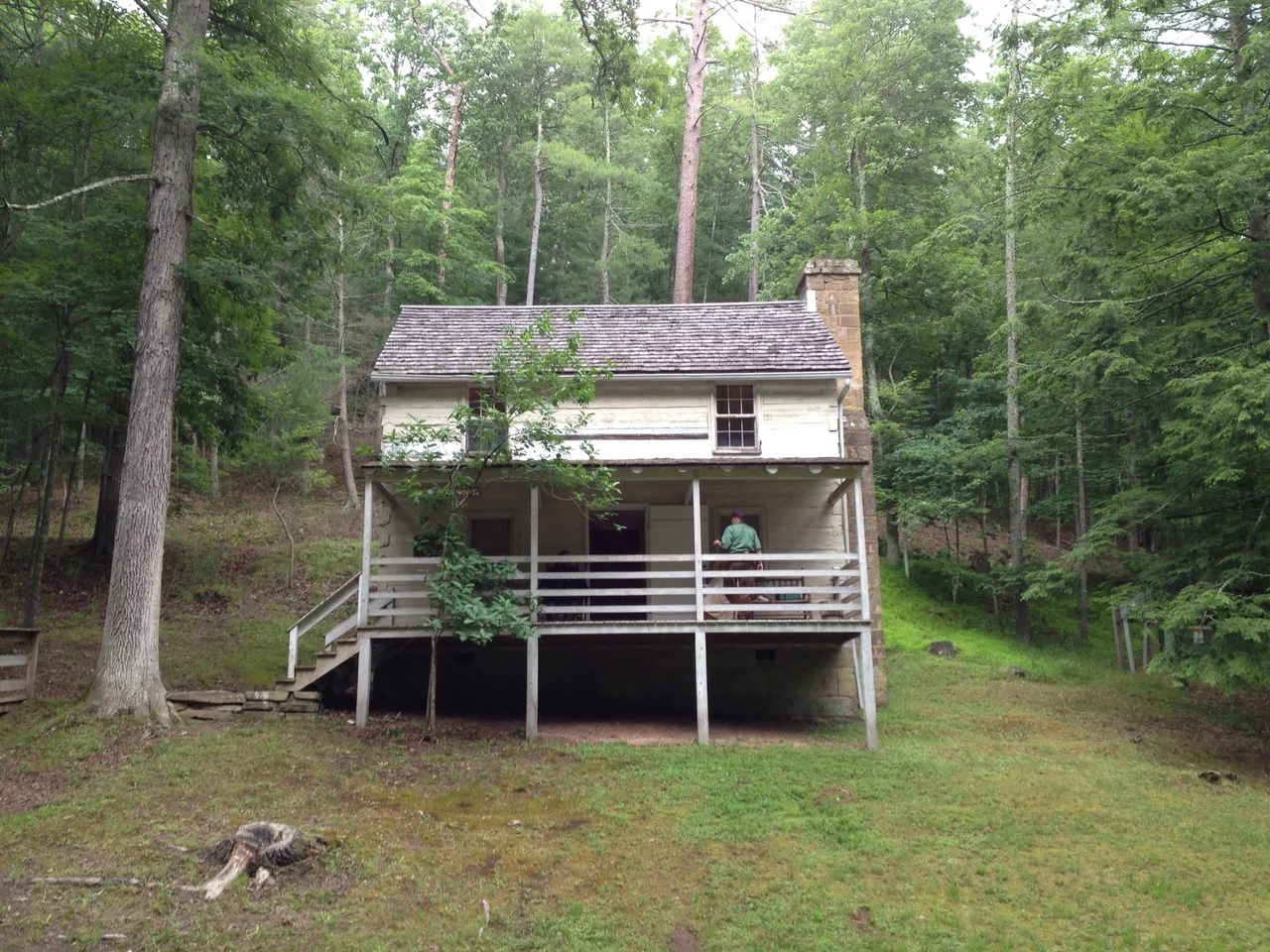

Lighthorse Harry Lee Cabin
Charles Carter Lee was the eldest son of a Revolutionary War cavalry hero and the older half-brother of the man who would lead the Confederate Army. He was also a man who liked to summer in the mountains. Around 1820, he built a log cabin in a remote fold of the Allegheny Mountains in western Virginia, far from the family seat at Stratford, far from the political crises gathering in Richmond - a quiet retreat where the Lee family could escape Tidewater summers. The cabin is still there.
A Famous Father, a Quiet Son
Henry Lee III - Light-Horse Harry to the country he had helped create - was one of the most celebrated cavalry commanders of the American Revolution, a former governor of Virginia, and the man who eulogized George Washington as first in war, first in peace, and first in the hearts of his countrymen. He died in 1818, broke and exiled, at Cumberland Island, Georgia, while returning home from the Caribbean. His older son Charles Carter Lee, born in 1798, was raised in the shadow of that fame. Charles inherited family land in the Lost River country of what was then Hardy County, Virginia. Around 1820, two years after his father's death, he built a summer cabin there. He was twenty-two years old.
Sixty Years in the Family
The cabin stayed in the Lee family until 1879. For nearly six decades it functioned as the family retreat: a small log structure tucked into the hardwood forests of the Lost River drainage, miles from the nearest town. Robert E. Lee, Charles's younger half-brother, is known to have visited. The cabin was a working summer house, not a showpiece - a place where the family could hunt, fish, ride, and weather the Virginia heat. The Lees finally sold it in 1879, fourteen years after the Civil War ended and nine years after Robert E. Lee's death. By then the wider Lee dynasty was scattered, financially diminished, and only beginning the slow rehabilitation of its public image.
The State Acquires the Cabin
Lost River State Park was created in the 1930s, during the Civilian Conservation Corps era when West Virginia was assembling a string of new parks out of donated, purchased, and seized land across the Allegheny highlands. The Lee Cabin was among the historic structures absorbed into the new park. The state restored the building and opened it as a museum, presenting it as a piece of Lee family history accessible to the public for the first time. The cabin was added to the National Register of Historic Places in 1974, formally recognizing its connection to one of the most consequential families in American history. The building still sits inside the park, near Mathias in Hardy County, surrounded by the same mountains the Lees once rode through on their summer visits.
Why the Building Matters
Most surviving Lee family residences are grand: Stratford Hall, Arlington, Shirley. The Lighthorse Harry Lee Cabin is the opposite - small, simple, working class in scale if not in ownership. That is part of what makes it valuable. The cabin shows what a wealthy 19th-century Tidewater family considered an acceptable second home: rough logs, a single fireplace, a setting reached only by long days on horseback. It also locates a piece of the Lee story in West Virginia, a state that did not exist when the cabin was built and that came into being in 1863 in part because the question of Virginia's loyalty had become, for the Lees and everyone else, a constitutional crisis. The cabin predates that question by four decades, and now sits inside the territory that broke away because of it.
From the Air
Located at 38.89 degrees north, 78.92 degrees west, inside Lost River State Park in Hardy County, West Virginia. From 5,000 to 7,000 feet AGL the cabin itself is hidden under the forest canopy, but the broad clearing of the park lodge and the ridge of Big Ridge Mountain provide a visual reference. Nearest airports include Hardy County (W22), Winchester Regional (KOKV), and Front Royal-Warren County (KFRR). Expect ridge turbulence and frequent valley fog in early mornings.
Nearby Stories
- Hoye-Crest 5.1 km away
- Battle of the Trough 6.5 km away
- Allegheny Mountains 8.2 km away
- Willa Cather Birthplace 9.9 km away
- Belle Grove Plantation 12 km away
- Lincoln Homestead and Cemetery 15 km away
- Jones-Imboden Raid 31 km away