
Limehouse
The name comes from lime kilns, not opium. Long before Sax Rohmer dressed it up as a pulp-fiction underworld, Limehouse was a working port — a curve of the Thames east of the City where ships were built, ropes were spun, and chalk was burned in oasts to make mortar for the growing town. The earliest written record, from 1335, mentions a place called "Lymhosteys." An inquest from 1417 still survives, recording the death of one Thomas Franke, a steersman from Harwich, killed when he fell on the sharp end of an anchor. Limehouse begins, in the written record, with a sailor and a bad accident on the riverbank.
Where the River Turned the Town
Limehouse always faced the water. The marshes behind it made overland travel slow, so the river was the road. By the late medieval period it had become a real port — not the place where great cargoes were unloaded (that happened upstream in the Pool of London) but where the support trades clustered: shipwrights' yards, chandlers' stores, ropewalks stretching back behind the wharves. John Boydell's 1751 view shows respectable houses crowding the riverfront alongside the shipyards, the working and the genteel jammed shoulder to shoulder. The Grapes, rebuilt in 1720 and still standing on Narrow Street, was already old by then; Dickens knew it well and put it into Our Mutual Friend as the Six Jolly Fellowship Porters. In 1820 the Regent's Canal Dock opened — what became Limehouse Basin — and the place picked up an entirely new identity as the hinge between deep-sea shipping and the inland canal network.
Chinatown Before Chinatown
Tudor-era ship's crews were hired by the voyage, paid off at the end, and recruited fresh from whatever port the ship happened to dock in. Sailors from West Africa, from the Indian subcontinent (the Lascars), and especially from southern China — men working the opium and tea trades — kept ending up in London with nowhere particular to go. Permanent communities took root: at Shadwell, at Limehouse, at Pennyfields in neighbouring Poplar. The Chinese community here was small but established, with shops, eating houses, and family homes. It was these residents — not the lurid invention that came later — who actually lived in Limehouse. The opium dens did exist; so did the racism. Sax Rohmer's Fu Manchu novels and Thomas Burke's Limehouse Nights turned a working immigrant neighbourhood into pulp shorthand for yellow-peril menace, and the films followed: Broken Blossoms (1919), The Blackbird (1926), and the dance number from Ziegfeld Follies (1946) in which Fred Astaire performed in yellowface. The community itself, much reduced after Second World War bombing destroyed large parts of the area, eventually shifted to Soho. The fiction lingered longer than the families it slandered.
Attlee's Conversion
In 1906 a young, conservative-leaning Oxford graduate named Clement Attlee took a job running Haileybury House, a club for working-class boys in Limehouse. He came expecting to do a little gentlemanly charity work. He found instead the East End — the slum housing, the casual hunger, the children who grew up old. Within two years he had joined the Independent Labour Party. By 1919 he was mayor of Stepney. By 1922 he was Member of Parliament for Limehouse, the constituency he would hold for nearly three decades, including the years when he served as Deputy Prime Minister to Churchill and then as Prime Minister himself from 1945 to 1951. The welfare state, the NHS, the post-war social settlement — they all trace, in part, back to what one young man saw walking these streets. His statue stands outside the former Limehouse Library to this day.
The Houses That Were Left Behind
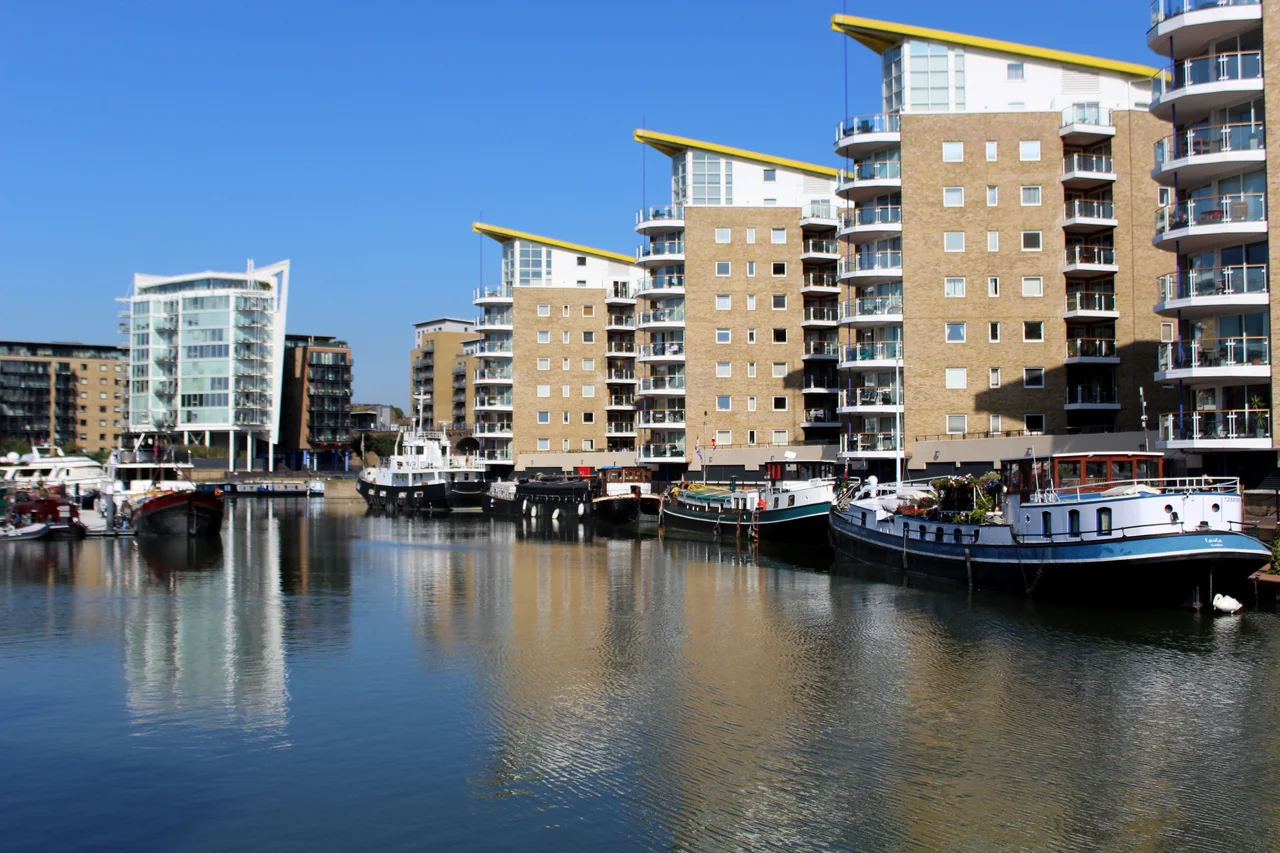
Second World War bombing flattened most of Narrow Street's southern side — hundreds of houses, the Barley Mow Brewery, a school. A single Victorian terrace survived, propped up afterwards by three large supporting pillars; locals still call it "The House They Left Behind." Across the street, the early Georgian terrace miraculously endured, one of the few left in London. The dock itself closed in the late 1960s, part of the East End-wide collapse that prompted the creation of the London Docklands Development Corporation in 1981. The LDDC's plans for Limehouse — combined with the explosive growth of Canary Wharf just south on the Isle of Dogs — turned the derelict basin into Limehouse Marina, where canal narrowboats now moor next to seagoing yachts. The dockmaster's house on Narrow Street is now a Gordon Ramsay gastropub. The wharves are luxury flats.
The Place That Gave a Word
On 30 July 1909, Chancellor of the Exchequer David Lloyd George stood in Limehouse and delivered a furious speech attacking the House of Lords for blocking his People's Budget. The speech was so incendiary it produced a new verb: to Limehouse meant to make a fiery political address. Seventy-two years later, on 25 January 1981, four Labour MPs — Shirley Williams, Roy Jenkins, William Rodgers and David Owen — stood on the bridge over the Limehouse Cut in Narrow Street and issued the Limehouse Declaration, announcing the breakaway Social Democratic Party. Twice in seventy-odd years, a small East London district lent its name to a moment when British politics tore itself apart. The neighbourhood that started as lime kilns by the marsh keeps turning up in the historical record where things change.
From the Air
Limehouse lies on the north bank of the Thames at 51.5158°N, 0.0318°W, about 3.9 miles east of Charing Cross. From the air, look for the distinctive triangular basin (Limehouse Marina) just inland from a kink in the river, with Canary Wharf's towers rising prominently to the south on the Isle of Dogs. The white spire of Hawksmoor's St Anne's Limehouse is a useful landmark. Nearest airport: London City (EGLC), 4 miles east-southeast. Heathrow (EGLL) and Stansted (EGSS) are the major hubs. Best viewed from low altitude on Thames-following approaches; air traffic into London City crosses this area at relatively low level.
Nearby Stories
- Stevenage 5.7 km away
- Malling Abbey 5.7 km away
- 1952 Farnborough Airshow Crash 7.7 km away
- Ingatestone Hall 8.2 km away
- Hellfire Caves 9.1 km away
- The Carrington Event: The Solar Storm That Could Happen Again 9.8 km away
- Bletchley Park 16 km away
- Castle Hedingham 23 km away