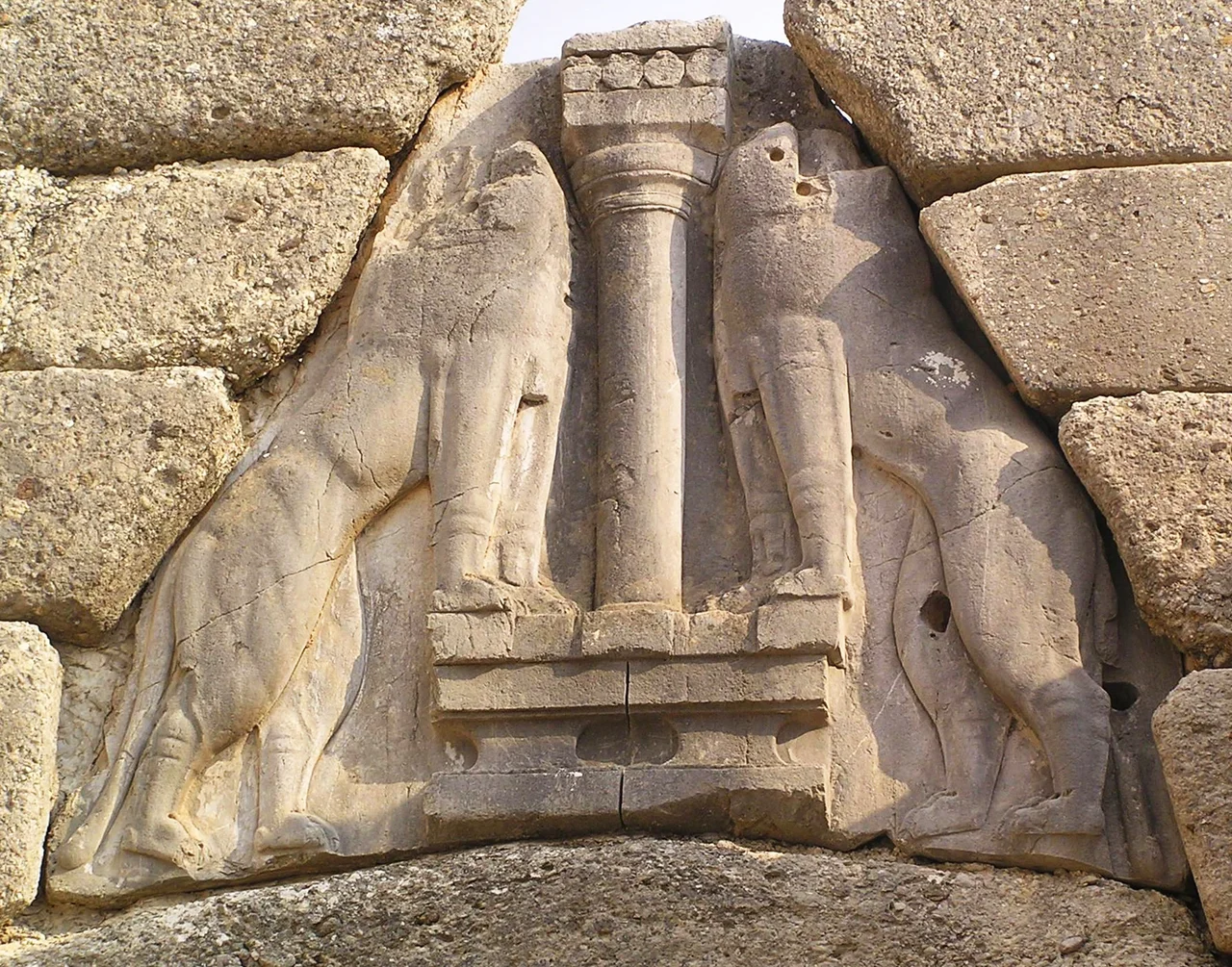

Lion Gate
The heads are gone. That is the first thing to understand about the Lion Gate at Mycenae — the two carved animals that have given the gate its name for centuries originally had separate stone heads, fashioned from a different material than their bodies and angled downward to stare at whoever was walking through. Those heads have not survived. What remains is the bodies: two large felines — almost certainly lionesses, scholars suggest, though the popular name has always said lions — rearing up on either side of a Minoan-type column set on an altar-like platform. The relief was carved in limestone around 1250 BC and set above the main entrance to the Bronze Age citadel of Mycenae. It is the oldest surviving monumental sculpture in Europe, and the largest surviving sculpture of the Bronze Age Aegean. It has been standing in roughly the same spot for more than three thousand years.
An Entrance Engineered to Intimidate
The Lion Gate was not simply a doorway — it was a carefully designed military and symbolic statement. Approaching it required walking up a ramp oriented on a northwest-southeast axis, the eastern side flanked by the steep smooth face of the earlier city wall. To the west, the builders erected a rectangular bastion, 14.80 meters long and 7.23 meters wide, constructed from enormous conglomerate blocks in a style later Greeks called 'Cyclopean' — too massive, they assumed, for ordinary humans to have built, and so attributed to the legendary race of giants. Between the bastion and the wall, the approach narrowed into a small open courtyard roughly 15 meters across. This was intentional. Any attacker who made it this far would be funneled into a confined space, unable to deploy numbers. The bastion on the right exposed their unshielded side — because soldiers in antiquity carried their shields on the left arm, their right flank was always the vulnerable one. The gate itself, standing at the end of this choke point, frames the relieving triangle above, and within that triangle, the sculpture.
What the Sculpture Means — and What It Might Have Been
The two figures in the relief rest their front feet on an altar-like base, between them a tapering column that some scholars identify as a Minoan type. The iconography was not invented here: a similar arrangement appears on 15th-century BC Minoan seals found on Crete, and on a large storage jar (pithos) from Knossos depicting a goddess flanked by two lionesses. The motif of two opposed animals separated by a vertical element — column, sacred tree, deity — recurs throughout Mycenaean art: two lambs facing a column, two sphinxes facing a tree. This context has led some researchers to propose that the Lion Gate figures might not be lions at all but composite creatures, perhaps sphinxes, in keeping with the broader Middle Eastern tradition of guardian beasts at gates. The debate remains open. What scholars agree on is that the composition carried meaning: a declaration of power over the threshold, a visual assertion that this citadel was protected by something more than walls.
Buried, Rediscovered, Excavated
By the time European travelers began visiting Mycenae in the early modern period, the gate was partly buried under soil and debris that had accumulated over centuries of abandonment. In 1840, the Greek Archaeological Society undertook the initial clearing of the site. In 1876, Heinrich Schliemann arrived with a copy of Pausanias — the 2nd-century CE geographer who had described the Lion Gate in his account of travels through Greece — and used it to locate the ruins. Schliemann excavated the area south of the gate, discovering the Shaft Graves whose golden contents stunned the world and launched modern Mycenaean archaeology. The gate itself required no dramatic rediscovery: it had always been partially visible. It simply needed to be understood. The Royal Institute of British Architects later incorporated a modified representation of the Lion Gate relief into its emblem — an acknowledgment that the engineering and artistry of the gate belong to the foundational tradition of European design.
Three Thousand Years of Weather
The gate stands today much as Schliemann found it, though the clearing work of the 19th and 20th centuries has opened the approach and the surrounding citadel to full view. The conglomerate blocks of the bastion remain in place, their surface weathered but intact. The triangular relieving space above the lintel — the structural device that prevented the immense weight of the wall from crushing the stone below — still frames the carved relief. Walking through the Lion Gate now means passing under the same threshold that Mycenaean rulers, soldiers, traders, and households crossed for two or three centuries of the Bronze Age, before the civilization that built it collapsed around 1200 BC. The reasons for that collapse remain debated. The gate outlasted whoever commissioned it by three thousand years.
From the Air
The Lion Gate is located at 37.7308°N, 22.7564°E, at the northwest entrance to the Bronze Age citadel of Mycenae in the Argolid, northeastern Peloponnese, Greece. Mycenae sits on a ridge between two smaller mountains, approximately 10 km inland from the Gulf of Argos. At 2,500–4,000 feet, the ruined citadel is identifiable as a compact, elevated rocky platform with visible ancient walls on a narrow spur between hills. The nearest major airport is Athens International (LGAV), approximately 130 km to the northeast. In clear weather, the Argive plain is visible to the south and southwest, with the Gulf of Argos beyond. Best approached from the direction of Corinth along the northeast Peloponnese corridor.
Nearby Stories
- Villa of Herodes Atticus 3 km away
- Sicyon 3.5 km away
- Battle of Megalopolis 4.5 km away
- Hermione: The City at the Edge of the World 7.5 km away
- Agia Lavra 7.7 km away
- Megara 13 km away
- Agistri 13 km away
- Teuthis 15 km away