
Livadeia
You did not consult Trophonios the way you consulted Delphi. At Delphi, a priestess spoke while you listened. At Lebadeia — the ancient name for Livadeia — the seeker descended alone into a dark chasm in the hillside, prepared by days of ritual fasting and sacrifice, and experienced whatever the god chose to show in the underground dark. Those who emerged were reportedly so shaken they could not smile for days afterward. Plutarch himself consulted the oracle; Croesus sent an embassy; Mardonius, the Persian general, asked it what to do before the Battle of Plataea. Long after every other oracle in Boeotia had fallen silent, the cave at Lebadeia still received visitors.
A Town Beneath a Cliff
Livadeia sits at the foot of an abrupt northerly spur of Mount Helicon, where the mountain drops suddenly onto the plain. The Herkyna river emerges from the hillside here — Pausanias described shallow grottos with niches and marble remnants at its springs, which he identified as the site of the oracle. Strabo placed the ancient town between Helicon and Chaeronea, and he was right: the settlement occupies the transitional zone where mountain and plain meet, the Herkyna providing fresh water and the limestone walls of the gorge providing both natural defense and dramatic theater. The modern town of Livadeia, capital of the Boeotia regional unit, lies 90 km northwest of Athens, still clustered at the gorge's mouth where it has been since antiquity.
The Oracle That Outlasted All the Others
Trophonios was a hero — a figure somewhere between mortal and divine in Greek religious understanding — whose underground sanctuary made Lebadeia famous. The ritual was demanding. Candidates spent days in preparatory rites, bathing in the Herkyna, eating specially prescribed foods, making sacrifices. Then, at night, they were lowered into a narrow underground passage. What they experienced below — visions, voices, terrors — they reported to the priests afterward, who recorded the oracular content. Pausanias, who underwent the descent himself in the second century AD, left the most detailed ancient account. The oracle was still functioning then, when, as he noted, all the other Boeotian oracles had ceased. The persistence of the cult at Lebadeia speaks to its reputation: people kept coming because the experience was real, whatever that meant to them.
A Castle Above the Gorge
Lebadeia occupied a different position in ancient politics than it did in ancient religion. During the war between Rome and Perseus of Macedon in 171 BC, the city sided with Rome — unlike its neighbors Thebes, Haliartus, and Coroneia, which supported the Macedonian king. That loyalty did not save it from later violence: Lysander sacked it, and Archelaus, the general of Mithridates VI of Pontus, plundered it again. After centuries of Byzantine decline, Livadeia revived under Frankish rule and then, in the fourteenth century, came under the control of the Catalan Company — a mercenary force that had carved out territory across Greece. Their castle still stands on the hill above the Herkyna gorge. One of only four Catalan castles in Greece, it is accessible on foot from the town below.
Temples Never Finished, Relics Returned
Pausanias recorded a dense religious landscape at ancient Lebadeia. The grove of Trophonios contained the hero's own temple, with a statue by Praxiteles resembling Asclepius; a temple of Demeter; a statue of Zeus Hyetius in the open air; a temple of Apollo; shrines to Cronus, Zeus, and Hera higher on the mountain; and the sanctuary of Persephone. On the hill of Profitis Ilias to the west, the enormous Temple of Zeus Basileus was begun — possibly in the third century BC — but never completed. Its unfinished columns still command a dramatic view. The cathedral church of St. George in modern Livadeia houses a remarkable relic: a head of St. George, taken to Venice in the fifteenth century and returned to the city in 1999 as a gesture of interfaith cooperation.
Water Mills and Living Memory
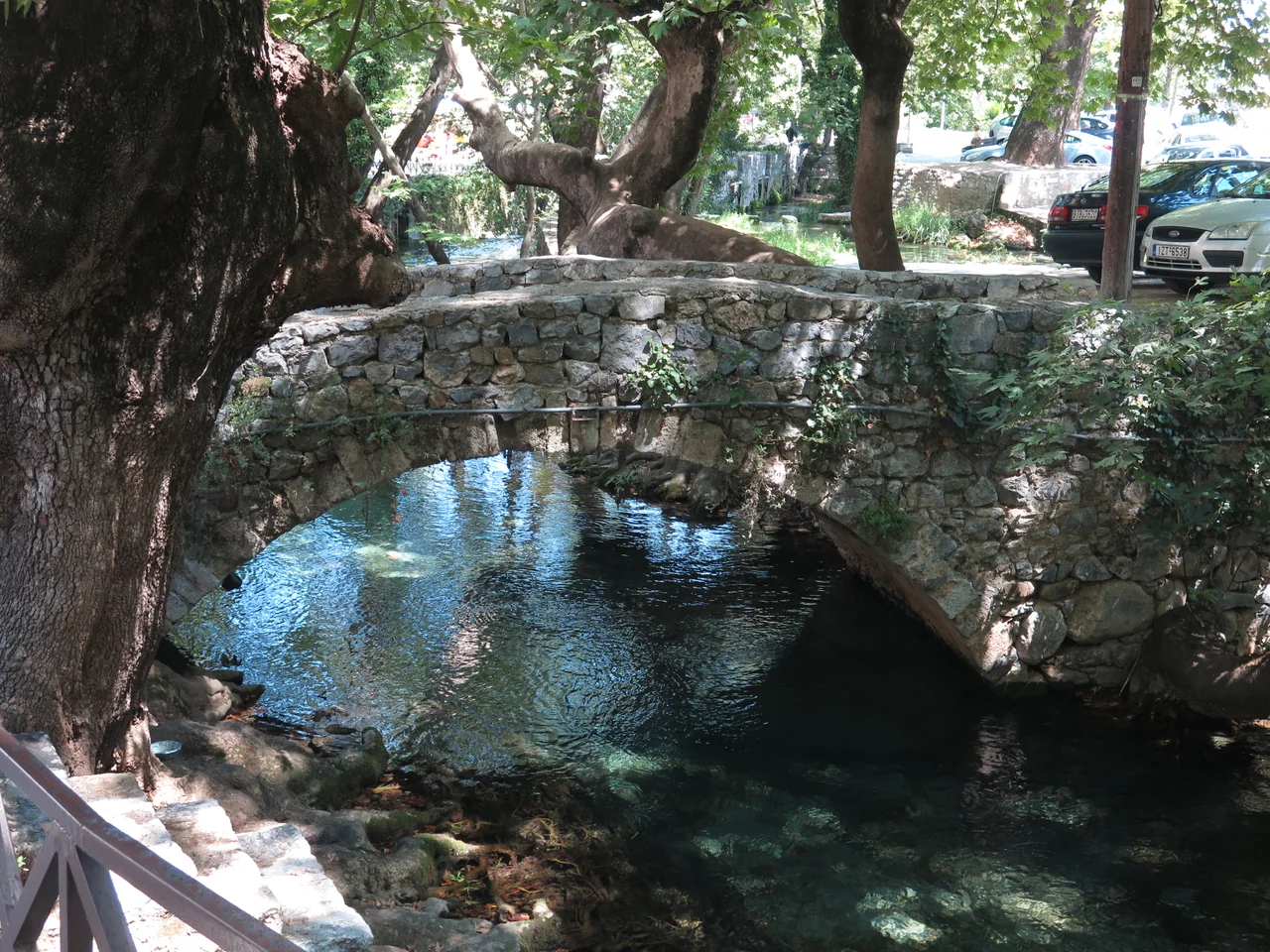
In medieval times the Herkyna ran through the gorge beneath a succession of water mills. One mill survives and is preserved near the old stone bridge. The gorge itself — narrow, dramatic, the walls of the Catalan castle visible above — is the kind of place that holds its history in its proportions. Strabo noted the town's importance; Pausanias called it the most flourishing city in Boeotia during his visit. The Ottoman period began in 1458 and brought administrative and economic privileges that kept the city active through centuries of foreign rule. Liberation came in the 1820s, in the Greek War of Independence. Livadeia today — with its football club, its regional government offices, its gorge full of cafes — carries its ancient reputation more quietly than it once did. But at the springs of the Herkyna, the grottos are still there.
From the Air
Livadeia lies at approximately 38.44°N, 22.88°E, at the foot of Mount Helicon in central Boeotia, 90 km northwest of Athens. From the air, the town is visible as a compact urban area at the point where the Helicon massif descends to the plain, with the Herkyna river gorge cutting into the hillside directly behind the town center. The unfinished Temple of Zeus Basileus on the hill of Profitis Ilias may be visible as ancient ruins to the west. Mount Helicon (1,749 m) rises prominently to the south. Recommended viewing altitude: 2,000–4,000 m for the full Boeotian plain context. The nearest major airport is Athens International Eleftherios Venizelos (LGAV), approximately 95 km to the southeast.
Nearby Stories
- Aulis (ancient Greece) 4.3 km away
- Pleistos 4.6 km away
- Doris (Greece) 5.9 km away
- Corinth Rail Disaster 6.9 km away
- Daphni Monastery 16 km away
- Loutraki 19 km away
- Saint George Monastery, Aidipsos 23 km away
- Skopelos 51 km away