
Daphni Monastery
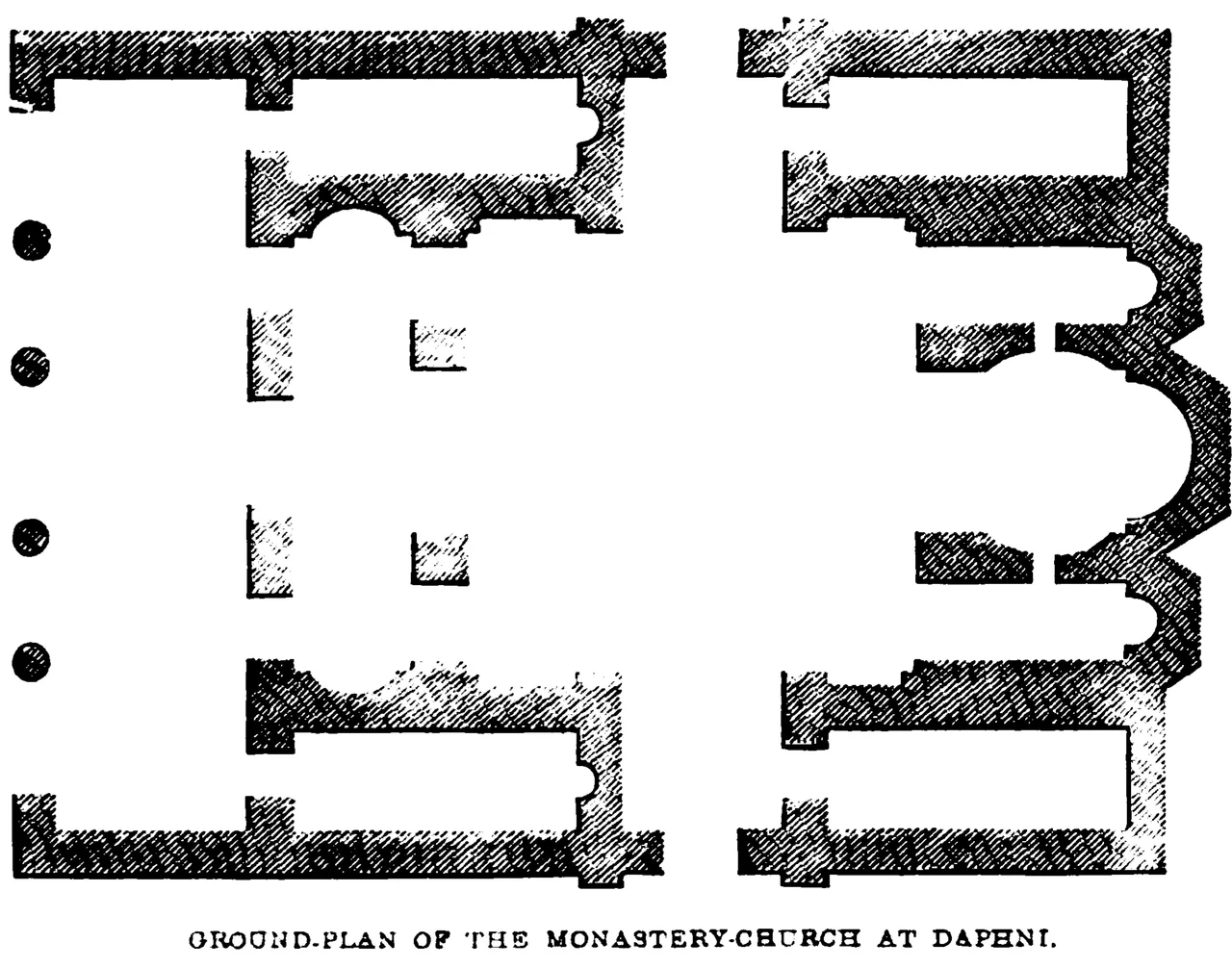
The road from Athens to Eleusis is the same road pilgrims walked for two thousand years to reach the Mysteries, and on a small rise eleven kilometers northwest of the modern city, in a grove of laurel trees the road's later travelers used as a landmark, eleventh-century Byzantine masons built a monastery on top of a destroyed pagan sanctuary. The Goths had ransacked the original Sanctuary of Apollo here in 395 AD. Three hundred years later, Christian builders raised a church over the ruins, incorporating the surviving walls into the new structure. They dedicated it to the laurel grove itself - daphneion in Greek, lauretum in Latin - and the name has stuck. Inside the dome of that monastery, the face that now stares down at visitors is one of the most studied images in all of Byzantine art.
Christ Pantocrator at the Crown of the Dome
Walk into the katholikon and your eyes go up. They have nowhere else to go. From the crown of the dome, head and shoulders only, Christ Pantocrator looks down. He wears a purple robe and a blue mantle. His face is stern, the gaze direct and not gentle. The eyebrows arch high, accentuating the long vertical line of the nose, which intersects the horizontal lines of the halo to suggest a cross at the center of the face. The image has been described by art historians as "one of the greatest creations in art," and what is remarkable is how little the modern face seems to have changed during restorations. Sixteen prophets stand at the base of the dome between the windows, robed in ancient garments and holding parchments inscribed with prophecies of Christ's coming. On the four pendentives that support the dome, four scenes from the life of Christ - among them the Crucifixion, with Mary and St. John arranged in a triangular composition that echoes the pediments of Greek temples.
Glass Made on Site
Byzantine mosaicists worked with tesserae - small cubes of colored stone, glass, or gilded glass set into wet plaster. The composition of the glass tells you where it came from. At Daphni, analysis indicates the glass was almost certainly made on site, which means craftsmen set up furnaces in the laurel grove and fused the cobalt blues, the malachite greens, and the gold-ground tesserae that catch lamplight and seem to dissolve the walls behind them. This was the system that emerged from the long iconoclastic crisis of the eighth and ninth centuries, formally ended by the Triumph of Orthodoxy in 843, after which the Church of Constantinople codified how images of saints, prophets, and Christ should be arranged in a church: holiest figures in the dome and apse, with scenes descending the walls in order of religious importance. Daphni was painted to that program with what specialists call rigid Constantinopolitan consistency. Some art historians believe Emperor Basil II - the Bulgar-slayer, who ruled from 976 to 1025 - sent workmen from the capital to do it.
Frankish Owners, Cistercian Monks
After the Fourth Crusade sacked Constantinople in 1204, the Duchy of Athens fell to French Crusader lords. The Daphni Monastery passed to Cistercian monks from Burgundy, who held it for more than two centuries and made it their own. They added a small cloister and a Gothic façade with twin pointed arches, an architectural language that sits oddly against the cloisonné brickwork of the Byzantine exterior. They buried their dead Frankish knights inside, and Daphni became a popular interment site for the Crusader nobility. In 1458, Sultan Mehmed II rode into Athens five years after taking Constantinople, the Duchy of Athens was abolished, and the Cistercians left. The mosaics survived all of this. They survived the Ottoman period as well, and a serious earthquake in 1999 that brought heavy restoration. They have outlasted Apollo, the Goths, the Byzantine emperors, the Crusader knights, and the sultans, which is what masterpieces of mosaic do when they are made well enough.
World Heritage in Three Sites
UNESCO inscribed Daphni in 1990 as part of a single grouped World Heritage site, listing it together with the monastery of Hosios Loukas near Delphi - the eleventh-century model that the Athens church on Filellinon Street was built to imitate - and Nea Moni on the island of Chios. The three monasteries are the surviving masterpieces of middle Byzantine architecture, and they share a vocabulary: the cross-in-square plan, the dome on an octagonal base, the gold-ground mosaic cycles, the geometric brick patterns on the exterior. Daphni is the closest to a major modern city and accordingly the most visited. The forest of laurel trees that gave the place its name is much reduced from what early travelers described, hemmed in now by the western suburbs of Athens, but the church still holds its high ground above Athinon Avenue, and the Pantocrator in the dome still meets the eyes of anyone who looks up.
From the Air
Coordinates: 38.0131 N, 23.6358 E. Suggested viewing altitude 1,500-2,500 ft AGL over the western suburbs of Athens. The monastery sits in the suburb of Chaidari, just south of Athinon Avenue (GR-8A) which runs from central Athens west toward Eleusis. Look for a small walled compound with a domed Byzantine church surrounded by cypress and laurel, on a low rise about 11 km northwest of the Acropolis. Nearest airports: Athens International Eleftherios Venizelos (LGAV) about 30 km east, Elefsina (LGEL) about 10 km west. The site is directly under the western approach to LGAV. Class C airspace requires ATC clearance below 3,500 ft.
Nearby Stories
- Great Sand Beach 5 km away
- Battle of Delium 7.7 km away
- Tower of Aliartos 9 km away
- HMHS Britannic 10 km away
- Saronic Gulf 15 km away
- Sousaki Volcano 17 km away
- Sanctuary of Apollo Maleatas 24 km away
- Skyros 66 km away