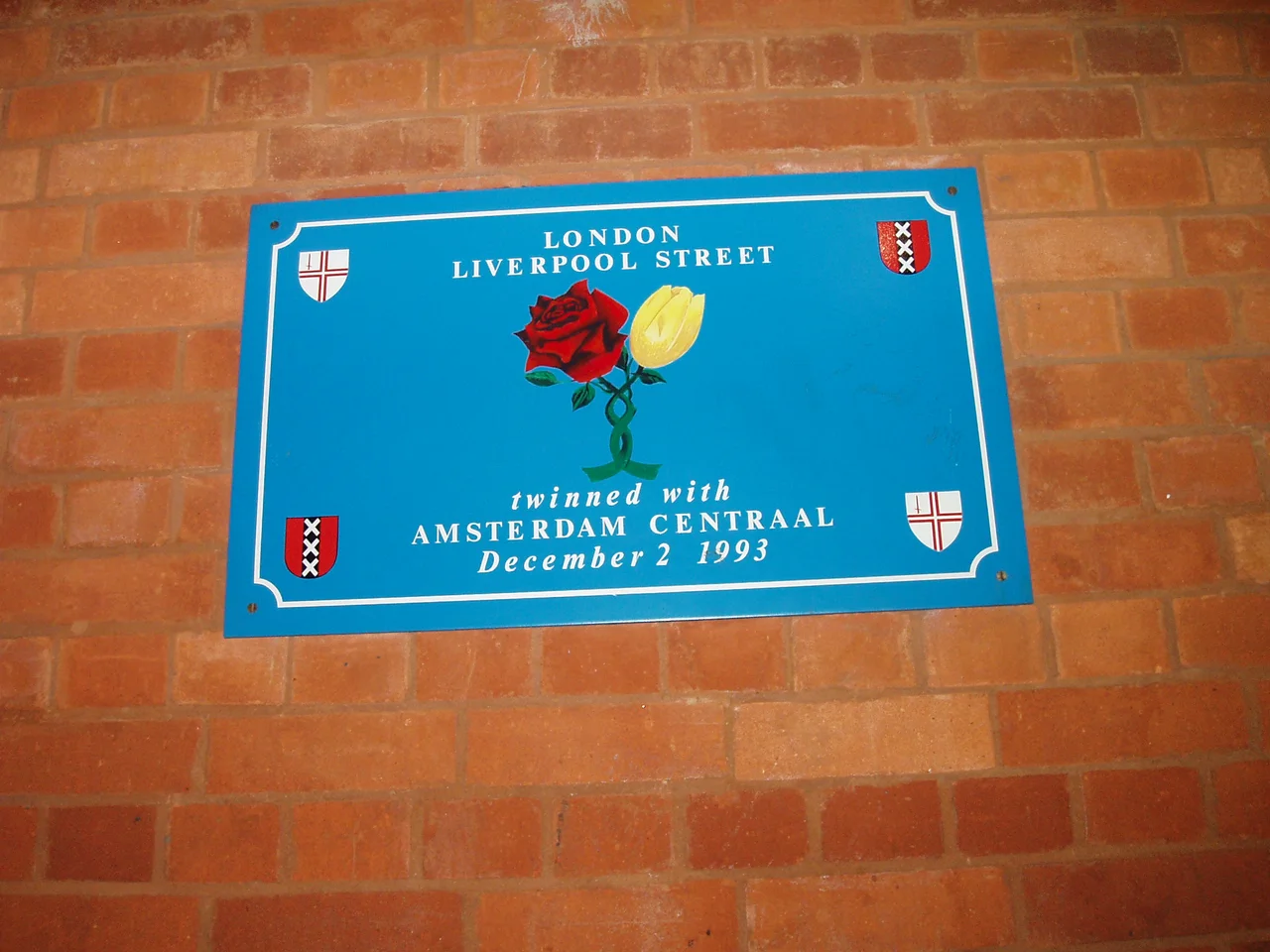

Liverpool Street station
On the platforms at Liverpool Street, a small bronze sculpture shows a girl with a battered suitcase. Her name is not given because the children who arrived here on the Kindertransport in 1938 and 1939 numbered in the thousands, each one a single child sent west by parents who, in most cases, would never see them again. Around 10,000 unaccompanied Jewish children passed through this station between December 1938 and the outbreak of war in September 1939, brought from Germany, Austria, and Czechoslovakia to escape the Nazi regime. Nicholas Winton, who organised much of the rescue from Prague, unveiled the original memorial here in 2003. The sculpture is small. The history it carries is not.
The White Elephant That Wasn't
When Liverpool Street opened on 1 November 1875, critics called it an expensive white elephant — over £2 million spent (a colossal sum) by the Great Eastern Railway to replace its inadequate Shoreditch terminus at Bishopsgate. The criticism lasted about a decade. By 1885 the station was working at capacity with around 600 trains per day. Parliament approved expansion in 1888; eight new platforms opened in 1895, giving Liverpool Street more platforms than any London terminus until Victoria expanded in 1908. By 1912, around 200,000 passengers were using the station daily on roughly a thousand separate trains. To rehouse families displaced by the works, the railway company was required to build replacement tenements for 600 people. Today the station handles around 98 million passenger entries and exits annually — the busiest railway station in the United Kingdom.
The First Air Raid
On 13 June 1917, twenty German Gotha G.IV bombers flew over London in daylight. It was Operation Türkenkreuz — the first biplane air raid on London, the deadliest single raid Britain suffered during the First World War. Seven tons of bombs fell across the capital; 162 people died and 432 were injured. Three bombs struck Liverpool Street; two exploded. One hit a train about to depart. Another hit carriages used by army doctors. Sixteen people at the station died, fifteen were injured. The Great Eastern Railway War Memorial, unveiled in the booking hall on 22 June 1922 by Sir Henry Wilson, names over 1,000 GER employees lost in the war. On his way home from the unveiling ceremony, Wilson was assassinated outside his London house by two members of the Irish Republican Army. He was commemorated by a second plaque, unveiled at Liverpool Street a month later. The Wilson and Fryatt memorials — the latter for Captain Charles Fryatt, executed by Germany in 1916 for ramming a U-boat with his GER steamer — sit alongside the main memorial today.
The Jazz Service
By 1920, Liverpool Street was at capacity and the company couldn't afford to electrify. So engineers tried something else: automatic signalling, redesigned track layouts, locomotives serviced right at the platforms to cut turnaround times. The scheme cost £80,000, compared to an estimated £3 million for full electrification, and it increased peak-hour capacity by 50 percent. Officially the Intensive Service, it became universally known as the Jazz Service for the brightly painted carriage classes (yellow first class, blue third class) and the syncopated regularity of the trains — every ten minutes to Chingford and Enfield. It ran from 1920 until the 1926 General Strike. For six years, the busiest commuter station in the world ran on rhythm rather than electricity.
Bombs Across the Decades
The station bore witness to terror across three eras. During the Blitz of 1940 and 1941, both German bombs and the underground tube platforms made for one of the East End's principal shelters; on 7 September 1940, during heavy raids, local people either forced entry or were quietly waved through by staff, in defiance of regulations. On 24 April 1993, the Provisional IRA detonated a one-ton truck bomb on Bishopsgate just outside the station, killing one journalist and injuring 44; Liverpool Street suffered around £250,000 of damage, mostly to its glass roof, but reopened two days later. On 7 July 2005 — the day after London learned it had won the 2012 Olympics — Islamist suicide bomber Shehzad Tanweer detonated explosives on a Circle line train just after it left Liverpool Street, killing seven passengers. Three other bombs went off elsewhere on the network and on a bus that morning; 52 people died across the four attacks. The station re-opened. Commuters came back the next day. They always do.
The Bedlam Burial Ground
In 2013, Crossrail diggers excavating for the new Elizabeth line tunnels broke through into something nobody had been quite expecting. A few feet below the surface lay a two-acre burial ground from the 17th century — the New Churchyard, known historically as the Bedlam burial ground after the nearby Bethlem Royal Hospital. Plague victims, prisoners from Bridewell, the unclaimed dead of Tudor and Stuart London. Among the bones, archaeologists found a small gold coin from the 1500s, pierced as if to be worn as a sequin or pendant. Full excavation began in 2015; some 3,000 interments were eventually recovered. When the Elizabeth line opened here on 24 May 2022, commuters travelled through tunnels that had passed straight through a mass grave nobody had remembered was there. London builds on London. Sometimes it builds on more London than anyone realised.
From the Air
Liverpool Street station sits at 51.5186°N, 0.0813°W in the City of London, just inside the eastern edge of the historic Square Mile. From the air, look for the dense cluster of glass towers around Bishopsgate (the Heron Tower, 22 Bishopsgate, the Cheesegrater) — the station sits in their shadow. The arched 1875 train shed roof and the long, low platforms are visible from low altitude. Nearest airport: London City (EGLC), about 5 miles east. Heathrow (EGLL), Stansted (EGSS), Gatwick (EGKK), and Luton (EGGW) all feed into central London. Best viewed in clear conditions from approaches into London City.
Nearby Stories
- Stevenage 5.7 km away
- Malling Abbey 5.7 km away
- 1952 Farnborough Airshow Crash 7.7 km away
- Ingatestone Hall 8.2 km away
- Hellfire Caves 9.1 km away
- The Carrington Event: The Solar Storm That Could Happen Again 9.8 km away
- Bletchley Park 16 km away
- Castle Hedingham 23 km away