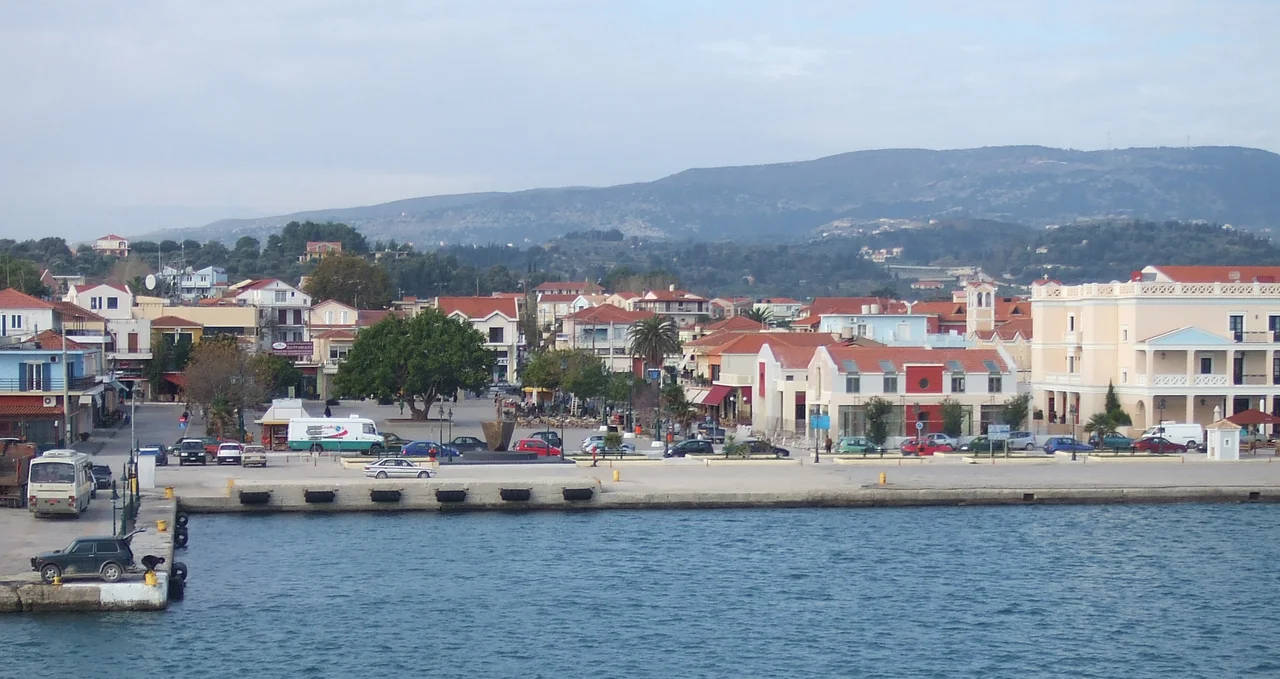

Lixouri
Lixouri is the kind of place that defines itself partly in opposition to somewhere else. Separated from Argostoli — the island's capital — by just four kilometres of bay, it is nevertheless 30 kilometres away by road, which means the ferry runs every hour in season and Lixouri maintains a cheerful, insolent independence. Residents of Argostoli are known to advise tourists to skip Lixouri entirely. Lixouri, for its part, has a poet, a philosopher's library, a department of ethnomusicology, red-sand beaches unlike anything on the rest of the island, and a history stretching back to one of ancient Cephalonia's four original city-states. There is quite a lot to see.
Ancient Pale and a New Name
Lixouri occupies the main town site of the Paliki peninsula — a broad thumb of land jutting westward into the Ionian Sea. The ancient city that preceded it was called Pale, one of the four poleis of Cephalonia's classical-era tetrapolis, alongside Cranii, Same, and Pronnoi. Pale minted its own coins. Two hundred of its hoplites fought at Plataea in 479 BC. The old city was abandoned entirely by the 16th century, though its ruins remain visible north of the modern town. The new settlement took a different name: according to local tradition, Lixouri is named after Paleas or Pileas, one of the four sons of the mythical king Kefalos — the same hero who gave the island its name. The first surviving document to contain the name 'Lixouri' was sent in 1534 by local authorities to the Senate of Venice, a bureaucratic record that anchors the modern name firmly in the Venetian period.
A Satirist's Hometown
Andreas Laskaratos was born in Lixouri in 1811, and the town made him sharp. A poet and satirist in the tradition of Greek vernacular literature, Laskaratos wrote acidly about the social hypocrisies of island life — a body of work that got him excommunicated by the local bishop, an honour he wore with evident satisfaction. The Iakovateios building in the town centre — one of the few structures that survived the 1953 earthquake intact — houses a public library and museum named partly in his memory. In 1720, another Lixouri resident, Petros Katsaitis, wrote a play called Iphigenia; Spyros Evangelatos's 1995 edition retitled it Iphigenia in Lixouri, placing the classical tragedy in the most local possible frame. The composer Antiochos Evangelatos was born here in 1903; the archaeologist Spyridon Marinatos, who excavated Akrotiri on Santorini, was born here in 1901. For a second city on a Greek island, Lixouri punches well above its weight in cultural production.
Earthquakes and Endurance
Lixouri has been struck repeatedly. The earthquake of 23 January 1867 destroyed many houses. The earthquake of August 1953 destroyed far more — a series of four quakes, the worst measuring 6.8, that erased nearly everything standing on the island. The 1st Primary School of Lixouri is among the very few buildings that survived from before 1953, still standing as both school and monument. The Iakovateios library and museum also came through. Everything else was rebuilt from rubble. The Kay Cicellis book Death of a Town, published in 1954, begins in Lixouri and describes the earthquake's immediate aftermath — one of the most direct literary accounts of what the 1953 disaster meant for the people who lived through it. In the early 1950s, the Royal Family of Greece sent their children for summer holidays to Lixouri. After the earthquake, summer visitors came slowly back; by the 1990s, the town was drawing tourists again, and larger hotels appeared south of the town near the peninsula's celebrated beaches.
Red Sand and the Paliki Coast
The Paliki peninsula's beaches are the reason most visitors make the ferry crossing. Xi Beach is the most famous: red-orange sand, distinctive and unusual, set against clear water. Petani and Fteri offer similar dramatic scenery further north on the peninsula's western coast — high cliffs, pebbles, deep blue sea. The reddish clay that colours the sand comes from the local geology, giving these beaches a Mediterranean palette unlike the white pebbles common elsewhere on Cephalonia. The ferry from Argostoli runs every hour or half-hour in peak season and takes vehicles under 5 tons; in summer, a service to Patras and Killini on the mainland connects Lixouri directly to the Greek ferry network. The Ionian University maintains a campus here with a department of ethnomusicology — a fitting presence in a town with Lixouri's musical and literary history.
The Town Across the Water
The rivalry between Lixouri and Argostoli runs deep enough to be amusing and shallow enough to be friendly. Historically, Lixouri was the island's cultural centre — home to a Catholic bishopric, known for its beaches, its learned families, its literary production. Argostoli became the administrative and commercial hub. The two towns look at each other across four kilometres of bay, linked hourly by ferry and separated by thirty kilometres of road. Carnival season turns the rivalry theatrical; sporting contests give it a competitive edge. A Lixouri team plays football under the name Panlixouriakos FC; a water polo club called Poseidonas Lixouriou competes in regional leagues. In 2011, government reorganization stripped Lixouri of its status as a separate municipality — it had held that status for 500 years. The town absorbed the change, as it has absorbed earthquakes and occupations, and remained itself: lively, particular, slightly proud of being overlooked.
From the Air
Lixouri lies at 38.20°N, 20.43°E on the western shore of the Paliki peninsula, directly across the Bay of Argostoli from the island capital. From the air, the Paliki peninsula reads as a broad western appendage of Cephalonia, nearly separated from the main island by the long bay. The town is visible as the largest settlement on the peninsula. Kefalonia International Airport (LGKF) is approximately 20 km to the southeast, on the eastern coast of the island. At 3,000–6,000 feet on a clear day, the red-sand beaches of Xi and Petani are visible along the peninsula's western coast, contrasting noticeably with the paler shores elsewhere. The ferry route between Lixouri and Argostoli traces a direct line across the calm inner bay.
Nearby Stories
- Glarentza 5 km away
- The Septinsular Republic 5.8 km away
- Battle of the Echinades (322 BC) 8.1 km away
- Hellenic Trench 19 km away
- Ionian Islands 22 km away
- Stratos 27 km away
- Achilleion (Corfu) 119 km away
- Corfu 153 km away